

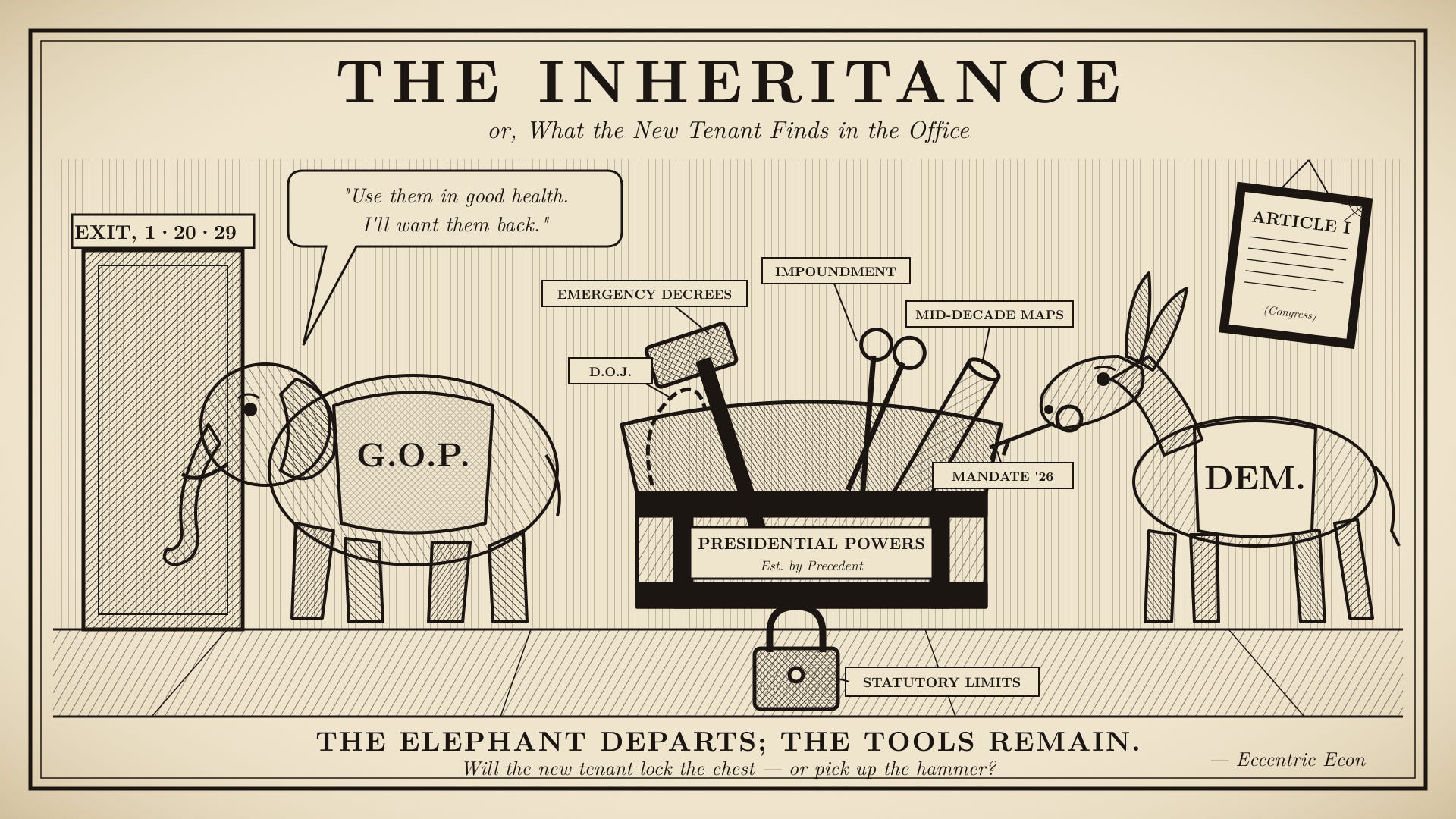
The distinction I pointed out in the headline is worth making while the celebrations are still underway. Democrats have won control of both chambers of Congress, overcoming a Senate map that carried them through states their party had little reason, until recently, to consider promising territory. North Carolina, South Carolina, Ohio, Texas, Kansas, Iowa and Maine all supplied Republican-held Senate seats. The last time a minority party flipped both chambers on a single election night was 2006. This was a substantial rejection of the governing party, not an exercise in finding encouragement in a narrow loss.
Here in Atlanta, the change is rather less abstract. Keisha Lance Bottoms will be Georgia’s next governor. Democrats swept the statewide offices and won the state House for the first time in more than two decades, although Republicans retained the Senate. Whatever else one thinks of the result, a party that had become accustomed to governing this state has been reminded that the offices do not belong to it.
Good.
For a classical liberal, however, the interesting question begins where the victory speeches end. What, exactly, have the winners acquired? A mandate to restrain the exercise of arbitrary power? Or an opportunity to exercise it themselves, once the appropriate personnel changes can be arranged?
These are different projects. Unfortunately, they often sound alike when their proponents are out of office.
What voters rejected
There is a temptation to interpret an election as a public endorsement of whatever argument one had been making before it. Those concerned about authoritarianism see a defense of constitutional government. Those concerned about corruption see a demand for clean administration. Those concerned about grocery prices see a demand for cheaper groceries.
The evidence leaves room for more than one explanation. NPR described a campaign defined by frustration with the cost of living and perceived public corruption. NBC’s exit poll found that 43 percent of voters identified opposition to Trump as one reason for their vote, while in The AP Voter Poll about 7 in 10 voters said Congress was not doing enough to provide checks and balances on the president, including about 4 in 10 Republicans. Those are overlapping judgments, not interchangeable ones.
A voter can dislike executive overreach, dislike corruption and dislike the cost of dinner without arranging those concerns into a coherent theory of limited government. Nor is the voter obliged to do so. Politicians, rather than their customers, ought to bear the burden of knowing the constitutional limits of the product they are selling.
Still, the distinction matters. An administration punished for expensive living has not necessarily persuaded the electorate that its methods of governing were unacceptable. Under more favorable economic conditions, some of those methods might have attracted less opposition.
That does not diminish the result. It limits what can reasonably be inferred from it.
The election demonstrated that voters could impose a substantial political cost on the governing party. It did not establish that the powers accumulated by the presidency will now be surrendered, that Congress will recover its institutional independence, or that the next president will be less interested in governing around the legislature.
Those outcomes require decisions. An election merely changes who gets to make some of them.
The attraction of a useful precedent
Consider California’s Proposition 50.
The case for it was straightforward enough. Texas Republicans had undertaken a mid-decade congressional gerrymander intended to improve their party’s position in the House. California Democrats responded by asking voters to temporarily set aside the congressional maps drawn by their independent commission and approve a legislature-produced map designed to yield additional Democratic seats. Voters agreed.
The sequence matters. Texas went first. California’s response went before the voters. One need not pretend the two processes were identical to recognize the difficulty facing Democrats who were being asked to preserve a restraint their opponents had declined to observe.
“Unilateral disarmament” is a persuasive objection because unilateral restraint can impose real costs. There is nothing especially liberal about insisting that one party accept permanent electoral disadvantage while the other manipulates the rules.
But there is also a difference between explaining a decision and establishing a principle worth keeping.
The immediate benefit of California’s response was an attempt to offset Republican gains. The institutional cost was to demonstrate that an independent redistricting arrangement could be suspended when the partisan stakes became sufficiently high. Supporters regarded that exception as necessary. The next group seeking an exception will presumably regard its circumstances as necessary, too.
This is how an emergency becomes a precedent. The original justification may be entirely sincere. Once the procedure has been established, however, sincerity is no longer required.
A defensible response to an opponent’s escalation therefore needs some account of how the escalation ends. If retaliatory gerrymandering creates leverage for a common prohibition, there is at least a path back toward a general rule. If the object is simply to ensure that both parties possess equally effective machinery for choosing their voters, the machinery has won.
Democrats who now control additional state governments should be able to explain which outcome they intend to pursue.
Antitrust is not a political loyalty test
A more troubling example concerns the proposed use of regulatory power against companies associated with Trump.
In March, Fox News reported Senator Ruben Gallego telling Semafor: “Once we take power, whoever the president is, we’re going to break up your companies.” Senator Chris Murphy supplied a related promise concerning Paramount: “when Democrats win back power we are going to break up these anti-democratic information conglomerates.”
There may be perfectly legitimate grounds for scrutinizing particular mergers. An approval procured through corruption does not become sacrosanct because reversing it would embarrass a politically connected chief executive. Market concentration, unlawful conduct and improper dealings with regulators are appropriate subjects for investigation.
But these are claims that must be established, not adjectives that can be supplied by the politician announcing the punishment.
A company does not acquire immunity from antitrust law by supporting the president. Neither should it become more vulnerable to antitrust enforcement because a senator dislikes its political associations or its news coverage.
The distinction is not difficult. It is merely inconvenient.
The same Fox report placed these Democratic threats alongside a post by FCC Chairman Brendan Carr suggesting the administration would more closely review license renewals for broadcasters perpetuating “fake news.” That context makes Democratic anger understandable. It also makes the need for a consistent rule rather obvious.
If regulatory discretion is dangerous when used to discipline hostile media, changing the identity of the hostile media does not make it safe.
Indeed, a system in which companies anticipate punishment from whichever party they failed to accommodate is likely to produce more political accommodation. Executives will devote greater attention to cultivating protection, arranging access and avoiding offense. The threat intended to punish corporate submission to political power can strengthen the incentives that produced the submission.
This should be familiar territory to anyone who studies incentives. The anticipated cost of political independence rises; the supply of political independence falls.
Investigate, and let the public see why
None of this is an argument for allowing misconduct to disappear beneath a bipartisan agreement to move on.
Impunity establishes precedents, too.
An official who learns that abusing public power carries no meaningful cost has received useful information. So has the official watching from the next administration.
Congressional oversight is therefore not some regrettable lapse into partisanship. It is part of the work Congress is supposed to perform. That is worth saying plainly now that the administration and its Justice Department are threatening to prosecute the lawmakers who investigate it criminally. The newly elected majorities should investigate credible allegations of corruption, conflicts of interest, unlawful spending and the use of government authority for private benefit.
Reuters reported before the election that House Democrats were preparing inquiries into Department of Homeland Security contracts, financing for Trump’s White House ballroom, corporate donors and alleged pay-to-play arrangements. Its report also made an important qualification: several companies had surfaced in planning discussions, but Reuters could not determine whether they faced accusations of wrongdoing. That distinction should survive the transition from campaign planning to committee hearing.
Being connected to a politician is not proof of corruption. Receiving a government contract is not proof of corruption. Neither fact is a reason to prohibit inquiry when there is evidence of improper conduct.
The task is to establish what happened.
That requires procedures which impose some discipline on the investigators. Committees should identify the conduct under examination and its connection to a legitimate legislative purpose. They should publish supporting evidence where lawful, permit meaningful minority-party participation, give witnesses a fair opportunity to answer allegations, and distinguish findings from suspicions.
Not every interview can occur before television cameras. Privacy, classified material and the integrity of an inquiry can justify closed proceedings. But secrecy should have a stated reason and a limited scope. Selectively leaking accusations while withholding the material needed to evaluate them is not transparency.
Public process matters because the investigators are exercising power as well. A hearing ought to expose a weak accusation, not merely amplify it. Findings should explain contrary evidence rather than conceal it. An investigation that fails to substantiate its original suspicion has still produced a useful result, provided the committee is willing to acknowledge it.
A serviceable test is to ask whether Democrats would accept the same procedures directed at their own officials in 2029. Not whether they would enjoy the experience. Nobody enjoys being subpoenaed. Whether they would recognize the process as legitimate.
If the answer depends entirely on who is holding the gavel, the proposed safeguard is a party preference.
The view from Georgia
The state results deserve attention beyond their usefulness as evidence of a national wave.
The Associated Press described the election as the largest single-election change in partisan power in state governments since 2010, citing the National Conference of State Legislatures. Democrats won governorships in Georgia, Iowa, Nevada, Ohio and Texas, while legislative gains created or restored unified Democratic control in several states.
These governments will make consequential decisions long before the next presidential inauguration. The new majorities will face demands to revise election laws, revisit congressional maps and use their newly acquired authority to protect their party’s position.
Here in Georgia, the limits of the Democratic victory should be kept clear. Bottoms will enter office with a Democratic House and a Republican Senate, not a Democratic trifecta. Divided government remains a fact, and persuasion will still be part of governing.
There was also a useful statement from the man preparing to leave the governor’s office.
The day after the election, Brian Kemp declined to call a special session either to redraw congressional districts or to limit Bottoms’ powers. “The voters of our state have spoken,” he said in a statement to The Atlanta Journal-Constitution. “As long as I’m governor, we will always respect the results of secure, accessible, and fair elections, and also abide by the laws and constitution of our state.”
Kemp said that. Not Bottoms, not a newly elected secretary of state, and not an incoming Democratic attorney general. The attribution matters because accepting a loss is an obligation of the losing party.
It is a good statement, and one worth preserving for later use.
It is also not the first time Kemp has made that choice. In 2020, under far heavier pressure from his own party, he refused to call a special session to help Trump overturn his narrow defeat in Georgia. The same man, facing the same temptation, declined it twice. That is about as close to a demonstrated principle as American politics currently offers.
The record should be kept accurately, however. Kemp had already called a special session earlier this year, partly to redraw Georgia’s maps for 2028 after the Supreme Court narrowed the Voting Rights Act in April. Declining to redraw the maps again after losing is not the same as declining to redraw them at all. Mid-decade mapmaking is neither a Democratic invention nor a Texas peculiarity. It is a bipartisan habit, and habits, once established, are path-dependent.
The incoming officials should adopt it as their own standard. So should the legislators who will eventually confront an election that does not go their way. Respect for an election cannot mean respect for the ones that produce agreeable winners.
From Atlanta, I welcome the demonstration that Georgia’s governing arrangements can change. But there is no reason to believe that a Democratic attorney general’s office is incapable of political abuse, or that a Democratic governor will find discretionary authority less attractive than a Republican governor did.
The officials have changed. The incentives require separate attention.
That is particularly important in states where one party now controls both legislative chambers and the governor’s office. Those governments will have fewer partisan obstacles to their ambitions. Whether that produces better government depends in part on whether they can distinguish the removal of an obstruction from the removal of a safeguard.
The presidency outlasts the president
Economists use the term path dependence to describe situations in which earlier choices shape the options and incentives available later. The point is not merely that history matters. It is that a decision can alter the institutional environment in ways that make reversal increasingly difficult.
Executive power presents an obvious example.
A president discovers a broad reading of an emergency statute. Administrative procedures develop around it. Officials learn to use it. Legislators discover that tolerating it is easier than negotiating a law. Supporters come to regard it as indispensable to achieving the president’s objectives.
The next president inherits the authority, the staff capable of exercising it and the expectation that an energetic executive will get things done.
Abandoning the power then has an immediate cost. Keeping it has a more diffuse constitutional cost, much of which will be borne by people who oppose the next occupant of the office.
One need not assume unusual wickedness to predict which choice will prove attractive.
This is why “our president will use it responsibly” is such an inadequate answer. Even if true, it answers a temporary personnel question while leaving the institutional problem intact.
A presidency safe only in the hands of one’s preferred candidate is not a safe presidency.
I made a version of this argument last week about Richard Posner: a system that learns only when a Posner is in the room is not a learning system. A presidency that behaves only when the right person occupies it is not a constrained presidency. It is a lucky one.
The relevant question for Democrats is therefore not whether they can prevent Trump from using every available power during his final two years. It is whether they will support restrictions that would bind a Democratic president beginning in 2029.
A restriction which expires at the next inauguration is a campaign tactic. A restriction which survives your own victory is evidence of a principle.
What to give back
The immediate political difficulty should not be understated. Democrats will control Congress, not the White House. Trump retains the veto, and NPR reports that he has already advertised his willingness to use it. Not everything Congress passes will become law.
That does not prevent Democrats from specifying which powers they believe the presidency should not possess.
Emergency authorities should require timely, affirmative congressional renewal, rather than depend on Congress assembling the votes to overcome presidential resistance. Limits on withholding appropriated funds should be made enforceable, with prompt reporting and a workable means of obtaining judicial review. Protections for career public servants should distinguish legitimate management and discipline from the substitution of personal loyalty for lawful administration.
The Justice Department presents constitutional complications that cannot be wished away by declaring it independent. But Congress can pursue clearer disclosure requirements for politically sensitive contacts, stronger protection for inspectors general and whistleblowers, and reporting obligations designed to expose interference with particular cases. The object should be to make improper direction harder to conceal, not to promise that a statute can eliminate politics from the executive branch.
On redistricting, Democrats should offer a national rule they are willing to apply to their own maps. Any negotiated retreat from partisan mapmaking must include actual Democratic concessions. Otherwise, the supposed principle amounts to a request that Republicans relinquish an advantage while Democrats preserve theirs.
And the investigations should proceed under rules worth retaining when Republicans recover the subpoena power. They eventually will.
None of this requires Democrats to become passive. Rejecting an unfit nominee is not authoritarianism. Investigating a corrupt contract is not authoritarianism. Defeating an administration’s legislation is not authoritarianism. Constitutional opposition is supposed to obstruct some exercises of power.
The question is whether the obstruction restores a limit or merely reserves the disputed power for later use.
The midterms have given Democrats an opportunity to make that distinction concrete. They can investigate abuses without establishing political affiliation as an offense. They can challenge executive overreach while committing to restrain their own future president. They can negotiate an end to manipulated maps rather than treat a successful retaliation as the final settlement.
Doing so will disappoint people who believe victory entitles them to the full use of whatever their opponents left behind. That disappointment is simply part of the work, and we are all better of when it is made and adhered to.
The powers accumulated under Trump will not disappear because voters punished his party. Someone will have to repeal them, narrow them, expose their misuse and refuse their convenience.
The election bought time for that work. It did not do the work itself. That is partially up to those whom the citizens elected, and largely up to us for the rest.