

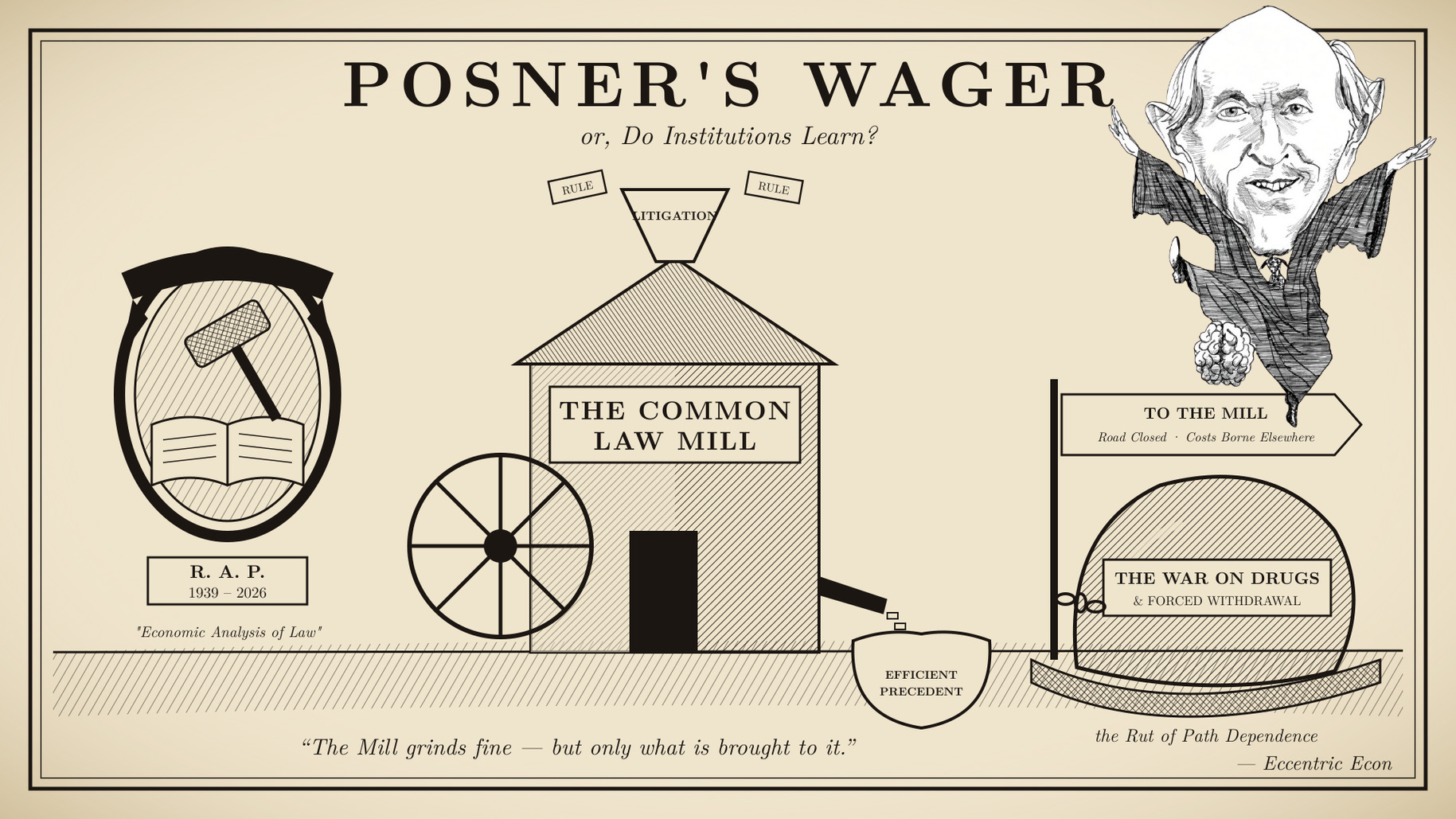
Richard Posner died on Tuesday, November 10, 2026, at the age of 87. It took me a couple of days to gather my thoughts, but it was important to say a few words about an intellectual titan whose work will be sorely missed. Over a career that defied normal measures of scholarly output, he authored more than 3,300 judicial opinions on the Seventh Circuit, published more than 50 books and hundreds of articles, and earned his place as the most-cited legal scholar of the twentieth century. Most obituaries this week rightly hail him as the intellectual architect who brought economics into the courtroom and made efficiency a central vocabulary of American law.
Yet for those of us who study how human societies organize themselves, his deeper legacy is institutional. Posner spent fifty years building the most influential economic account of legal institutions in modern history, even as he famously dismissed the New Institutional Economics, which claimed the very same territory. Reading Posner as an institutional economist helped teach me to look past formal legal rules and ask how incentives actually operate within public agencies, courts, and correctional systems. I wasn’t looking for Posner; a professor told me that if I wanted to be at the top of my game, he was required reading. That professor was right. He showed us how institutions work when price signals are absent. Where his optimism ran out—and where path dependence pushes back—is in his wager that legal institutions reliably learn from their mistakes.
Law as a Market for Efficient Rules
When Posner published the first edition of Economic Analysis of Law in 1973, his positive thesis startled the legal academy. He argued that the common law—the sprawling body of judge-made rules governing tort, contract, and property—tends over time to evolve toward economic efficiency. This was not merely a normative plea for judges to pull out calculators before ruling. It was an evolutionary theory of an institution.
What made the claim revolutionary was how it treated judicial reasoning. Posner viewed judges as unwitting optimizers. Even when jurists spoke in the traditional language of fairness, foreseeability, or proximate cause, Posner read their doctrines as implicit answers to incentive problems. Negligence standards, such as Learned Hand’s famous formula comparing the burden of precaution against the probability and gravity of loss, were reframed as mechanisms for minimizing the total social cost of accidents.
Still, an evolutionary claim requires an evolutionary mechanism. If judges were not consciously maximizing wealth, why would efficient rules survive while inefficient ones died out? A companion literature quickly emerged to supply the missing engine. In two landmark 1977 articles in the Journal of Legal Studies, Paul Rubin and George Priest argued that the selection pressure came not from judicial brilliance, but from litigation itself. Inefficient rules impose higher deadweight losses on the parties governed by them. Because the stakes of overturning a bad rule are systematically larger than the stakes of overturning a good one, inefficient doctrines are litigated more frequently. Even if judges decide cases randomly, the sheer attrition of repeated challenges pushes the surviving stock of precedent toward efficiency. In Posner’s hands, the courtroom looked remarkably like a decentralized market discovering prices without an auctioneer.
Regulation as Politics by Other Means
While Posner saw the common law as an engine of wealth maximization, he held no such romanticism about the administrative state. In his early essays on regulation, he stripped away the civics-textbook assumption that regulatory agencies exist to correct market failures on behalf of the public.
In “Taxation by Regulation” (1971), Posner showed that rate-regulated monopolies—in airlines, telecommunications, and railroads—functioned as a hidden fiscal system. Regulators routinely permitted firms to charge above-cost prices on lucrative routes or services so those excess profits could cross-subsidize unprofitable service to politically favored constituencies. Rather than passing a transparent tax-and-spend bill through Congress, legislatures delegated a covert taxing power to administrative boards.
Three years later, in “Theories of Economic Regulation” (1974), Posner weighed the traditional public-interest model against emerging capture theories, including George Stigler’s 1971 economic theory of regulation. Posner concluded that the economists’ interest-group framework—treating regulation as a product supplied to organized industries and coalitions that bid highest in political support—was far more promising than naive public-interest accounts. At the same time, he warned that the theory remained too crude and needed sharper analytical and empirical discipline before it could serve as a complete explanation.
Here we see Posner at his most institutionalist, building a direct bridge to public choice economics. By treating regulatory rules as endogenous outcomes of political exchange rather than exogenous commands from benevolent planners, he laid the groundwork for analyzing how bureaucratic rules entrench incumbents and obscure true social costs.
The Quarrel with the New Institutionalists
Given how deeply Posner analyzed courts, agencies, and legal rules, one might have expected him to make common cause with the New Institutional Economics (NIE) led by Ronald Coase, Oliver Williamson, and Douglass North. Instead, he picked a famous fight.
In a 1993 symposium in the Journal of Institutional and Theoretical Economics, Posner argued that the New Institutional Economics was largely old wine in new bottles—an anti-theoretical, overly descriptive offshoot that added little to standard price theory and his own law-and-economics framework. The provocation drew immediate, sharp replies from Coase and Williamson. Coase, in “Coase on Posner on Coase,” flatly rejected Posner’s account of his methodological views, writing that Posner’s commentary “mainly misses.” Williamson countered that Posner’s legal centralism—the assumption that courts are the primary enforcers of agreements—overlooked the private ordering, such as contracts, hierarchies, and credible commitments, that holds economic relationships together when friction is positive. Posner fired back in a brisk rejoinder, defending parsimony over taxonomy.
The clash was fundamentally about method. Coase and Williamson wanted case-rich empirical study of real institutions to see how transaction costs shape organizational form. Posner wanted crisp, generalizable theory derived from rational choice. Seventeen years later, in a 2010 essay in the Journal of Institutional Economics, Posner revisited the debate through the lens of organization economics—an offshoot closely related to the New Institutional Economics. While he remained skeptical of NIE as a standalone paradigm, he gave sustained, sympathetic attention to how organizational structure, information flows, and internal agency costs shape public and private institutions.
Who was right? In hindsight, both sides held half the puzzle. Posner was right that institutional economics without rigorous price theory risks degenerating into endless storytelling and classification. Yet Coase and Williamson saw what Posner missed: transaction costs are not mere friction around an otherwise frictionless market. They determine which actors can even reach the bargaining table—or the courthouse—in the first place.
Judges as Economic Actors
If Posner resisted the label of institutionalist, he nonetheless produced one of the sharpest institutional analyses of the judiciary ever written. In How Judges Think (2008), he turned the economic lens inward on his own profession.
Rather than treating judges as legal priests who mechanically deduce outcomes from constitutional text, Posner modeled them as ordinary workers operating inside a peculiar labor market. Federal judges enjoy life tenure and fixed salaries, which insulates them from direct financial bribes. Yet they still respond to non-monetary incentives: leisure, reputation among peers, intellectual satisfaction, reversal aversion, and the desire to leave a coherent legacy. Because legal texts frequently run out before hard cases do, judges inevitably exercise discretion.
This realism fueled his long-running debate with Antonin Scalia over originalism versus legal pragmatism. In Law, Pragmatism, and Democracy (2003) and on the bench, Posner argued that pretending to be bound by eighteenth-century semantic puzzles merely disguises policy choices behind historical cherry-picking. Better, he insisted, for judges to openly weigh the systemic consequences of their rulings.
Viewed through modern institutional economics, Posner was applying mechanism design to the bench. Institutional rules—tenure, appellate review, caseload pressures—channel judicial self-interest into predictable patterns of behavior. Incentives shape judicial rulings in much the same way administrative budgets and liability rules shape jail medical formularies. People inside institutions respond to the constraints placed immediately in front of them.
Where Path Dependence Pushes Back
This brings us to the central tension in Posner’s thought. His early evolutionary thesis predicted that legal institutions tend to converge on efficient rules. Modern institutional theory—specifically the literature on path dependence developed by scholars like Mark Roe and Oona Hathaway—explains why institutions frequently lock into bad ones.
In “Chaos and Evolution in Law and Economics” (1996) and “Path Dependence in the Law” (2001), Roe and Hathaway showed that legal systems are heavily conditioned by early historical accidents, sunk organizational investments, and network effects. Once a legal regime takes root, constituencies form around it, bureaucracies adapt to it, and the switching costs of reform climb.
Consider two stark examples from criminal justice. First is the War on Drugs™: a multi-decade enforcement regime that persisted long after its staggering fiscal costs, collateral damage to communities, and failure to curb substance use were thoroughly documented. Second is the punitive equilibrium surrounding medications for opioid use disorder (MOUD) inside American jails and prisons. Even when clinical evidence overwhelmingly demonstrates that continuing or initiating buprenorphine and methadone cuts post-release overdose deaths dramatically, correctional facilities have long defaulted to forced withdrawal. (I walk through how to break that equilibrium in Nobody Broke a Rule, and James Still Died.)
Both regimes represent stable institutional equilibria, yet both are deeply inefficient. Why did the Rubin-Priest litigation mechanism fail to weed them out? Because efficiency is the evolutionary endpoint only when feedback loops work. In commercial contract disputes, repeat players internalize the cost of bad rules and pay lawyers to challenge them. In criminal justice and correctional healthcare, the human and fiscal costs fall overwhelmingly on marginalized individuals who lack the resources to litigate repeatedly, while the downstream emergency-room and mortality costs are externalized onto other budgets entirely. When decision-makers do not bear the costs of failure, institutional evolution can select for the wrong rule and keep it alive for generations.
The Late Posner: A Mind Willing to Change
What separates Posner from lesser system-builders is that he refused to remain prisoner to his own early models. When empirical reality collided with his theoretical priors, he updated.
Following the 2008 financial crisis, Posner published A Failure of Capitalism (2009), a remarkably candid reckoning in which a founding figure of Chicago law and economics acknowledged that deregulated financial markets could generate catastrophic systemic risk without vigilant institutional guardrails. He was equally willing to revisit his own judicial record. Years after authoring the majority opinion upholding Indiana’s strict photo-identification law in Crawford v. Marion County Election Board, Posner publicly regretted the ruling, admitting that he had lacked adequate empirical information about the law’s real-world burdens on voters when he wrote it.
In the end, Posner’s greatest lesson for institutionalists may be the one he embodied rather than the one he theorized. He updated when the evidence turned against him, on financial markets and on voter ID. But a system that learns only when a Posner happens to be in the room isn’t a learning system. As I often observe, heroes don’t scale. If institutions are going to correct themselves, the feedback has to be built into the rules: costs that land on the people who make the decisions, harms that show up in the numbers they’re judged by, and defaults that make the evidence-backed choice the easy one. Posner showed us that individual minds can change. The institutionalist’s job is to design systems that don’t have to wait for them.
Great post! And a nice balance to today’s uncritical hagiographies.
Complex systems exhibit path dependence and attractor basins, and the law, society and economy is perhaps the most complex system in the universe.
Acknowledging this forces us to give up the notion that any set of rules and constraints will reliably produce a good outcome.
One must have rules, but one must acknowledge that the creation of an institution is simply the start of its eventual corruption. The dynamics of the system will always discover its holes, and the basin will be inhabited.
I appreciate that Posner cared enough to look deeply, and that he was wise enough to understand that what he believed once did not hold.