

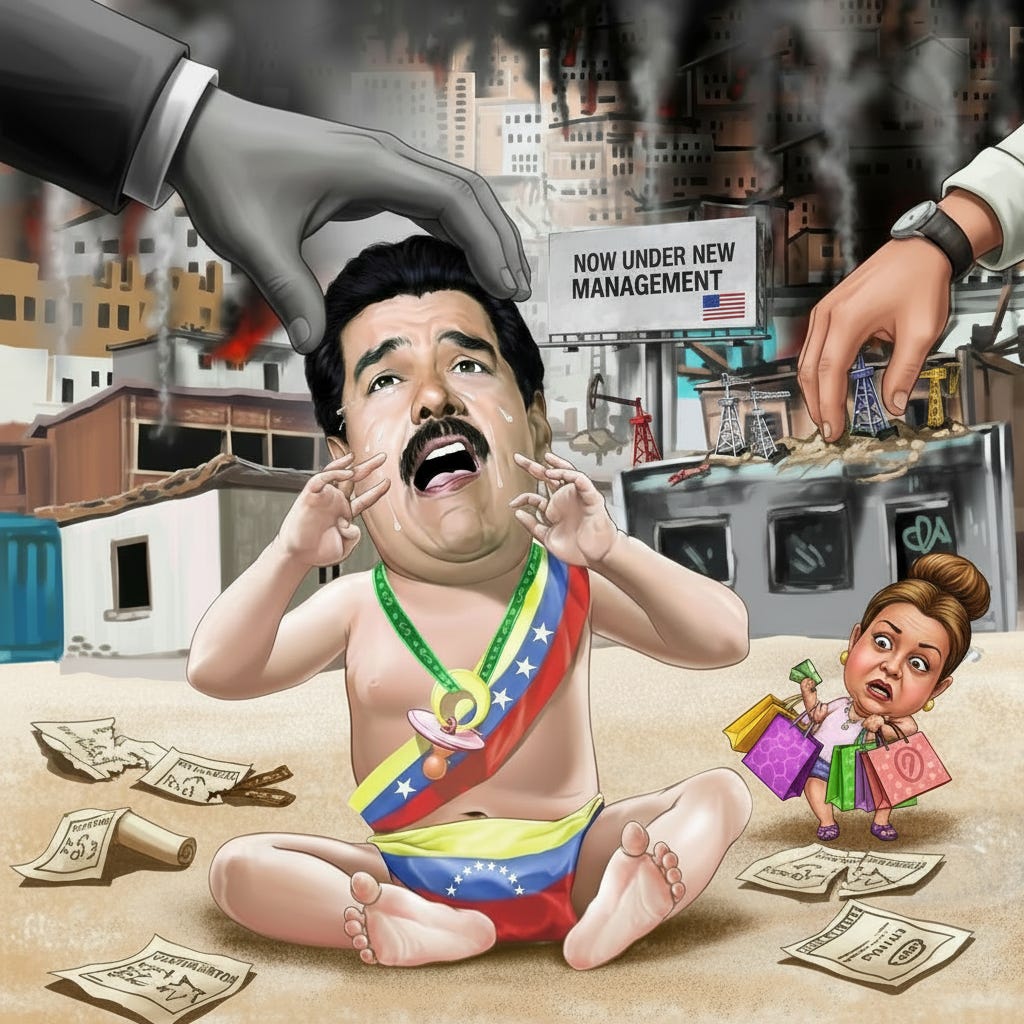
Two photographs emerged from Caracas on January 3, 2026, that crystallize a paradox at the heart of American foreign policy and the broader crisis of liberalism. In one, Nicolás Maduro is shown being flown out of Venezuela by U.S. special operations forces, his two-decade kleptocratic and authoritarian regime finally undone by a large-scale military strike that faced little internal resistance. In the other, Donald Trump stands at a podium declaring, “We are going to run the country”—referring to Venezuela—“until we can do a proper transition.” A tyrant has fallen. But the language of liberation has been swallowed by the language of empire.
For classical liberals, this moment demands clarity about both what we celebrate and what we fear. Maduro’s removal is good. His regime was a catastrophe for civil liberties, property rights, and human flourishing—and libertarian principles demand that we say so plainly. But Trump’s willingness to run a sovereign nation and oversee the reconstruction of its oil sector through preferred U.S. firms is not liberation. It is a different form of the same central-planning hubris that destroyed Venezuela in the first place. And it threatens to poison the well for market-oriented reform in Latin America for a generation.
Maduro’s Record: A Case for Removal
Begin with the easy part. Nicolás Maduro took office in 2013 as Hugo Chávez’s chosen successor and spent the next thirteen years perfecting a fusion of socialist rhetoric and fascistic practice. His government did not merely expand state control of the economy—it weaponized property law, judicial independence, and the security apparatus against political opponents.
The economic collapse was real and devastating. State control of oil production, combined with price controls, currency manipulation, and the expropriation of productive firms, destroyed the sector that had once generated Venezuela’s wealth. Hyperinflation ravaged the currency. Public services disintegrated. By the early 2020s, millions of Venezuelans had fled the country as refugees—one of the largest displacement crises in recent Latin American history.
But beyond economics lay something darker: the systematic dismantling of constitutional constraints on executive power. Maduro dissolved the opposition-controlled National Assembly, created a parallel legislature filled with loyalists, and used security forces—particularly the shadowy National Guard and intelligence agencies—to terrorize political opponents, labor organizers, and journalists. He claimed victory in the 2024 election despite widespread evidence of electoral fraud, facing mass protests that his security forces repressed with violence.
From a classical liberal perspective, Maduro’s government violated every principle we hold dear: rule of law, property rights, political pluralism, and personal liberty. His removal, by whatever means, eliminates a regime that would not have tolerated free elections or a peaceful transfer of power. On that, the moral case is straightforward.
Trump’s Strike: The Problem with Force Without Limits
The trouble begins with how the removal happened and—more importantly—what comes next.
The U.S. strike on Venezuela was launched without a declaration of war, congressional authorization, or consultation with regional allies. It was, by any serious measure, an act of war conducted unilaterally by the executive branch. That this strike achieved its narrow military objective—capturing Maduro and disrupting the regime’s command structure—does not address the constitutional and strategic questions it raises.
Classical liberals have a centuries-old tradition of skepticism toward unilateral executive war-making. From Madison’s warnings about the concentration of power to Acton’s insight that power corrupts and absolute power corrupts absolutely, we understand that allowing presidents to launch offensive military operations abroad without legislative check is a recipe for imperial overreach. Trump’s language—“we’re going to run the country”—is precisely the kind of casual assertion of dominion that should alarm anyone who believes in limited government.
The practical dangers are just as acute. Military occupation and nation-building are hard. They require sustained commitment, vast resources, and a willingness to absorb costs and casualties over years or decades. The United States, having learned this lesson in Iraq and Afghanistan, should know better. When Washington promises to “run” a country until “a proper transition can take place,” what actually happens is that the transition never quite arrives, the occupation persists, local resentment builds, and American servicemen and women pay the price.
For classical liberals, there is a deeper problem: the intellectual confusion between removing a bad government and building a good one. Maduro’s fall is genuine good news. But that does not mean Washington is now competent to reconstruct Venezuelan civil society, institutions, and property law from scratch. It does not mean that American corporate interests and geopolitical preferences should drive the design of a new Venezuelan economy. And it certainly does not mean that the Venezuelan people have consented to being administered by the U.S. military during an indefinite “transition.”
The Risk of Blowback: Why This Model Fails
History provides a clear script for what happens next. In the 1950s, when the CIA orchestrated a coup against Iran’s Mohammad Mosaddegh to protect British and American oil interests, it achieved its immediate goal—but set in motion decades of anti-American sentiment that culminated in the 1979 revolution and the theocratic Islamic Republic. The American public now recognizes that operation as a mistake. Yet we seem poised to repeat the error.
When foreign powers control the “reconstruction” of a nation’s most valuable resource, local elites and ordinary citizens alike come to see markets not as liberating but as extractive. They associate deregulation with theft. They link property rights to foreign occupation. And when the inevitable disappointments come—when oil revenues don’t flow as expected, when environmental damage accumulates, when a new political movement emerges with a populist critique of “sell-out” elites—they have a ready-made narrative: markets failed because they were imposed by outsiders for outsiders’ benefit.
This is not a trivial political problem. It is how Venezuela gets Chavismo again, but with a different cast of characters. It is how market-oriented reforms become politically impossible for a generation. And it is why classical liberals should be most alarmed by what Trump is promising.
What Liberalism Actually Demands
So what should happen instead? A genuinely liberal approach would look radically different.
First, it would acknowledge that while removing Maduro is legitimate—even necessary—it does not grant the United States the right to govern Venezuela. A transitional authority drawn from Venezuelan civil society, opposition leaders, business figures, and international observers should take responsibility for elections, constitution-writing, and initial governance. American military presence should be minimal, clearly temporary, and focused narrowly on preventing state collapse or mass atrocities. Not running the country. Protecting the space for Venezuelans to run it themselves.
Second, it would insist on the rule of law before major economic deals. Rather than using American leverage to fast-track oil contracts, the immediate priority should be building independent courts, a professional civil service, and transparent regulatory institutions. These are unsexy reforms, but they are foundational. Without them, any investment will be political spoils, not productive capital.
Third, it would open reconstruction efforts to genuine competition. Not just U.S. firms, but European, Asian, and Venezuelan companies should have equal standing to bid for concessions and contracts. The world’s largest oil reserves should attract global competition, not become a patronage network for firms with American backing.
Fourth, it would ensure that Venezuelans themselves benefit equitably from oil wealth. That means property rights for the state and negotiated contracts that reflect fair market value—not sweetheart deals that transfer the bulk of rents abroad. It means education, healthcare, and infrastructure funded by transparent resource taxes. It means decentralization, so that communities where oil is extracted have a say in its development.
Fifth, and most fundamentally, it would treat Venezuela as a sovereign nation whose people have the right to make their own mistakes. If Venezuelans, after building genuine democratic institutions, choose a mixed economy with strong state involvement in oil—that is their choice. If they choose heavy regulation or majority state ownership of key sectors—that is their choice. Liberalism requires that we defend their right to choose, even when we would advise differently.
The Parallel with Milei’s Bailout
I don’t want to seem like a feedback loop, because I know I just wrote about what I’m mentioning next, but there is a mirror here to an earlier moment. When Trump offered Argentina a bailout conditional on Javier Milei’s electoral success, he married American financial power to a particular political outcome. Maduro’s capture represents something more extreme: American military power married to corporate reconstruction. Both represent a confusion between supporting liberal reform and controlling it from the outside.
The problem is not that markets need to develop in Venezuela. They do. The problem is not that oil should remain in the ground. It shouldn’t. The problem is the claim that Washington can—or should—manage the process. That claim rests on a fantasy of technocratic omniscience that has failed everywhere it has been tried.
An Uncomfortable Truth for Liberals
Classical liberals have long had an awkward relationship with regime change. We oppose tyranny in principle, yet we distrust the concentrated power required to remove it. We see the brutality of authoritarian rule and wish to end it, yet we recognize that outsiders cannot build liberal institutions by force. We value property rights and markets, yet we know they cannot flourish under occupation.
The capture of Maduro should be celebrated for what it is: the end of a regime that systematically violated every principle Venezuelans should hold dear. But Trump’s swagger about “running the country” and the corporate scramble for oil concessions should alarm us equally. Because what emerges from that process is unlikely to be liberal democracy or free markets. It is more likely to be a new form of the same old story: power and profit concentrated among those close to Washington, ordinary Venezuelans left to wonder why “freedom” looks so much like the last regime.
The hard truth is this: Maduro’s fall creates an opportunity for Venezuela to build liberal institutions and a market economy. But that opportunity will be squandered if the United States uses military occupation and corporate patronage to foreclose Venezuelan choice. For Venezuela’s sake—and for the credibility of liberal ideas in Latin America—the United States must resist the temptation to run the country, and instead help create the conditions for Venezuelans to run it themselves.