

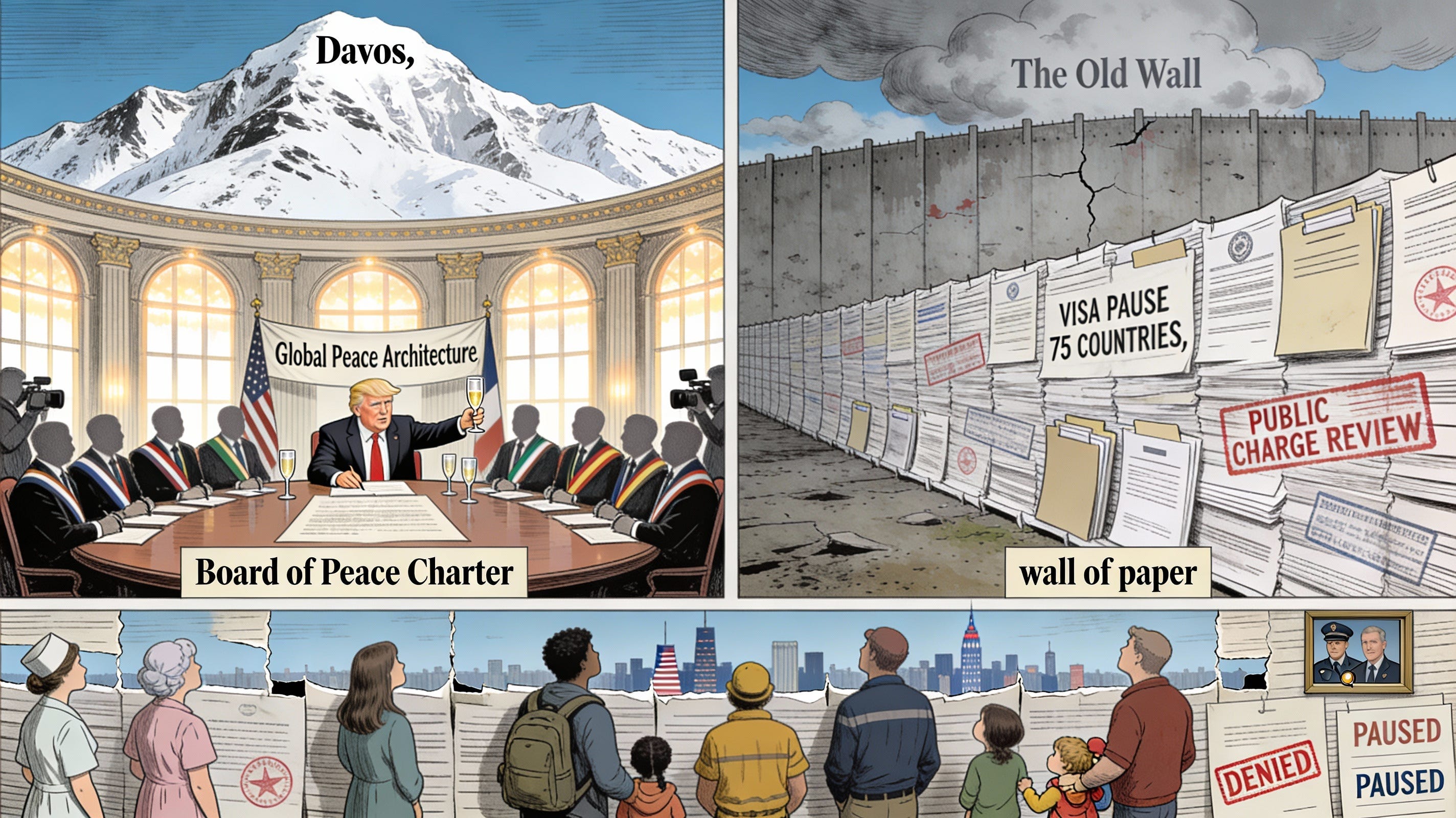
Trump’s second term offered a revealing split screen this week. On one side: a made-for-TV ceremony in Davos, where the president unveiled something called the “Board of Peace,” flanked by flags and cameras and talk of ending conflicts. On the other: a State Department cable quietly putting immigrant-visa issuance for 75 countries on indefinite hold, under the anodyne banner of a “public charge” review.
The same government that now proposes to architect peace for the world is, at the same time, making it much harder for millions of people from conflict-affected and poorer countries to ever live, work, or join family in the United States. That tension is not a side note; it is the story.
Davos boardroom, State Department back office
In Davos, the Board of Peace arrives wrapped in symbolism and, well, money. Trump signed a charter alongside a select group of leaders, promising a standing body to negotiate and fund peace arrangements, starting with Gaza and potentially expanding to other conflicts. Nothing says “global peace” quite like a billion-dollar buy-in club—reports describe founding members as expected to contribute up to a billion dollars each, with Trump himself at the center as broker and chair.
Critics worry this new structure could effectively rival or sideline the UN, concentrating agenda-setting power in a smaller, more transactional group. Notably, several traditional U.S. allies have kept their distance, wary of the Gaza focus, the process, or both. Davos, in other words, is the mountaintop: a place where heads of state, billionaires, and hired experts discuss how peace should be organized.
A few thousand miles away, the State Department is quietly deciding who can actually live under that peace.
How the visa pause really works
The new visa policy is, on paper, narrow. The State Department has ordered consulates to halt immigrant-visa processing for nationals of 75 countries deemed at “elevated risk” of becoming public charges—people who might one day use certain public benefits. The pause applies to immigrant visas only; tourists, students, and most temporary workers are formally unaffected.
The list reads like a map of the global periphery: countries across Africa, Asia, Latin America, and the Middle East, including Afghanistan, Haiti, Nigeria, Pakistan, and many others. Family-based migrants are especially exposed, because many of those green cards are processed abroad rather than through status adjustments inside the United States. Dual nationals get an escape hatch—if they can apply under a “clean” passport from a non-listed country, the pause does not apply.
The justification is “public charge.” The administration argues that this is just a prudent effort to ensure that new immigrants are unlikely to rely on U.S. welfare programs. But immigration advocates and policy analysts point out that the law already requires a public-charge test; consular officers can and do deny visas to applicants who lack adequate financial support. If the real goal were simply stricter screening, the government could tighten the rules universally—by, for example, raising income thresholds for sponsors or clarifying that more forms of assistance count.
Instead, guidance tells consular officers to presume public-charge risk based on a wide range of factors—age, health, English proficiency, prior benefit use—while the pause freezes entire nationalities. That combination massively expands discretionary power. It is less a scalpel and more a switch.
Peace rhetoric, closure in practice
That brings us back to Davos. The Board of Peace is presented as a new way to manage conflict and reconstruction, starting with Gaza and potentially extending to other flashpoints. Yet many of the countries whose nationals are now effectively barred from obtaining immigrant visas are themselves deeply affected by conflict, economic crisis, or both.
There is a basic credibility question here. A government that is actively reducing legal pathways for ordinary people from those places—nurses, students, family members—while constructing a high-level peace board for states and funders is trying to have it both ways. It is cosmopolitan in the boardroom and restrictive at the border.
The economic context makes that tension sharper. A recent analysis drawing on Brookings work and related coverage suggests that the United States likely experienced negative net migration in 2025 for the first time in decades. Economists warn that this will mean slower labor-force growth, weaker job creation, and modestly lower GDP, especially if restrictive policies persist into 2026. Put it plainly: if you subtract a mid-sized city’s worth of migrants, you also subtract a mid-sized city’s worth of workers and consumers. A large share of that shift is driven not by big dramatic laws but by administrative moves like visa pauses, tighter enforcement, and consular slow-downs that quietly cut the number of people who can come.
The Board of Peace decides who sits at the negotiating table for reconstruction and aid. The visa pause helps decide who will never get the chance to move to a safer, more prosperous place in the first place. Those are not separate questions.
Why the wall of paper is attractive
From a political-economy perspective, the appeal of this approach is obvious. Dramatic symbols—border walls, mass raids, large new detention camps—generate backlash, lawsuits, and bad optics. Administrative tools are different. A consular pause here, a broadened “public charge” presumption there, a tweak in how officers are told to weigh age or health or English proficiency—these changes are hard to photograph and even harder to mobilize against.
The benefits of restriction are concentrated on constituencies that care intensely about reducing immigration. They will notice every new limit. The costs are diffused across future workers and consumers who are not yet here, and across immigrants’ U.S. citizen relatives who do not experience a single big “event” so much as years of delay and disappointment. That is a recipe for durable policy: small, unglamorous levers that shift numbers without a single high-profile vote in Congress.
If the symbol of the first Trump era was a physical wall, the symbol of the second is a wall of paper: visa backlogs, paused categories, ever-stricter interpretations of who might one day be a “public charge.” Davos is comfortable with this; invitations go out, speeches are made, peace boards are launched, while the machinery that determines who can join the societies those boards claim to stabilize grinds away in the background.
What a more honest posture would look like
None of this is to say that migration policy is irrelevant to social stability. There are reasonable debates to have about how fast populations should grow, how to manage pressures on housing and schools, and how to structure safety-net programs. But those debates should be held in the open, with clear numerical targets and explicit votes—not smuggled into the Federal Register or a consular manual.
A more honest posture would start from a different place. It would pair diplomacy and reconstruction funds with predictable, rule-based access to migration, trade, and investment, including for people from precisely the countries that now find their nationals frozen out of immigrant visas. It would treat the ability to move to safety and opportunity as part of what peace is, not as an afterthought.
Right now, the architecture runs in the opposite direction. The Board of Peace decides who gets to sit in the room and sign the communiqués. The wall of paper decides who even has a chance to live in the societies those communiqués are meant to safeguard.
If peace is going to be more than a Davos stage set, it has to begin with the quiet barriers—not just the flashy boards—that keep millions on the outside looking in.