

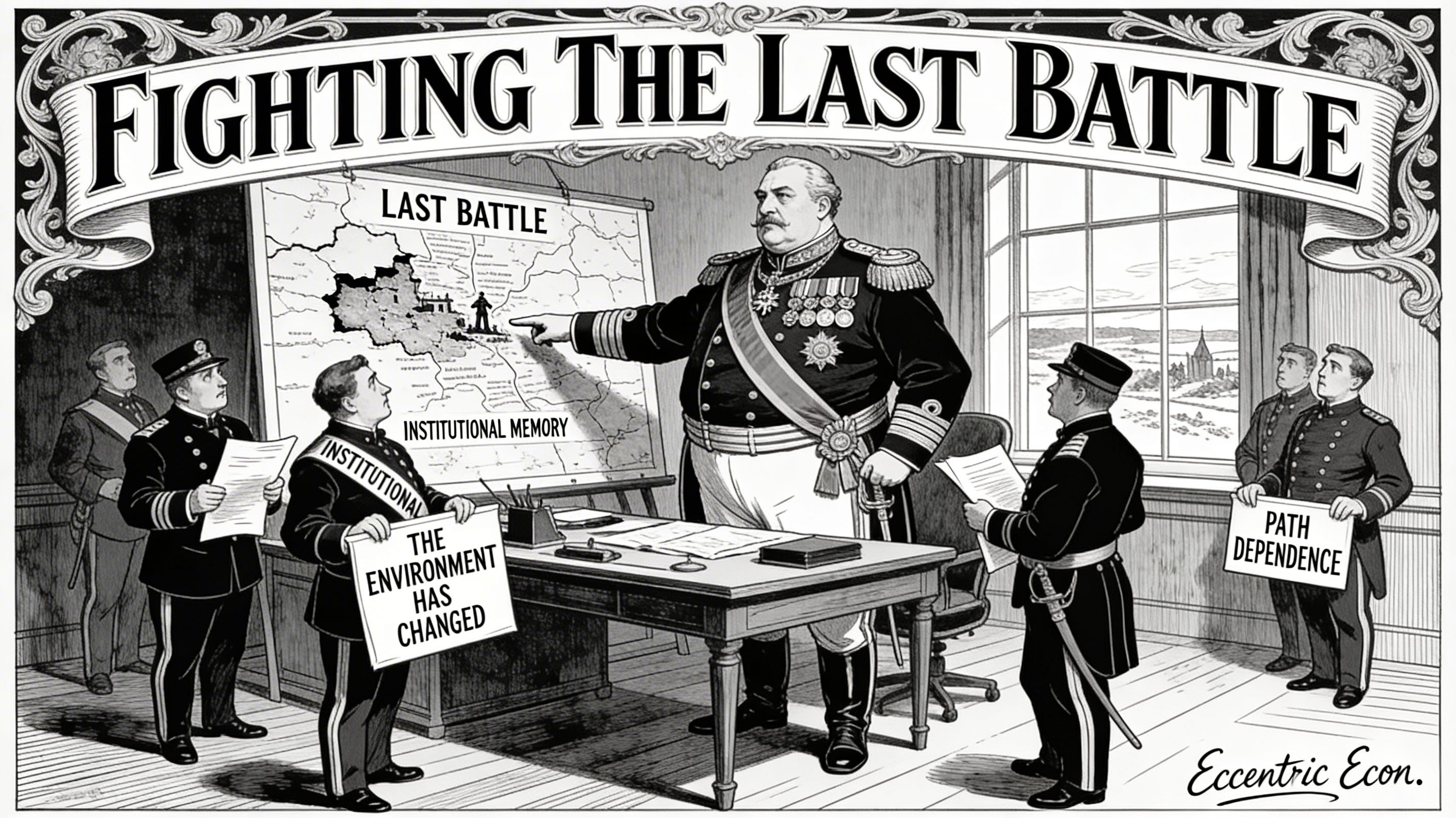
One of the most common explanations for institutional failure is incompetence. Another is conspiracy.
Both explanations are emotionally satisfying. They also happen to be wrong most of the time.
A far more mundane explanation appears again and again in politics, public administration, corporate governance, and even academic institutions: organizations continue to deploy strategies that previously worked, even after the environment around them has changed.
Learning and Lock-In
Institutions, like individuals, learn from experience.
The difference is that institutional learning tends to be sticky. Strategies that succeed become embedded in norms, procedures, reputations, and career incentives. Leaders rise within organizations precisely because they mastered the tactics that worked under earlier conditions.
When a new crisis emerges, the natural response is therefore not innovation.
It is repetition. Run the playbook.
After all, the playbook worked last time. If it worked once, surely it will work again.
Institutions are nothing if not optimistic about their own past successes.
From inside the institution, this feels like prudence. Experience should count for something. Organizations that constantly reinvent themselves rarely survive long enough to build experience in the first place. From the outside, however, this same behavior often looks like paralysis.
The deeper issue is institutional lag. Environments change faster than leadership structures do. Authority tends to remain in the hands of actors who succeeded under the previous equilibrium. Adaptation therefore trails the conditions that require it.
Sometimes by years. Sometimes by decades.
Institutions as Strategic Systems
Economists have long understood that actors respond to incentives and constraints rather than abstract moral appeals. Even in situations as extreme as political violence, participants behave strategically. Earlier work in political economy has described terrorists and counterterrorist actors as agents operating within a constrained marketplace, maximizing utility under severe limitations rather than acting outside economic logic altogether.
That insight applies far more broadly than its original context.
Institutions are not monolithic entities guided by a single rational mind. They are collections of actors navigating incentives, reputational risks, and organizational constraints. Strategies that once produced success become institutional memory. Procedures are written around them. Careers are built on them. Entire professional identities form around defending them.
Under those conditions, repeating past strategies is not a sign of irrationality. It is exactly what rational actors inside the system are expected to do.
The problem arises when the environment changes faster than those incentives. Institutions then find themselves operating according to a map that describes a world that no longer exists.
Path Dependence and the Comfort of Familiar Tools
Once a strategy becomes embedded within an organization, abandoning it is surprisingly difficult.
The costs are not only operational but reputational. Imagine telling a room full of senior professionals that the very strategies responsible for their careers no longer work. This is not a recipe for calm reflection. It is a recipe for institutional defensiveness.
Path dependence follows naturally. Policies persist because they succeeded in the past. Decision-makers interpret new problems through the lens of previous victories. When the system encounters turbulence, the instinctive response is to apply more of the same medicine. If the cure worked once, surely the dosage just needs adjusting.
Or so the thinking goes.
The result is often a peculiar phenomenon: institutions that appear highly active yet strangely ineffective. Meetings multiply. Reports circulate. Committees form. Press conferences abound.
Activity is not the problem. Direction is.
The organization is running hard. It just happens to be running on yesterday’s map.
Institutional Lag in Real Time
You can observe this mechanism unfolding across modern democracies.
Many opposition parties, for example, still rely heavily on strategies that proved effective during earlier electoral cycles: disciplined messaging, procedural maneuvering, and the expectation that the next election will restore equilibrium. These strategies are not irrational. They succeeded before.
But when the surrounding environment has changed—when trust has eroded, coalitions have shifted, and institutional legitimacy itself has become contested—the old playbook may not produce the expected results. Yet abandoning that playbook is difficult. Party leadership tends to be dominated by actors whose careers were built during the previous equilibrium. Their instincts, understandably, favor the tools that once delivered victory.
Younger political actors often see things differently.
Having entered politics under altered conditions, they suspect that the underlying equilibrium has already shifted. The resulting internal conflict is frequently interpreted as ideological division. In reality it is often something simpler: a disagreement about time horizons. One faction believes the previous equilibrium still exists. The other suspects it quietly expired several election cycles ago.
Neither side can prove its position in advance. So the argument continues.
Meanwhile the public grows impatient.
Why Observers Reach for Conspiracies
To citizens watching from outside the institutional machinery, this lag can be infuriating.
Outcomes appear persistent. Problems remain unsolved. Leadership rotates but the system itself seems strangely immovable. At this point, many observers reach for darker explanations.
Perhaps the system is rigged. Perhaps elites secretly coordinate outcomes. Perhaps nothing will ever change because the system is designed not to change.
The appeal of these explanations is understandable. Humans prefer narratives with intentional villains. Structural explanations, by contrast, are unsatisfying. They lack drama. Worse still, they imply that replacing individuals may not fix the underlying problem.
But most institutional persistence does not require conspiracy. It only requires incentives.
Systems reproduce outcomes because the incentives sustaining those outcomes remain intact. The system behaves “as designed” not because someone secretly designed it that way, but because the existing constraints make the current equilibrium stable. It really doesn’t matter if and when the actors change. If the incentives stay the same, the outcome usually does too; either Edward Norton or Mark Ruffalo still give you a Hulk.
This is less sinister than conspiracy. It is also much harder to fix.
Reform is Hard, Bruh…
If institutional failure were simply a matter of bad leadership, reform would be easy.
Replace the leaders. Elect new ones. Hire different experts. Problem solved.
But structural equilibria do not yield so easily. Evidence alone rarely moves institutions out of stable equilibria. Moral outrage rarely does either. History is full of eloquent arguments and righteous anger that changed absolutely nothing.
Institutions respond instead to changes in incentives. Shift the constraints. Alter the payoffs. Redistribute the risks. Create credible expectations that the environment has changed.
Then—and only then—do strategies begin to evolve.
Until that happens, institutions will continue doing what they have always done. Repeating the tactics that once worked. Defending the playbook. Fighting the last battle.
A Small Dose of Realism
This is the uncomfortable implication many reform debates prefer to avoid.
The problem is rarely that institutions refuse to listen. The problem is that institutions are responding exactly as their incentive structures tell them to respond. In other words, the system is not malfunctioning.
It is functioning perfectly.
Just not in the way anyone hoped.
And that is why institutional reform is so difficult. You are not merely arguing with people. You are arguing with equilibria. Equilibria, unfortunately, do not care about speeches. They change only when the underlying structure changes.
Until then, the pattern repeats. Institutions keep fighting the last battle.
And the next one quietly begins without them.