

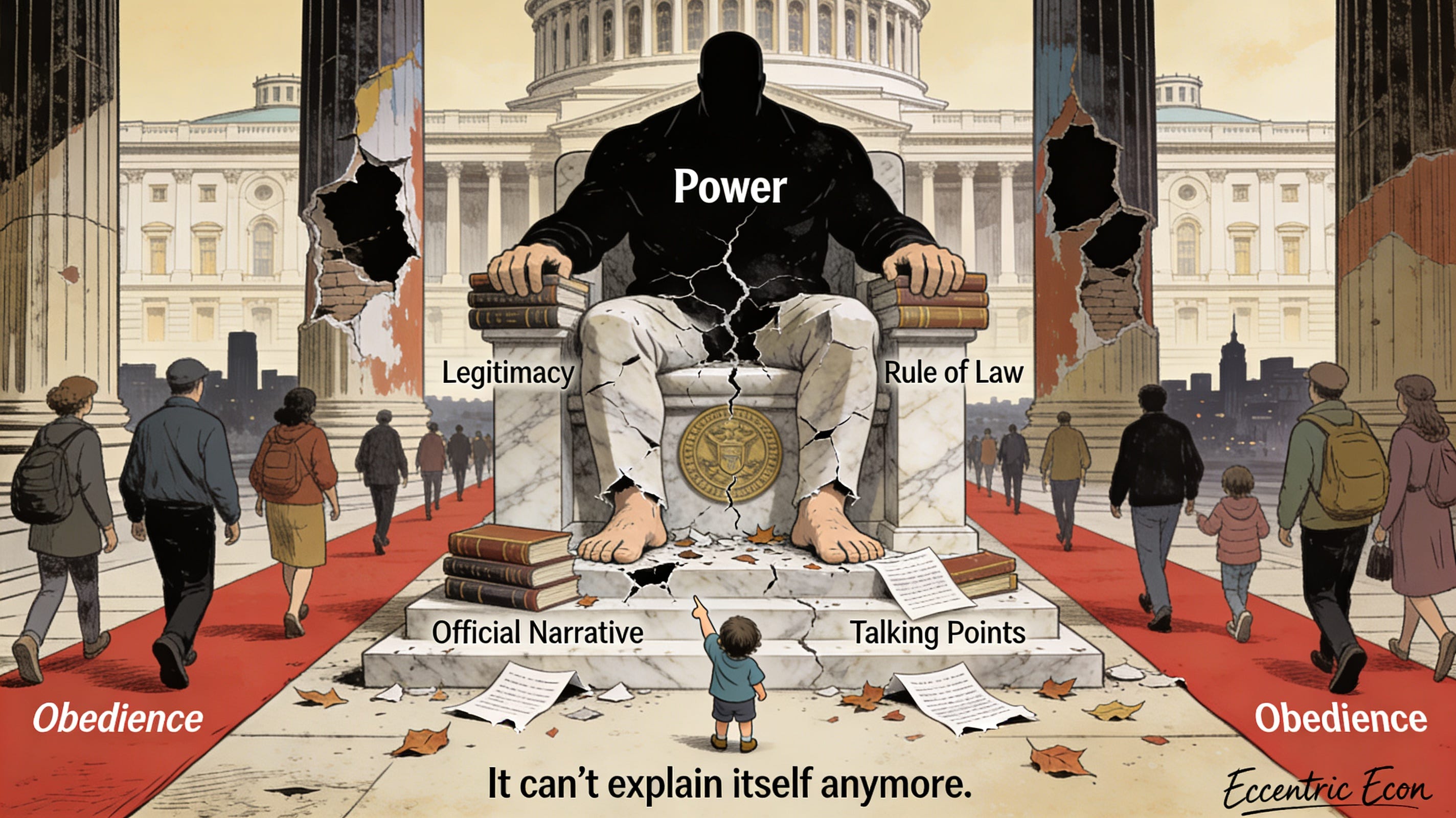
Modern power doesn’t usually die in a firefight; it dies when its explanations stop making sense. That’s the core insight in Jennifer Nemecek‘s recent essay, “When Legitimacy Breaks Before Power,” where she traces how institutions can remain formally intact long after the stories that once made them feel binding have worn through. What she’s describing is not just corruption or hypocrisy; it’s a deeper fracture between the language power uses about itself and the way it actually behaves, the moment when obedience shifts from “this is ours” to “this is theirs.”
The argument below is meant as a complement to her piece rather than a restatement of it. If Jennifer is giving us the field report from inside a fraying order, this is an attempt at the mechanism design: a sketch of how legitimacy, narrative, and what Timur Kuran famously called “preference falsification” interact to let systems look stable right up until the day they don’t. Her line—“Power does not collapse when challenged. It collapses when it can no longer be explained.”—is the thesis; what follows is one way of cashing out why that’s true for modern democracies, liberal hegemons, and any regime that depends more on authority than on raw coercion.
Power that can no longer explain itself doesn’t just look ugly; it looks stupid, arbitrary, and optional—and that’s when people quietly start walking away from it. That’s the nerve her line hits: the real inflection point isn’t resistance, it’s the collapse of the story that made obedience feel like common sense.
Modern states don’t run on brute force; they run on legitimacy—the sense that “this is just how things are done” and “these are, more or less, our rules.” You can see it in the long slide of trust metrics documented by places like Pew Research Center: U.S. public trust in government doing the right thing “most of the time” fell from around 60 percent after 9/11 to under 20 percent by the mid‑2010s, well before the current round of institutional drama. When that trust erodes, people don’t instantly revolt; they downgrade institutions from “ours” to “theirs,” from furnished home to Airbnb.
Legitimacy is what turns raw power into authority: the cop isn’t just a person with a gun; the judge isn’t just someone in a robe; the regulator isn’t just a bureaucrat with a pen. Once the story that connects those tools to a shared moral frame breaks, the same actions start to read as naked self‑dealing, and the audience’s posture shifts from consent to containment.
The usual myth is that regimes shatter when someone finally “stands up” to them. In practice, decay is slower and pettier: power stops even trying to make sense. You end up with governments that still claim the language of rule of law and public interest while openly gaming procedures, neutering checks, and treating basic constraints as technicalities to be lawyered around.
At that point, you don’t yet have tanks in the streets; you have something more corrosive: a ruling class that can’t be bothered to justify itself in terms that apply equally to friend and enemy. Law becomes “what our side can get away with,” foreign policy becomes “what we feel like,” and enforcement becomes “who we can scare,” and everyone can see it—even if saying so out loud is still costly.
The sociologists call this “preference falsification,” a term made famous by Timur Kuran: people nod along publicly while privately disbelieving, because they assume everyone else still buys the story. Nothing looks more stable than a system in which everyone is lying in the same direction. Then one person refuses to play along, and suddenly the room discovers it was full of heretics.
That’s why power seems to “collapse overnight” even when the rot has been decades in the making: what’s new is not dissent, but its visibility. The moment people realize that their skepticism is widely shared—that the emperor’s clothes are not just thin but imaginary—the cost of obedience spikes and the cost of honest speech falls, and a status order that looked immovable suddenly looks ridiculous.
The liberal international order always depended on a certain kind of story: that even the hegemon was bound, at least cosmetically, by rules it didn’t write on the fly. Once a hegemon’s internal institutions stop constraining its executive—once courts, legislatures, and “independent” agencies become extensions of one man’s will—you don’t just get more aggression; you get radical unpredictability.
Without a shared justificatory framework, other states can’t tell the difference between rule‑enforcement and whim. That’s not just “bad behavior,” it’s a breakdown of the conditions under which behavior can be judged at all: there is no longer a stable reference frame for what counts as overreach, restraint, or violation.
The academy has started to describe this as a chronic legitimacy crisis: not a clean break, but a long, grinding mismatch between what institutions claim to be and how they actually operate. Executives hollow out checks and balances piecemeal, usually through legal channels—constitutional rewrites, emergency powers, politicized appointments—leaving the form of democracy intact and the substance eaten away.
I appreciate this thoughtful engagement — especially the decision to work the argument through a visual frame.
Seeing ideas translated rather than summarized is always clarifying.