

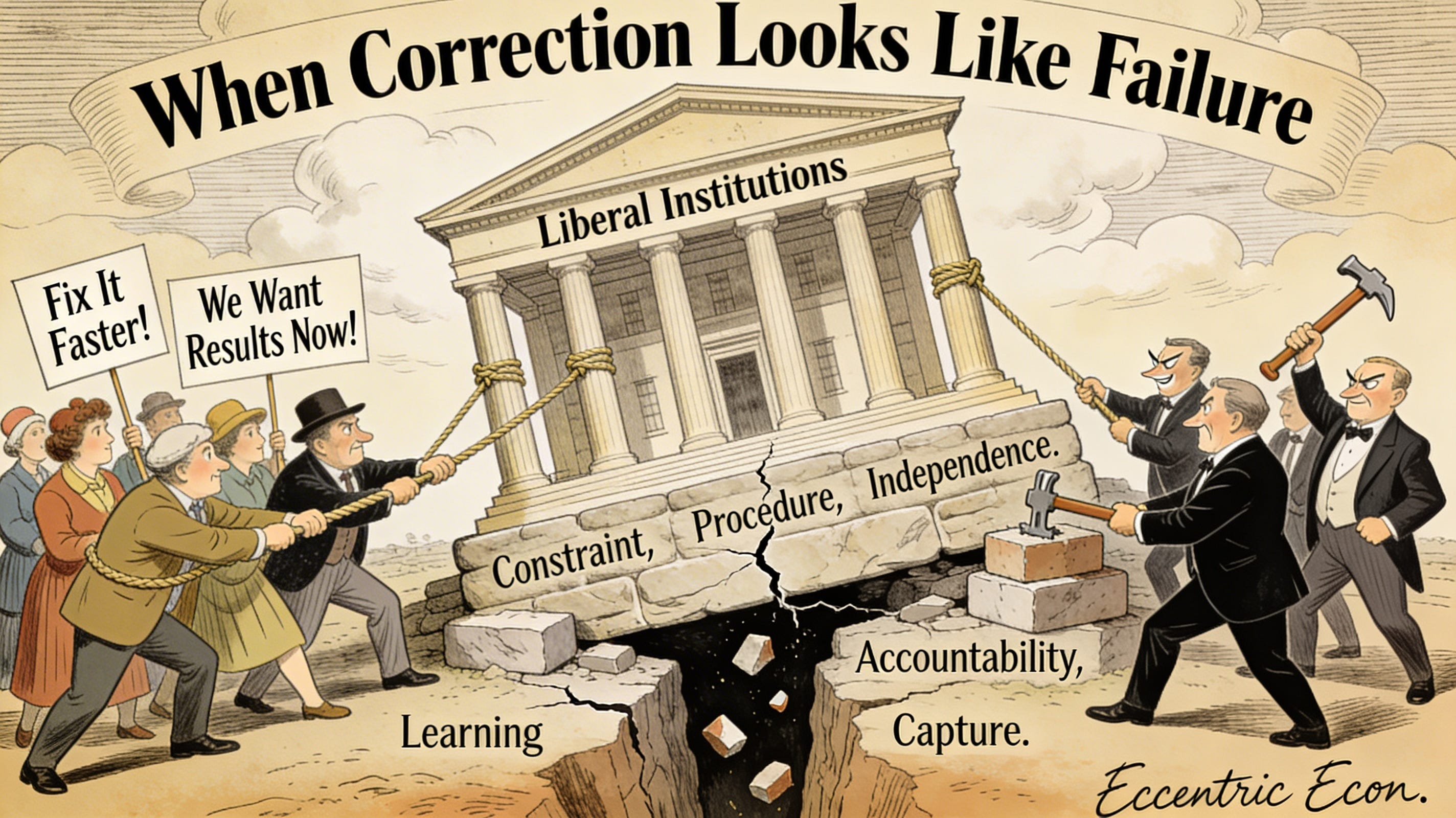
Modern democracies face a strange and increasingly visible dilemma. Citizens increasingly demand institutions that respond faster when problems arise, yet the mechanisms that allow institutions to learn often depend on resisting immediate pressure. What looks like institutional failure may sometimes be the uncomfortable process of correction itself. Efforts to force faster responsiveness, however understandable, can unintentionally weaken the very constraints that make learning possible.
When Institutions Appear Unable to Learn
Public frustration with institutions is not irrational. Citizens often experience problems that seem to persist despite expert management, procedural safeguards, and repeated promises of reform. When outcomes fail to improve — or improve too slowly to be visible — it is reasonable to conclude that institutions have become insulated from accountability. Demands for faster responsiveness emerge not from hostility to democracy, but from a growing belief that correction itself has stalled.
In an environment of epistemic fragmentation, even genuine attempts at learning become difficult to recognize. Signals about reform are filtered through polarized media, partisan narratives, and uneven expertise, so citizens struggle to distinguish between failure, delay, and slow-moving correction. Under those conditions, skepticism about institutional learning is not simply cynicism; it is an understandable response to an opaque and noisy information environment.
The Temptation to Loosen Constraints
Yet pressure for faster correction can produce an unintended consequence. Institutions designed to learn over time typically rely on constraints that slow decision-making: independence from immediate political pressure, procedural safeguards, and rules that limit discretionary action. When public confidence weakens, these constraints increasingly appear not as protections but as obstacles. Efforts to restore accountability therefore often begin by loosening the very limits that allow institutions to evaluate outcomes, absorb feedback, and adjust course responsibly.
This does not imply that insulated institutions perform well by default, nor that independence guarantees sound policy; only that the capacity for correction depends on preserving conditions under which error can be recognized over time.
This pattern is visible in debates over central banks, courts, and regulatory agencies, where proposals for “democratization” frequently involve narrowing terms, weakening independence, or tightening electoral control. The underlying impulse is understandable: if institutions are not learning, bring them closer to immediate public pressure. But in doing so, societies risk dismantling the buffers that separate short-term moods from long-horizon evaluation.
How Learning Capacity Degrades
As constraints weaken, institutional decisions become more directly responsive to short-term pressures. Feedback grows noisier, policy horizons shorten, and outcomes become harder to evaluate before new demands for change arise. Adaptive learning begins to degrade. Opportunistic actors find systems easier to influence, while genuine correction becomes more difficult to distinguish from political reaction. What began as an effort to restore responsiveness can gradually erode the conditions that make institutional learning possible.
Research on populism and institutional capture suggests that when voters become impatient and institutions are weakly constrained, leaders face stronger incentives to seize control of the very bodies meant to oversee them. In such environments, capture is not an aberration but a predictable response to loosened guardrails. Over time, institutions shift from processing information to protecting incumbents, further degrading their capacity to learn.
A Self-Reinforcing Perception Loop
The result is a self-reinforcing dynamic. Citizens interpret persistent problems as evidence that institutions cannot correct course, prompting demands for greater immediacy and responsiveness. Yet as stabilizing constraints weaken, institutions lose the capacity to evaluate policy over time, making successful correction less likely. Performance deteriorates in ways that confirm the original perception of failure. Institutional distrust, initially rooted in understandable frustration, becomes progressively self-validating.
In this loop, populist pressure and institutional underperformance are not opposing forces but co-producers of decay. Leaders respond to distrust by weakening constraints; weakened constraints make capture easier; capture further undermines trust. Each side can accurately point to real dysfunction while contributing, often unintentionally, to its escalation.
The Liberal Tension: Responsiveness vs. Learning
Liberal institutions therefore operate under a persistent tension. To remain democratically legitimate, they must ultimately respond to public concerns. Yet to remain capable of learning, they must sometimes resist immediate demands long enough to evaluate outcomes and incorporate feedback over time. Constraints that slow decision-making — independence, procedure, and limited discretion — are not obstacles to accountability but conditions that make meaningful accountability possible. When this distinction becomes difficult to recognize, restraint begins to resemble betrayal.
Comparative work on democratic resilience shows that democracies survive not by avoiding shocks, but by maintaining institutions that can absorb and learn from them. Where horizontal constraints and rule-of-law protections are strong, electoral responsiveness and long-horizon learning reinforce each other; where these constraints are weak, the same electoral pressures can accelerate instability.
When Disagreement Becomes About Possibility
Much contemporary political conflict may therefore reflect not simply disagreement over policy, but disagreement over whether institutions remain capable of correction at all. When citizens lose confidence that systems can learn, pressures naturally arise to bypass constraint in favor of immediacy. Yet adaptive institutions rarely improve through acceleration alone. Their capacity to correct mistakes depends on preserving the very structures that make evaluation, revision, and delayed accountability possible.
This helps explain why debates over courts, central banks, public health agencies, and universities often feel existential rather than merely technical. For some, constraints signal captured, self-protective elites; for others, the same constraints represent fragile preconditions for any hope of impartial learning. Both interpretations contain elements of truth, yet they point toward radically different responses.
The Fragility of Learning Societies
Liberal societies do not fail simply because institutions make mistakes. Error is inevitable in complex systems. They fail when citizens and institutions alike lose confidence that mistakes can still be recognized and corrected over time. The challenge facing modern democracies may therefore be less about choosing the right policies than about preserving the conditions under which learning remains possible.
When constraint is mistaken for indifference and delay for dysfunction, societies risk dismantling the very mechanisms that allow them to correct their own course. Liberal institutions may endure only if we retain the ability to distinguish between failure itself and the difficult process of adaptation.