

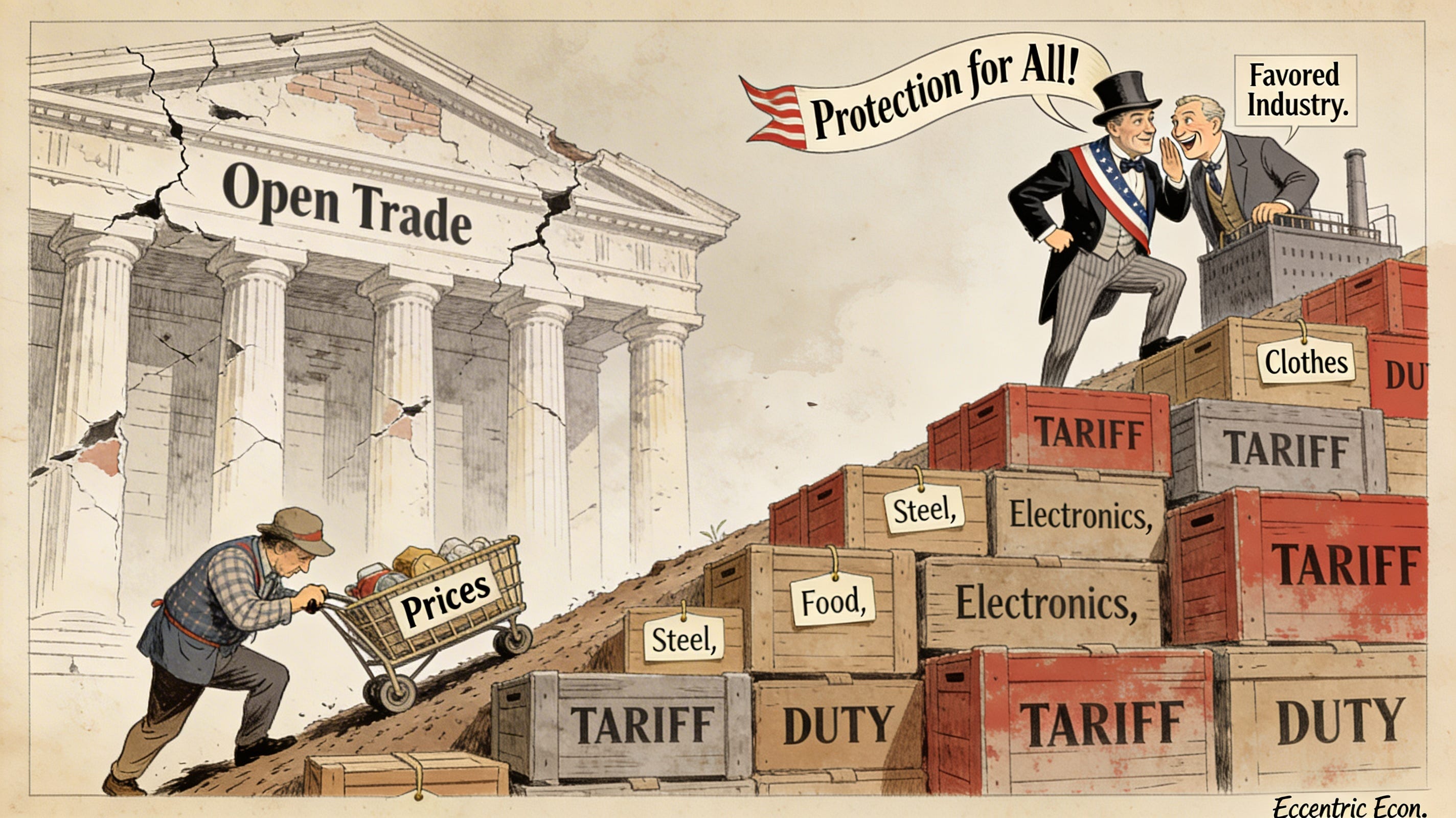
Tariffs are almost always sold as a way to have it all. Politicians promise to protect domestic industries and jobs, keep foreign rivals in check, and still deliver low prices and rising prosperity at home. Recent debates in the United States, with claims that “foreigners pay our tariffs,” fit this pattern neatly. I’ve called this narrative out before in “Tariff Truths,” where I walked through how both Trump and Biden have leaned on duties while downplaying who actually pays for them.
But trade policy, like any other policy that touches scarcity, obeys constraints. In practice, governments face a tariff trilemma. They cannot simultaneously deliver, at high levels, all three of the following:
Durable protection for politically favored domestic industries.
Low prices and broad consumer prosperity.
An open, rules‑based trading system that sustains long‑run productivity growth.
They can choose any two corners of this triangle, but the third will give way. The rhetoric around tariffs usually denies this, which is why the costs so often show up in places voters are not looking.
A free lunch that isn’t
The modern protectionist pitch goes something like this:
Foreign producers are “cheating” or benefiting from unfair advantages.
Imposing tariffs will level the playing field and bring back domestic jobs.
The burden will mostly fall on foreign exporters or their governments, not on American consumers.
That is the story behind claims that new tariffs on imports are a painless way to raise revenue or discipline trade partners. It suggests that the United States can achieve strong protection for targeted industries and still enjoy low prices and stable growth, because someone else will foot the bill. Recent empirical work finds the opposite: Americans—importers and consumers—are bearing almost the entire cost of recent U.S. tariffs.
Experience—and basic economics—tell a different story. Tariffs are taxes on imports, and taxes on imports raise the domestic prices of those goods and the things made from them. They also invite retaliation, uncertainty, and lobbying for special treatment, all of which erode the openness and predictability of the trading system.
The trilemma framework simply makes this more visible: to the extent tariffs succeed in protecting favored sectors, they do so by sacrificing either consumer welfare or the health of the broader trade regime.
Who really pays?
The first place the trilemma shows up is in incidence. When tariffs are imposed on intermediate goods—steel, aluminum, semiconductors, or inputs to consumer products—domestic firms that rely on those imports see their costs go up. They respond by raising prices, cutting back production, or both. Consumers pay more for cars, appliances, and electronics. Exporters whose products use imported components become less competitive abroad.
Recent analysis of U.S. tariff rounds finds that domestic consumers and downstream firms have borne much of the burden. Even where tariffs increase output or employment in the protected sector, they do so by diluting real incomes elsewhere. Economists such as Donald Boudreaux have spent years pointing out that the real economic case against tariffs is not that they always cause recessions, but that they quietly make most people poorer to privilege a few.
This is the first edge of the trilemma:
You can protect a domestic industry with tariffs, and you can pretend that foreign firms will pay the bill.
In reality, if you hold protection high and try to keep the trade system broadly open, the adjustment will come through higher prices and reduced purchasing power at home.
You can keep the protection and avoid being honest about who pays, but you cannot avoid the payment.
Protection versus openness
The second edge of the trilemma concerns the trade regime itself. A relatively open, rules‑based system—with lower barriers, clear commitments, and predictable dispute resolution—creates the conditions for investment, specialization, and long‑run productivity growth. Firms build supply chains and export markets because they expect the rules of the game to be reasonably stable.
When governments start treating tariffs as a first resort, especially when they claim those tariffs are costless, they inject uncertainty into those expectations. Each protected sector becomes a precedent for another. Trading partners respond with retaliation, creative circumvention, and their own special protections.
From the trilemma perspective:
If you want strong, durable protection for a wide range of industries, and you also want to reassure voters that prices will stay low, you will sacrifice openness and predictability.
The trading system becomes more politicized and brittle, as each country carves out exceptions for its own favored constituencies.
In other words, a world of widespread, permanent protectionism is not a world of robust, rules‑based trade. It is a world of chronic skirmishes, “temporary” tariffs that never quite go away, and a gradual erosion of the institutional framework that supported postwar prosperity.
Prices, prosperity, and saying no
There is, however, one corner of the triangle that is compatible with openness and broad prosperity: keeping trade relatively free and accepting that not every industry can be sheltered forever.
Choosing low prices and an open, rules‑based system means accepting more competition and more visible change. Some industries will shrink or relocate; others will grow. Workers and capital will move toward more productive uses. The gains are spread across many people and many sectors, which is why they are less politically salient than the concentrated losses in a declining industry —a textbook case of concentrated benefits and diffused costs.
This is the least comfortable position for politicians who want to promise specific job counts or targeted protection. It requires saying, in effect:
We can help workers adjust,
We can encourage growth and innovation,
But we cannot guarantee that today’s pattern of production will be frozen in place without making everyone poorer.
That is a hard sell in the short run. It is also the only configuration of the triangle that does not rely on wishful thinking.
Choosing corners honestly
The tariff trilemma does not tell us what to value; it tells us that values are in tension. I develop a related “fairness trilemma” in a different context—algorithmic governance—in my working paper, “The Fairness Trilemma: An Impossibility Theorem for Algorithmic Governance,” which formalizes this “pick any two” structure in a more general way. Protection for specific industries, low prices for consumers, and a stable, open trade regime are all good things. The point is simply that they cannot all be maximized at once.
A more honest trade debate would start by asking:
Which two corners are we choosing in this case?
How large are the costs at the third corner, and who bears them?
Are there better ways to help workers than taxing their consumption and risking a trade war?
For free‑traders, this framing has an advantage. It shifts the conversation away from abstract claims that “trade is always good” for everyone, and toward a concrete question: if we use tariffs to privilege some producers, which consumers and future opportunities are we willing to sacrifice, and are we prepared to say so explicitly?
The alternative is the status quo: protectionist promises that pretend costs do not exist and then allow them to surface later as higher prices, slower growth, and a more fragile global order.
There is no tariff that can repeal scarcity. There is only a choice about where scarcity bites. The tariff trilemma is a reminder that if we want open markets and broad prosperity, we cannot also demand permanent shelter for every politically favored industry.