

Immigration policy is often debated as morality or identity. This tool treats it as institution design: what signals are suppressed, where knowledge relocates, and what metrics reveal brittleness early—before the costs become irreversible.
Use it for: mass deportation proposals, E‑Verify mandates, visa caps, asylum backlogs, employer sanctions, sanctuary crackdowns, or “border security” packages.
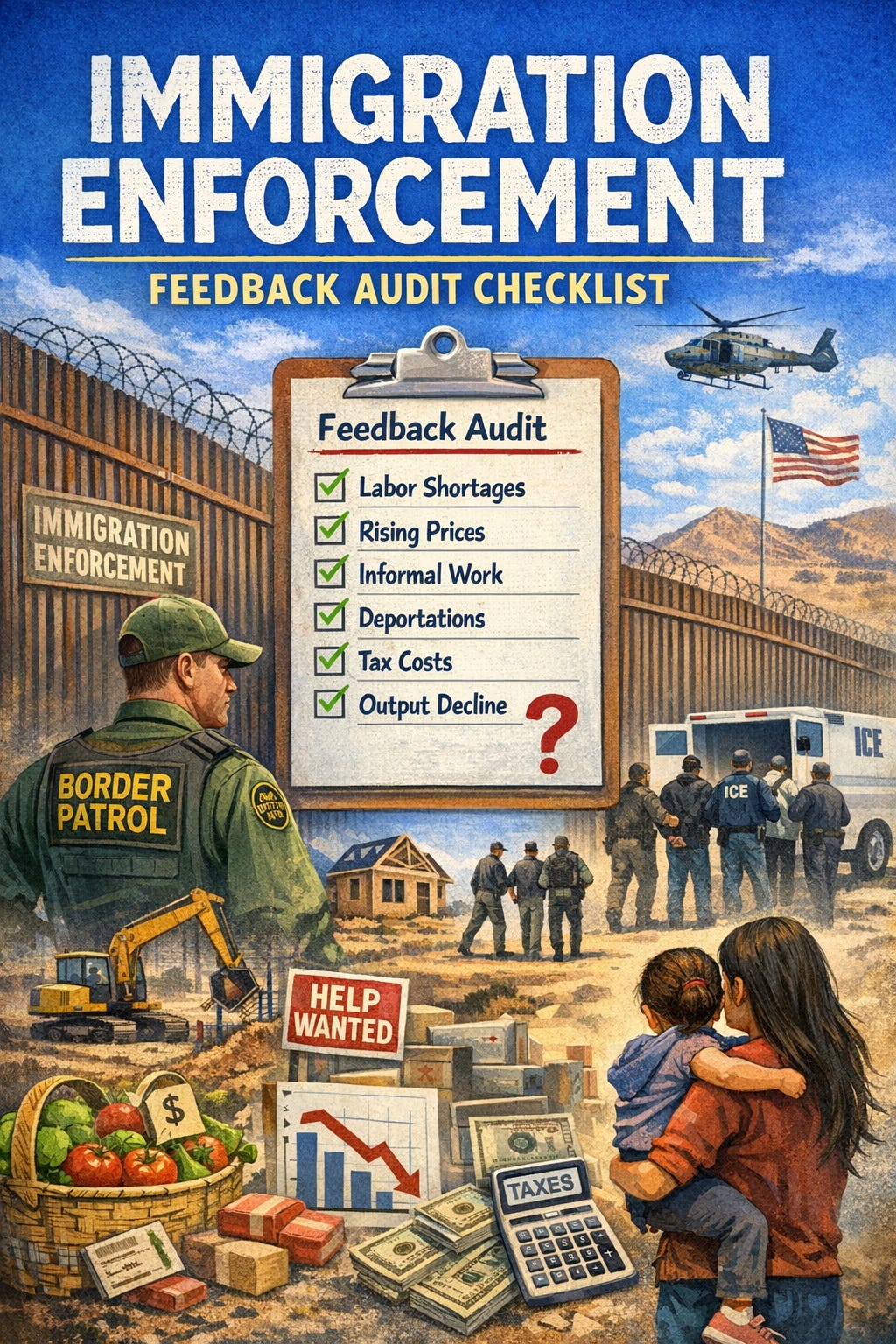
1) What labor‑market signal is being suppressed?
· ☐ Wage signal (what it costs to hire in a sector/region)
· ☐ Mobility signal (workers moving toward higher‑productivity regions)
· ☐ Entry/exit signal (firms expanding/shrinking in response to labor conditions)
· ☐ Hours/availability signal (overtime, seasonality, shift coverage)
· ☐ Task allocation (team production; supervision vs manual)
· ☐ Risk pricing (who bears enforcement risk: workers, firms, consumers)
Diagnostic: Which coordinating signal (wages, mobility, entry/exit) is being replaced by quota, force, or paperwork?
2) Where does the displaced knowledge go?
· ☐ Recruiter networks and informal hiring (off‑the‑books labor, labor brokers)
· ☐ Fraud/gaming (misclassification, subcontracting chains, identity markets)
· ☐ Queues/backlogs (asylum, visas, work authorization delays)
· ☐ Discretion (case‑by‑case enforcement; unequal treatment by jurisdiction)
· ☐ Political allocation (industry carve‑outs, exemptions, lobbying wars)
Diagnostic: If workers can’t move legally, do you get prices adjusting—or do you get rationing, evasion, and lobbying?
3) What are the real adjustment margins in exposed sectors?
· ☐ Output reduction (less gets built/harvested/served)
· ☐ Price increases (housing, food, services)
· ☐ Quality reductions (maintenance deferred; thinner staffing; worse service)
· ☐ Automation (where feasible) and offshoring/relocation (where feasible)
· ☐ Crew reorganization bottlenecks (supervisors without crews; machines without operators)
· ☐ Exit/non‑entry (projects never started; farms switch crops; restaurants cut shifts)
Diagnostic: If labor tightens, which margin will move first: wages, output, prices, or project timelines?
4) Incidence map: who benefits, who pays?
· Potential winners (narrow):
· ☐ Direct competitors in specific local labor markets (short‑run wage bump possible)
· Likely payers (broad):
· ☐ Consumers (prices and availability: housing/food/services)
· ☐ Complementary workers (productivity, hours, and earnings up the skill chain)
· ☐ Taxpayers (enforcement apparatus + courts/detention + admin capacity)
· ☐ Local governments/schools (spillovers from household disruption)
· ☐ Firms/owners (profit compression, output contraction, higher risk premia)
· ☐ Citizen children / mixed‑status families (income shock, instability)
Diagnostic: Are benefits visible and concentrated while costs are diffuse (prices, productivity, taxes)? If yes, expect political durability even if outcomes worsen.
5) Enforcement capacity reality check
· ☐ Do you have the agents, detention capacity, court capacity, transport/logistics?
· ☐ What is the likely error rate (false positives, mistaken identity, collateral disruption)?
· ☐ Will enforcement be consistent, or vary by region, employer, and politics?
· ☐ What happens to compliance incentives when fear rises (tax compliance, reporting crime, cooperation with regulators)?
Diagnostic: Is the policy administratively scalable without massive discretion, error, and spillover costs?
6) Persistence mechanisms (why feedback‑suppressing enforcement sticks)
· ☐ Ratchet effect: temporary “crackdowns” become permanent bureaucracy
· ☐ Budget incentives: enforcement capacity becomes self‑justifying
· ☐ Diffuse incidence: price increases look like “inflation,” not policy costs
· ☐ Metric laundering: success defined as removals, not welfare or output
· ☐ Carve‑outs: industries lobby for exceptions, entrenching crony allocation
Diagnostic: Once built, what political coalition would ever vote to shrink the enforcement apparatus?
7) Metrics dashboard: brittleness vs resilience
· Labor/production: sector employment & hours; output/throughput (permits/starts/completions; harvested volume; service hours); project timelines/backlogs.
· Prices: construction bids/cost indices; rents/home prices (new build vs existing); category‑level food prices (labor‑intensive produce); service prices (childcare, cleaning, hospitality).
· Substitution and informality: subcontracting depth; misclassification proxies; E‑Verify mismatch rates / identity‑fraud indicators; enforcement variance across jurisdictions.
· Fiscal/social: enforcement spend; court/detention backlogs; payroll tax receipts in high‑exposure areas; school mobility/absenteeism proxies in high‑removal communities.
Diagnostic: Pick 5–8 metrics ex ante. If you can’t articulate them, you don’t have a policy—you have a slogan.
Verdict rule
If enforcement increases and you observe throughput down + prices up + informality up, you’re not “helping workers.” You’re purchasing visible control with hidden economic brittleness.
Alternative (if your goal is wages and abundance)
If you want higher real wages and lower prices, the system needs legal labor mobility + contract enforcement, not forced scarcity: expand legal work visas, price them transparently, and enforce wage/safety laws aggressively so gains come from productivity and bargaining power—not from collapsing output.
Footnotes
[1] Hayek, F. A. “The Use of Knowledge in Society.” American Economic Review (1945). https://www.econlib.org/library/Essays/hykKnw.html
[2] Penn Wharton Budget Model. “Mass Deportation of Unauthorized Immigrants: Fiscal and Economic Effects.” (July 28, 2025). https://budgetmodel.wharton.upenn.edu/issues/2025/7/28/mass-deportation-of-unauthorized-immigrants-fiscal-and-economic-effects
[3] USDA ERS. “Farm Labor” (NAWS summaries; updated). https://www.ers.usda.gov/topics/farm-economy/farm-labor/
[4] ITEP. “Tax Payments by Undocumented Immigrants.” (2024). https://itep.org/undocumented-immigrants-taxes-2024/
[5] Howard, Troup; Wang, Mengqi; Zhang, Dayin. “Cracking Down, Pricing Up: Housing Supply in the Wake of Mass Deportation.” SSRN 4729511. https://papers.ssrn.com/sol3/papers.cfm?abstract_id=4729511