

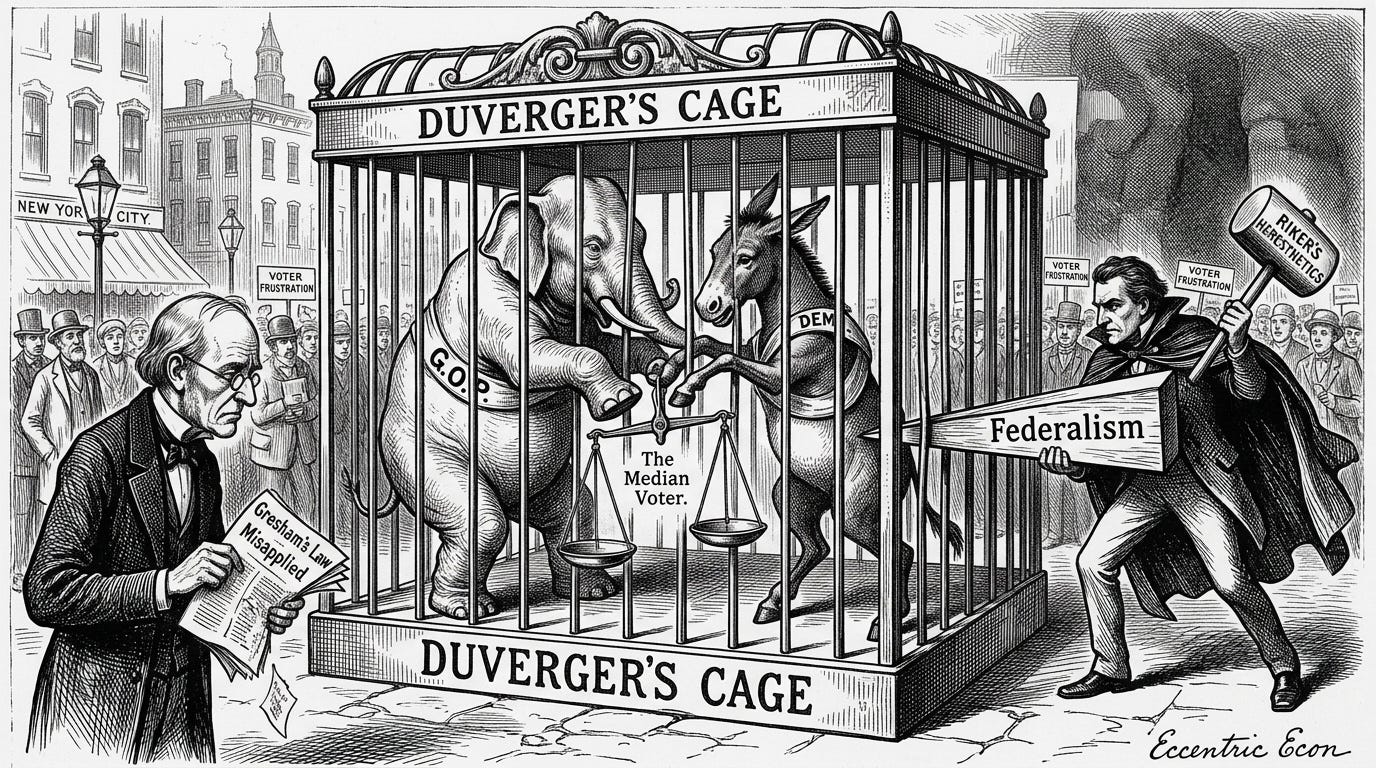
I was scrolling, as I sometimes do when I feel the need to punish myself for some real or imagined sin, through social media when I came across this gem from Reason bemoaning the state of the choices we voters must sometimes hold our noses at. Nick Gillespie, bless his heart, decried the lack of libertarian candidates in his state of residence, making the slate of creeping mediocrities from which he must choose all the more onerous. Of course, there’s no guarantee a Libertarian Party candidate would have represented any great improvement, but that’s a different meandering for an entirely different day of curmudgeonly reverie.
It got me all to thinking about certain realities and binding constraints. Once upon a time, Hans Eicholz and Emilio Pacheco accused me of being as much political philosopher as economist—an accusation which still causes a great deal of irrational irksomeness in me for some reason—but I shall indulge that yearning today.
The Allure of the Gresham Analogy
When classical liberals look at a degraded electoral slate, their first instinct is to open their economic toolkit. For decades, a dominant framework within the liberty movement has been an intellectual hand-me-down: a political variant of Gresham’s Law (yes, yes, nerds; I’ll get to Duverger’s in a bit). In finance, Sir Thomas Gresham’s observation—christened “Gresham’s Law” by the Scottish economist Henry Dunning Macleod in 1858—holds that when legal-tender laws fix an exchange ratio that overvalues debased coin, the “bad money” drives the “good money” out of circulation. If a silver dollar and a clad coin are legally decreed to carry the exact same purchasing power, people will spend the cheap metal and hoard the precious one.
Applied to politics, the metaphor is incredibly seductive. Libertarian commentators treat public office as a marketplace and the vote as a unit of currency, and, you know, that’s totally fair. The argument goes that populist pandering, fiat-style campaign promises, and state-expanding rhetoric have artificially overvalued the political charlatan. Consequently, the high-quality, principled statesmen—those advocating for strict fiscal restraint, decentralized authority, and personal liberty—are hoarded away, driven completely out of the political marketplace by a flood of low-quality political actors.
But this (kind of) reliance on an analog of Gresham’s Law reveals a deep conceptual flaw. It presumes that the ballot box functions like a traditional retail market, where a superior product will eventually clear the shelf if consumers simply wise up, improve their economic literacy, or refuse to buy the inferior goods.
Politics, however, is not a decentralized market characterized by variable pricing and marginal utility. It is an arena governed by rigid spatial constraints, majoritarian physics, and structural bottlenecks. To treat a multi-dimensional ideological crisis as a simple failure of supply and demand is to fundamentally misunderstand how political choices are manufactured. Libertarians continuously misdiagnose the disease because they are looking at a problem of geometric constraints through the lens of price theory.
Duverger’s Iron Cage
To understand why the political marketplace never clears in favor of the classical liberal product, we have to transition from the laws of economics to the strictures of political institutionalism. The foundational baseline of our dilemma is Duverger’s Law, which we libertarians love to cite effusively - and which, as it happens, William H. Riker did more than anyone to defend. Formulated by the French jurist and political scientist Maurice Duverger, this law states that a single-member district system utilizing first-past-the-post (plurality) voting pushes, with remarkable reliability, toward a two-party equilibrium.
This is the binding constraint that economists so often fail to model correctly. In our electoral ecosystem, voters engage in highly rational, strategic behavior. They recognize that casting a ballot for a minor third-party candidate who aligns perfectly with their ideological purity is functionally equivalent to throwing their political currency into a void. It is a psychological and structural bottleneck: voters choose the “lesser of two evils” because the institutional architecture penalizes any other choice.
The “mediocrity” that Gillespie laments is not an accident of poor moral character among politicians, nor is it a sudden drought of virtuous leaders. It is the mathematically predictable Nash equilibrium of the system. Duverger tells us how many viable parties we get; the Median Voter Theorem , from Duncan Black and Anthony Downs, tells us where they will stand. On a single dimension, both coalitions are pulled toward the decisive middle, and in a polity whose median voter wants Social Security untouched and the roads paved, that middle is no friend of limited government. (That the parties look more polarized than converged these days is not a refutation of my argument, by the way; it is a hint that the one-dimensional model was never the whole story.)
Where does this leave the libertarian? It leaves them structurally stranded on the tail of the distribution. When a minor party tries to run a pristine, philosophically consistent candidate to “cover the spread,” they are playing a game whose rules ensure their complete exclusion. They are trying to sell a luxury niche product in an institutional ecosystem designed exclusively for mass-market duopolies. They are not victims of a corrupted public culture; they are victims of Duverger’s iron cage.
The Rikerian Alternative to Defeatism
This is where William H. Riker’s true solution emerges, offering a real alternative to the classical liberal defeatism that culminates in writing in “none of the above” as an act of hollow protest. Riker accepted Duverger’s cage; he simply never thought it was the whole story. Working in social choice theory, and building on the work of Charles Plott and Richard McKelvey, who showed that majority rule has no stable resting point once a second dimension enters the contest, Riker recognized that political reality is multi-dimensional and inherently unstable. Stability on one axis is an artifact of keeping everyone arguing about that one axis.
Riker introduced the concept of heresthetics—the art of political strategy and manipulation. While rhetoric is the art of persuasion (convincing people to change their underlying preferences), heresthetics is the art of restructuring the decision-making environment so that people choose your preferred outcome even if their preferences remain completely unchanged.
The mistake libertarians make is remaining trapped in a single dimension of conflict (the standard left-right, tax-and-spend axis). In a single dimension, the duopoly always wins because they can easily straddle the median voter. Riker’s solution requires the strategic introduction of a new dimension of preferences to destabilize the dominant coalition, forcing the major parties to fracture and realign.
Consider how Riker analyzed historical pivot points, such as the Federalist maneuvering during the Constitutional ratification or Abraham Lincoln’s exploitation of the slavery issue to shatter the Democratic majority in the 1850s. Lincoln did not win by slowly persuading voters on economic policy; he introduced a second, highly explosive dimension that forced the dominant, seemingly immovable majority coalition to split wide open.
Federalism as a Spatial Weapon
We are, in theory, a federalist society. But federalism shouldn’t be worshipped as a passive, historical relic or a mere talking point for a constitutional seminar. In a Rikerian framework, federalism is a spatial weapon; the perfect perpendicular dimension to jam directly into Duverger’s iron cage.
Think about how political conflict is currently organized. The national duopoly wants every issue mapped onto a single, centralized axis: a wrestling match over control of the federal apparatus. When libertarians play on this axis, they are forced to participate in debates about which flavor of federal overreach they prefer.
By introducing a hard federalist dimension, you rotate the entire axis of conflict. You stop asking what the federal policy should be and start weaponizing where the authority resides. This is exactly the kind of heresthetical maneuver Riker described: change the question, and you change the coalition. When you elevate jurisdictional competition, you bypass the national median voter and splinter the major party coalitions.

Look at the 2026 Cato Institute “Freedom in the 50 States” report, which for the first time grades all 50 governors on how they have affected economic and personal liberty in their states. The results refuse to sort by party: Colorado’s Jared Polis, a Democrat, ranks second, behind only Montana’s Greg Gianforte. That is the vital reality the national duopoly obscures: real policy variation happens when states break away from the national baseline, and the axis along which they break is not the left-right one.
A heresthetic strategy uses federalism to exploit the internal contradictions of the major parties. It forces a wedge between national corporate party apparatuses and their localist, populist factions. Cannabis is the textbook case. States legalized first, the federal prohibition stayed on the books, and both national parties found their coalitions split between drug warriors and voters who had already decided the matter at home. School choice and occupational licensing work the same way. Force a hard line on questions like these at the state level, and you create a dilemma for national politicians. They must either alienate their centralized donors or alienate their base voters who want local autonomy. You shatter their stable majority, not by persuading them to love liberty, but by making their current coalition mathematically untenable.
Now, I would be remiss not to mention the awkward fact that Riker himself was no friend of federalism. In his 1964 book on the subject, he concluded that the chief accomplishment of American federalism had been to shelter Southern segregation, and that anyone who disapproves of racism ought to disapprove of federalism too. As someone who has spent a good part of his career on civil rights, I don’t wave that away; “states’ rights” has a history, and it is not a pretty one. But Riker’s own framework supplies the answer. Heresthetics is a tool, not a creed, and it serves whoever picks it up. The federalism of 1964 was a dimension a segregationist coalition used to wall itself off from a national majority. The federalism of today is states curbing civil asset forfeiture while federal equitable sharing kept the spigot open, cities declining to deputize themselves for federal immigration enforcement, and states expanding school choice or loosening licensing faster than Congress ever could. Jurisdictional competition now cuts in every direction, which is precisely what makes it useful for breaking coalitions rather than entrenching one. The lesson of 1964 is not that decentralization is poison; it is that rights need a floor no jurisdiction can dig beneath, and that above that floor, competition is how a free people finds out what works.
Beyond the Purist’s Lament
Standing outside the gates of power, clutching a copy of Human Action or Anarchy, State, and Utopia, and writing in a protest vote is an exercise in personal catharsis, not political philosophy. It treats the ballot box as a confessional booth for ideological purity rather than an exercise in social choice aggregation.
If Hans Eicholz and Emilio Pacheco were right to brand me a political philosopher, then the philosophy must be grounded in the structural realities of the state we actually inhabit. The state is not a market; it is an apparatus of concentrated coercion managed through electoral rules.
So long as libertarians treat politics through a misapplied economic lens, bemoaning Duverger’s cage while ignoring Riker’s way out of it, Election Day will continue to be a source of self-inflicted misery. The slates will remain mediocre, the candidates will remain crummy, and the choices will continue to be held at arm’s length. The solution is to stop lamenting the rules of the game and start using Rikerian heresthetics to break them.
Hans and Emilio were right. You should have gone into philosophy!
Never even knew that strategy had a name. Thanks, Tarnell! [Still clutching my copy of _Anarchy, State, and Utopia_]