

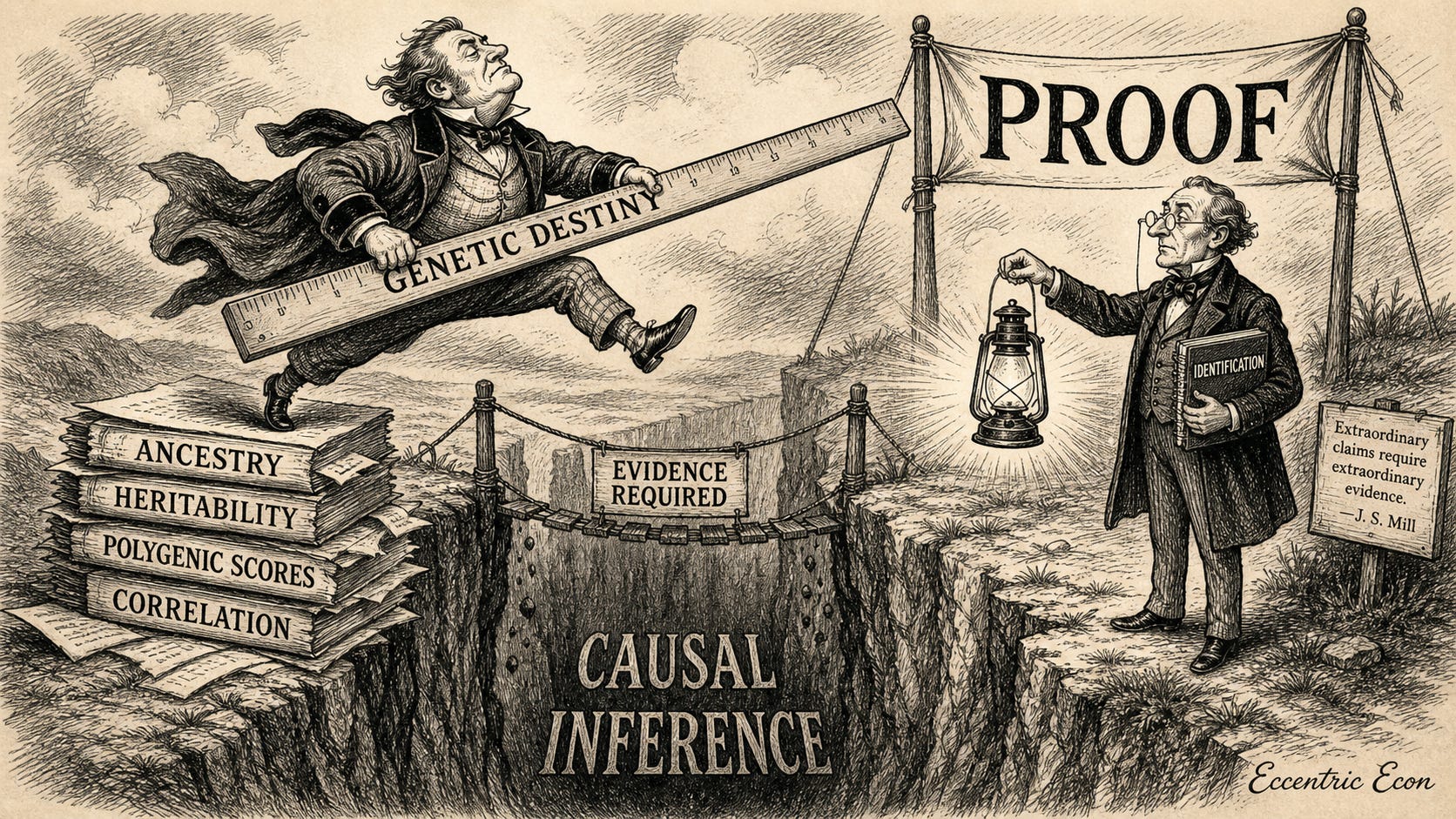
Richard Hanania’s recent essay, “The Strange, Secret, Open Triumph of Race Science,” has the shape of a scientific argument. It invokes ancient DNA, Neanderthal ancestry, recent natural selection, genome-wide association studies, and David Reich’s work on population history. But its central claim does not emerge from that evidence. It is inserted between the lines.
The key move is familiar: human populations differ genetically; intelligence is partly heritable; therefore contemporary racial gaps in intelligence and behavior probably reflect inherited differences, and ordinary racial stereotypes are probably rough descriptions of biological reality.
That is not how causal inference works. It is not how behavioral genetics works. And it is especially not how a careful political scientist or economist should reason about outcomes produced by a complicated interaction of family background, institutions, schooling, health, exposure, incentives, discrimination, neighborhood effects, culture, and genes.
A brief disclosure is appropriate here. Like Hanania, I am neither a biologist nor a geneticist. I am an economist; he is a political scientist. But this is not a dispute in which one needs to claim specialist authority in population genetics to notice a basic analytical problem. When an argument moves from observed group differences, to the heritability of a trait within groups, to a genetic explanation for differences between groups, it has made a causal inference. And causal inference is not a decorative feature of social science. It is the work
Hanania is right about one narrow point: it is not scientifically coherent to say that every possible average genetic difference among human populations is impossible in principle. Population structure exists. Migration, isolation, admixture, mutation, drift, and selection have shaped human genomes.
Fine. Now comes the part he skips: none of that establishes the genetic source of observed racial gaps in cognition, educational attainment, income, criminal justice contact, occupational sorting, or any other socially salient outcome. The difference between “possible” and “demonstrated” is the entire issue.
The Evidence Does Not Say What He Says
Start with the most important distinction: Ancestry is real. Race is a historically contingent social classification that bundles people with varied ancestries into broad, shifting categories.
A geneticist can identify patterns of shared ancestry, often with considerable precision. But that does not mean that census categories such as “Black,” “White,” “Asian,” or “Hispanic” are discrete natural types, much less that they can bear the theoretical weight Hanania places on them. The National Academies has explicitly advised researchers not to use race as a proxy for human genetic variation, because race is a social concept and is often a misleading, inaccurate, and harmful substitute for ancestry in genetic research.
This is not an argument that “genes do not matter.” Genes obviously matter. It is an argument against an illicit mapping:
Genetic population structure → racial hierarchy in socially valued traits.
The implication does not follow.
Consider the passage in which Hanania treats the discovery of Neanderthal and Denisovan ancestry as a watershed for racial hereditarianism. It is fascinating science. It tells us that modern human populations have different histories of admixture with archaic hominins. It also tells us almost nothing by itself about contemporary racial intelligence gaps.
A Tibetan high-altitude adaptation associated with Denisovan-derived DNA is a successful example of linking a genetic variant to a biologically intelligible phenotype under a concrete environmental pressure. Oxygen availability at high altitude is not mysterious. The phenotype is measurable. The mechanism is testable.
Compare that to the claim that broad U.S. racial categories differ genetically in “cognitive ability” in a way that explains test-score gaps. There, the phenotype is entangled with education, language, health, stress, childhood development, test construction, peer effects, wealth, and the social organization of opportunity. The causal task is much harder. One cannot solve it by gesturing toward ancient DNA.
Heritability Is Not a Group Explanation
Hanania’s essay depends heavily on a common misunderstanding: if intelligence is heritable within a population, then average differences between populations are likely genetic. That conclusion is not merely premature. It is a category error.
Heritability is a statement about variation within a specified population, in a specified environment, at a specified time. It does not report the proportion of an individual’s trait that “comes from genes.” Nor does it decompose a difference between group averages into genetic and environmental components.
This is easier to see with height. Height is highly heritable within many contemporary populations. Yet average height has changed sharply over time in some countries, too rapidly to be explained by genetic evolution. Nutrition, disease burden, prenatal care, childhood health, and living conditions matter a great deal. A society can have high within-group heritability and large environmentally produced differences in average outcomes across social groups or generations.
The same logic applies to cognitive test scores. A recent analysis in Proceedings of the National Academy of Sciences makes the point directly: even perfect knowledge of within-group heritability provides no information, by itself, about the heritability of a difference between groups. Without environmental control or a well-specified causal design, one cannot separate aggregate group differences into genetic and environmental components.
This should be elementary for economists. We do not infer the causal effect of schooling from the fact that education predicts income. We worry about selection, omitted variables, reverse causation, family background, and institutional context. Yet when the subject is race and IQ, Hanania suddenly asks us to accept a much weaker standard: visible group differences plus a plausible genetic story.
That is not rigorous skepticism. It is credulity with a scientific vocabulary.
“Just Look Around” Is Not Identification
Hanania says that people who deny systematic psychological or cognitive differences among populations can be refuted by “simply looking at human beings.” This is perhaps the most revealing sentence in the essay.
“Simply looking” is not a research design.
Suppose we observe that one group is overrepresented in a profession, another in a sport, another in imprisonment, another in college completion, and another in a standardized-test distribution. What have we learned? We have learned that outcomes differ. We have not learned why.
Behavioral economics should make this obvious. People respond to incentives and constraints. They are shaped by defaults, social expectations, scarcity, stress, information, and institutions. A child’s cognitive development is not formed in a vacuum. Prenatal conditions, lead exposure, sleep, nutrition, school quality, parental time, neighborhood safety, family income volatility, discrimination, trauma, and access to medical care all plausibly affect measured outcomes.
None of this requires a romantic claim that every person has identical talents or that all group distributions must be equal. It requires only the modest proposition that observed disparities do not explain themselves.
If a bank finds that loan repayment differs across neighborhoods, it does not get to announce a genetic explanation because creditworthiness has some heritable correlates. It must identify mechanisms. Are applicants facing different interest rates? Different labor markets? Different wealth cushions? Different exposure to shocks? Different underwriting practices? A competent empirical researcher begins there.
Race-hereditarian argument often works backward. It begins with the outcome, adds the indisputable observation that humans have evolved, and declares the causal work mostly finished.
The Polygenic-Score Problem
Hanania also treats the advance of genomic research as though it has dissolved the empirical obstacles. In fact, modern genomics has clarified why his confidence is misplaced.
Polygenic scores combine many genetic variants into an estimated predictor for a complex trait. They can be useful in some contexts, particularly when they are developed and validated in similar populations. But their predictive accuracy often declines substantially when applied across genetic ancestries. That limitation is known as the portability or transferability problem.
An eLife study found that polygenic-score prediction varies not only between ancestry groups but also within ancestry groups according to characteristics such as age, sex, and socioeconomic status. A 2024 review likewise notes weaker predictive performance between populations defined by genetic ancestry and even within some ancestry-defined subgroups.
Why does this matter? Because Hanania wants to move from associations in genetic data to claims about genetic causes of differences between populations. But associations can reflect population stratification, nonrandom mating, gene–environment correlation, and indirect genetic effects.
Here is a simple illustration. Children inherit genes from their parents. They also inherit environments partly shaped by their parents: books in the house, school choices, conversational styles, neighborhoods, financial stability, and social networks. If a genetic variant is correlated with parental education, a polygenic score may predict educational outcomes partly because it tags an environment parents created, not because the variant directly causes the child’s outcome.
That is not a speculative concern. A Nature Communications study estimated that indirect, environmentally mediated genetic effects accounted for roughly 36 percent of the population association for a cognitive polygenic score and 40 percent for a noncognitive score across the designs and cohorts studied.
This is not an argument that the direct genetic component is zero. It is an argument that the association is not a clean causal coefficient. A behavioral economist might put it this way: the measured “genetic effect” can bundle an individual’s inherited variants with the institutional and familial environment correlated with those variants. Treating that bundle as a racial genetic ranking is a spectacularly bad identification strategy.
The Flynn Effect Should Humble Everyone
There is another stubborn fact that should make grand hereditarian claims much less comfortable: average IQ test performance has changed across generations far faster than genes could plausibly change.
A meta-analysis covering 285 studies found mean gains of 2.31 standard-score points per decade across the relevant studies. The precise magnitude and pattern of the Flynn effect vary by country, period, and test domain. But the basic lesson is unavoidable: measured cognitive performance is environmentally responsive on a large scale.
That does not prove that all group differences are environmental. It does prove that test scores are not fixed readouts of immutable inherited rank.
The right response to this fact is not to replace one totalizing story with another. It is to take interaction seriously. Genes matter. Environments matter. Genes help shape how people respond to environments; environments shape which genetic propensities are expressed and rewarded. Social institutions influence both the distribution of environments and the returns to traits.
That is messier than Hanania’s story. It is also closer to reality.
David Reich Is Not a Witness for the Prosecution
Hanania repeatedly invokes David Reich, but Reich’s actual caution is precisely what Hanania wishes to escape.
In his 2018 New York Times essay, Reich wrote that genetic differences aligning with some contemporary racial categories are real, while also emphasizing that claims connecting those differences to racist stereotypes lack evidence. He warned that current beliefs about the genetic nature of population differences are likely to be wrong in important respects.
Hanania regards this as evasive. It is not. It is what intellectual discipline looks like when the data do not support a stronger claim.
Reich’s work has transformed our understanding of population history. That does not make it a warrant for turning contemporary stereotypes into priors. To learn that Europeans are descended from the mixture of several ancient populations is not to discover a biological essence called “white intelligence.” Identifying selection on hundreds of alleles is not inferring a racial league table for cognition. And observing that a trait is polygenic does not make it easy to identify its between-group causes.
The American Society of Human Genetics puts the core point plainly: genetic variation is largely distributed along gradients, with substantial overlap among populations; the evidence does not support biologically distinct human racial subcategories or genetics-based rankings of populations.
Individualism Requires Better Science
Hanania closes by insisting that distributions overlap and that individuals should be treated as individuals. Good. But this is not a minor caveat attached to the argument. It should destroy the argument’s political and moral swagger.
If distributions overlap substantially, then group averages are poor tools for judging particular people. If the causal sources of group differences are unresolved, then using group membership as a proxy becomes still less defensible. If social outcomes are responsive to institutions and environment, then fatalism becomes both analytically lazy and politically costly.
The classical liberal case for equal treatment does not depend on pretending human beings are identical. It rests on a more robust insight: institutions should not assign rights, dignity, opportunity, or suspicion by using crude group averages as substitutes for information about individuals.
That insight also has a behavioral-economic foundation. Humans are prone to overgeneralize from salient cases, mistake correlations for causes, and turn descriptive patterns into moral narratives. We are particularly vulnerable when the pattern confirms an existing social stereotype. The appropriate corrective is not denial of human variation. It is a higher standard of evidence before declaring that a social hierarchy has been found in the genome.
Hanania’s essay asks readers to believe that a taboo has concealed an obvious truth. The more prosaic possibility is that he has mistaken an open scientific question for a settled result because he likes where the answer appears to lead.
There is no need to fear population genetics. There is also no need to let it be conscripted into a theory it has not demonstrated.
This is a sharp piece, and the move that does the real work is separating "heritable" from "genetically caused between groups," the point most of these arguments quietly skip.
The threads you cite fit together well: if polygenic scores already lose predictive power across ancestries, and indirect genetic effects are running at 36 to 40% of the signal for cognitive scores, then the within-group number was never a clean read on direct biology to begin with. The Flynn data just puts a clock on how fast the environment moves the same trait. Well argued.
Here's a fun thought experiment. Suppose I do genetic research, and I discover the exact genes that create higher intelligence. And .. black people have more of those beneficial genes than white people! So why do blacks score poorly on tests compared to whites? Because of environmental factors: 500 years of slavery, Jim Crow, and discrimination resulted in poverty, broken families, and drug abuse.
So that's the theory; can any racial geneticists prove it wrong?