

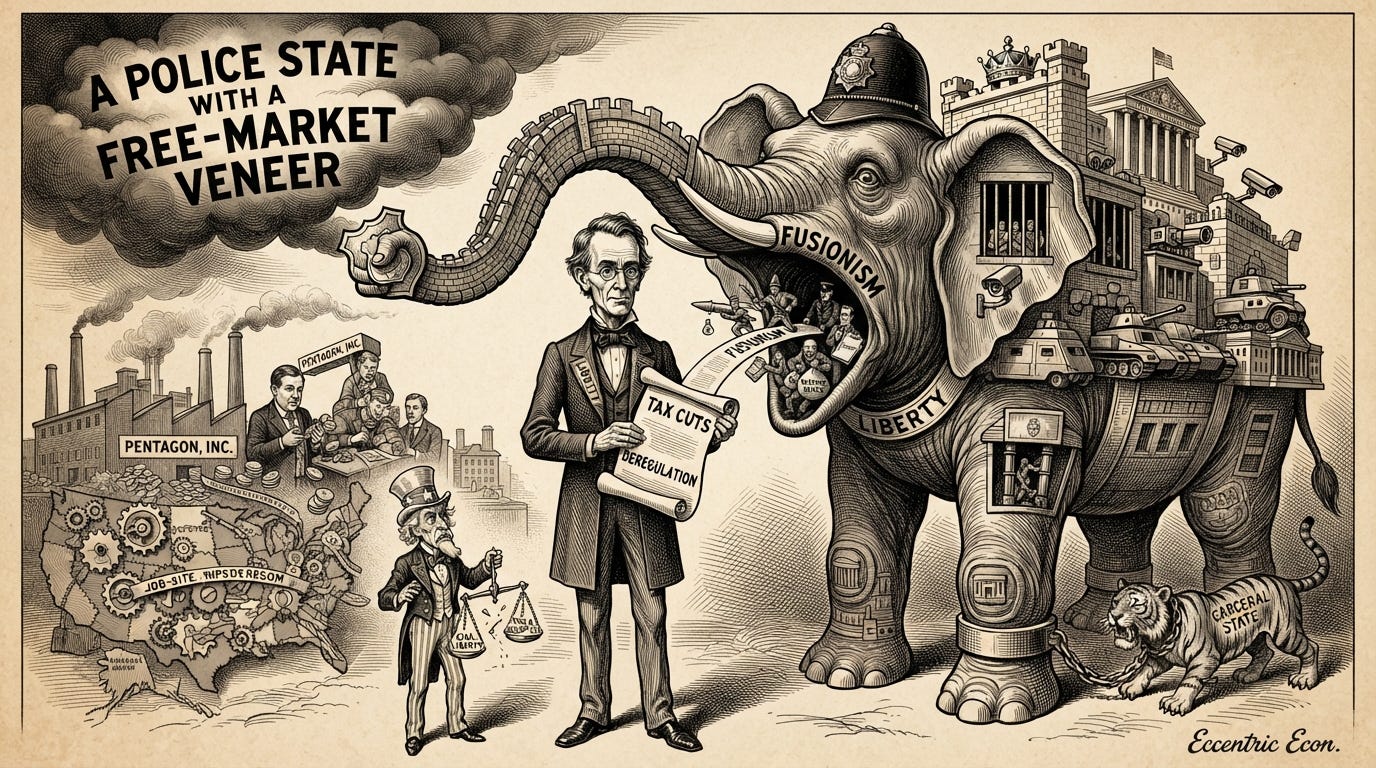
In a recent essay on The Volokh Conspiracy, Ilya Somin offers a measured, characteristically insightful autopsy of “fusionism;” the decades-long marriage of convenience between libertarians and traditional conservatives that anchored the American right from the late 1970s through the dawn of the 21st century. Somin is entirely correct in his skepticism regarding a potential revival of this alliance. He rightly identifies that MAGA nationalism and “postliberalism” have definitively evicted the old fusionist guard from the halls of conservative power, and he notes the inherent, fatal limitations of a philosophy that purports to love freedom while weaponizing the state to wage a catastrophic War on Drugs™.
Yet, as an institutional economist, I find Somin’s analysis misses the systemic core of why fusionism failed. Somin treats fusionism’s collapse as a tragic political eviction, or, to wit, a case of a decent, liberty-leaning ideology being overwhelmed by a sudden, unfortunate wave of populist nationalism and zero-sum protectionism.
It wasn’t an eviction. Oh, no; that would be much too simple, as well as innocuous and innocent. It was a predictable, path-dependent digestion.
Fusionism was not a noble experiment cut short by historical bad luck. It was an institutional trap meticulously designed to fail the very ideals it claimed to protect. By ignoring the core mechanics of public choice theory, bureaucracy, and regulatory capture, libertarians voluntarily entered into an alliance where they were structurally destined to be swallowed whole.
The Transactional Trap and Institutional Asymmetry
To understand the failure of fusionism, we must look past the abstract philosophy of Frank Meyer, who famously argued that liberty and virtue are mutually reinforcing, and look instead at the concrete balance of power within the alliance. As outlined by contemporary retrospectives, Meyer's model required a shared structural baseline. However, the fundamental flaw of the conservative-libertarian coalition was a massive, uncorrectable institutional asymmetry. Libertarians brought the economic theory, the policy papers, and the intellectual justifications for deregulation and tax cuts. Traditional conservatives, on the other hand, brought the actual, raw material of political leverage: a mass, highly organized voting base.
When you anchor a political movement to an asymmetrical transaction, the faction that controls the voter base and the raw machinery of state power will inevitably co-opt and digest the faction that merely provides the intellectual white papers. For the last fifty years, while libertarians were largely asleep at the wheel - distracting themselves with fringe, hyper-individualistic internet arguments about circumcision, cryptocurrency mechanics, and the age of consent - the state was quietly building a massive, self-perpetuating enforcement apparatus.
In the language of public choice theory, the primary output of any machinery ceases to be its stated mission and becomes, instead, the perpetuation and expansion of its own budget. The military-industrial complex, the prison-industrial panopticon, and the domestic carceral state did not care about the fine print of libertarian essays on spontaneous order. What they actually cared about, and cared about quite deeply, was longevity, funding loops, and regulatory capture. They found their perfect patrons in the social conservative movement, which rapidly learned that state coercion was an extraordinarily efficient tool for enforcing cultural homogeneity, dispensing corporate welfare to defense contractors, and projecting power.
Libertarians foolishly believed they could use the conservative movement as a vehicle to dismantle the administrative state. In reality, the conservative movement used libertarian economic rhetoric as a shield to mask the aggressive expansion of the state’s enforcement arms. The tax cuts and deregulation of the Reagan era, while achieving genuine economic gains, were paired with a massive, catastrophic expansion of the domestic police state via the War on Drugs™. Libertarians accepted this compromise, believing the fiscal wins outweighed the carceral losses. They failed to realize that once you build the physical architecture of a police state, it will eventually be turned on the market itself.
The Public Choice Mechanics of Defense Rent-Seeking
Nowhere is the institutional economists’ concept of path dependency more starkly visible than in the budgeting of the modern defense establishment. The Pentagon does not function as a defensive asset; it functions as a highly sophisticated, distributed corporate welfare program. When an institution logs its eighth consecutive financial audit failure, flatly admitting it cannot account for trillions of dollars in assets, a rational market observer should conclude that the system is fundamentally broken.
Yet, the funding increases never stop. This is because defense contractors have mastered the art of regional job dispersion - a deliberate strategy designed to maximize political capture.
When a major defense firm designs a new weapons system, it does not concentrate manufacturing in a single, efficient hub. Instead, it systematically distributes components, subassemblies, and supply chains across hundreds of different congressional districts. A fuselage is built in Ohio; the software is developed in California; the electronics are manufactured in Texas. By transforming corporate welfare into a localized employment program, defense contractors create an ironclad, bipartisan rent-seeking loop.
For a congressional representative, voting against a bloated defense appropriation bill is no longer an abstract debate over fiscal conservatism; it is a direct threat to manufacturing jobs in their own backyard. This geographic distribution creates absolute regulatory capture, ensuring that the defense bureaucracy scripts its own justifications, manufactures its own demand through threat-inflation, and completely immunizes itself against market-driven fiscal discipline.
Border Restrictions as Artificial Labor Caps and Inflationary Anchors
While libertarians spent decades cheering on abstract tax cuts, the state was quietly implementing one of the most destructive forms of economic central planning in human history: the militarization of the border. In modern right-wing discourse, this is shrouded in the intellectual gymnastics of “bordertarianism.” Proponents of this view claim that you can maintain a radical commitment to free markets domestically while supporting an aggressive, militarized federal apparatus to seal off the labor market from external competition.
From an institutional and economic perspective, this is a massive delusion. Border restrictions are, fundamentally, state-enforced artificial labor caps.
When the state intervenes to restrict the free mobility of labor, it deliberately distorts the natural pricing mechanisms of the market. In a healthy economy, price signals and labor mobility allow human capital to flow toward its most productive uses. By weaponizing a federal bureaucracy to choke off this supply, the state creates artificial labor scarcities in critical sectors like agriculture, construction, hospitality, and healthcare.
The immediate byproduct of an artificial labor shortage is structural inflation. When business owners cannot fulfill their labor needs due to regulatory barriers, production costs spike, supply chains bottleneck, and those increased costs are passed directly to the domestic consumer.
To maintain this artificial restriction, the state must expand a massive domestic panopticon. It requires the implementation of state surveillance systems like E-Verify, which transform every private business owner into an unpaid, conscripted agent of the federal enforcement apparatus. It mandates the use of eminent domain to seize private property along border corridors, strips native-born citizens of their civil liberties within legal border zones, and empowers a heavily armed federal bureaucracy with sweeping authority to detain, audit, and deport.
You cannot coherently claim to believe in free markets, capital mobility, and spontaneous order while simultaneously cheering for a centrally planned, taxpayer-funded surveillance state at the physical border. A border wall is not a defense of private property; it is a violent intervention in the market that distorts price signals and anchors structural inflation across the entire economy.
The Paleolibertarian Blueprint: Engineering the Nationalist Capture
The intellectual collapse that allowed some once-dedicated libertarians to buy into border and Pentagon conservative fever dreams didn’t happen by accident. It was explicitly engineered in the early 1990s through a deliberate, strategic pivot known as paleolibertarianism.
Following the collapse of the Soviet Union, a distinct faction of the libertarian movement -most prominently led by Murray Rothbard and Llewellyn Rockwell - grew deeply frustrated by their inability to build a mass political movement around pure, cosmopolitan free-market principles. Looking out at the political landscape, they realized that the libertarian movement had spent decades prioritizing fringe, hyper-individualistic intellectual arguments while alienating the broader public.
To solve this recruitment problem, Rothbard and Rockwell designed a conscious, transactional strategy: they would strip libertarianism of its cultural progressivism, its cosmopolitanism, and its support for open borders, and intentionally fuse it with the cultural grievances of the populist, paleoconservative right.
In essays like Rothbard’s infamous 1992 manifesto, Right-Wing Populism: A Strategy for the GOP, the blueprint was laid out with cold clarity. The goal was to reach the working-class voting base by tapping into reactionary cultural anxieties. To make this palatable to free-market theorists, paleolibertarians constructed elaborate philosophical workarounds.
Crucially, rather than utilizing Murray Rothbard's decentralization essays like Nations by Consent: Decomposing the Nation-State - which advocated for radical secession down to the neighborhood level - this strategy relied heavily on Hans-Hermann Hoppe’s alternative formulation. Hoppe argued that until all public property was fully privatized, the immigrant was an uninvited intruder, and the state had a legitimate obligation to act as a trustee of taxpayers' implicit property rights to restrict entry.
This was the ultimate intellectual capitulation. By offering an intellectual pass to a massive federal enforcement apparatus on the border, the paleolibertarians opened a Pandora’s box of state overreach. They validated the core premise of state-enforced cultural preservation, which naturally paved the way for accommodating other “national security” expenditures like the Pentagon.
The modern MAGA movement and the rise of “bordertarianism” are not distortions of the paleolibertarian blueprint; they are its literal, realized endpoint. The libertarian movement didn’t get blindsided by right-wing nationalism; its own intellectual leadership explicitly invited it in, thinking they could ride the populist tiger without getting swallowed by it.
The Technocratic Mirage of “Abundance Liberalism”
Recognizing the total collapse of the right, Somin suggests that libertarians should look elsewhere for allies, pointing toward “abundance liberals” as a cleaner alternative. Popularized by center-left commentators like Ezra Klein and Derek Thompson in their book Abundance, this framework focuses on supply-side progressivism: streamlining regulations, slashing NIMBY zoning laws, and fast-tracking permits to build housing, green energy, and physical infrastructure. As political scientist Gary Winslett notes in his framing of this “Up-Left” politics, the core thesis relies on leveraging growth, technological innovation, and regulatory optimization rather than standard progressive rationing or degrowth to solve cost-of-living crises. Somin notes that these liberals share our distaste for both left-wing and right-wing identity politics, are less paternalistic, and are far more open to immigration and trade than the nationalist right.
While an issue coalition with abundance liberals is incredibly valuable for housing and energy deregulation, substituting traditional conservatives for abundance liberals as a long-term ideological home ignores the profound technocratic traps inherent to that framework.
Abundance liberalism does not seek to limit the state; it seeks to optimize it. It is fundamentally a philosophy of industrial policy and state-directed capacity. Look no further than modern center-left industrial policy, such as the massive public expenditures, domestic sourcing mandates, and top-down project selections embedded in the CHIPS and Science Act. This framework skirts past the necessity of radical fiscal constraints and relies heavily on the administrative state to select corporate winners, fund massive subsidies, and direct economic outcomes from the top down. For an institutional economist, trading a conservative social planner who wants to centrally plan the labor market at the border for a progressive technocratic planner who wants to centrally plan manufacturing supply chains is a lateral move, not an escape velocity. It replaces cultural engineering with economic engineering, leaving the core machinery of the state entirely intact.
Somin warns that the left has its own dangerous, illiberal menace in the form of “democratic socialists,” though he argues they have not yet captured the Democratic Party to the degree that nationalists have captured the GOP. But let’s be perfectly candid: while public ownership of corporations is a total economic nonstarter, the Democratic Socialists of America (DSA) and the progressive left aren’t wrong about everything.
They are entirely correct about the dangers of the police-industrial complex, the carceral state, and the bloated, unaccountable nightmare that is the Pentagon. The only reason the DSA and the progressive left currently hold the monopoly on criticizing these glaring corporate-welfare rackets is because the libertarian movement spent half a century playing second fiddle to a conservative movement that worshiped the state’s monopoly on domestic and international violence.
Moving Beyond Institutional Capture
The lesson of the last fifty years is stark: Issue coalitions are rational. Long-run ideological mergers are insanely insane.
When libertarians lock themselves into permanent political marriages, they don’t change the trajectory of the state; they merely get digested by it. The institutional capture of the political right is now complete. As Somin points out, independent-minded representatives who previously attempted to challenge state overreach or protect fiscal sanity have been systematically targeted, primaried, or pushed out of office by nationalist factions. The remaining leadership is locked into a path-dependent spiral of threat-inflation and budget expansion designed to protect defense contractors and border enforcement monopolies.
We do not have to buy into the false binary offered by the modern political landscape. We do not have to choose between a progressive state that wants to control our commerce and a conservative state that wants to control our borders and bodies. As realists, we must recognize that we can severely curtail the Pentagon, strip away qualified immunity, and dismantle the police-industrial complex without demanding a total anarchic collapse of the government. We can starve these institutions of their funding, their legal shields, and their corporate rents through targeted, aggressive institutional reform.
But to do that, we have to stop putting our eggs into the fusionist basket. We have to stop lighting incense at the altar of conservative national security fever dreams, and we must realize that a police state with a free-market veneer is still, fundamentally, a police state. It is time to treat political alliances for what they are: temporary, transactional tools to achieve specific, limited, anti-statist goals. Anything more is an institutional suicide pact.