

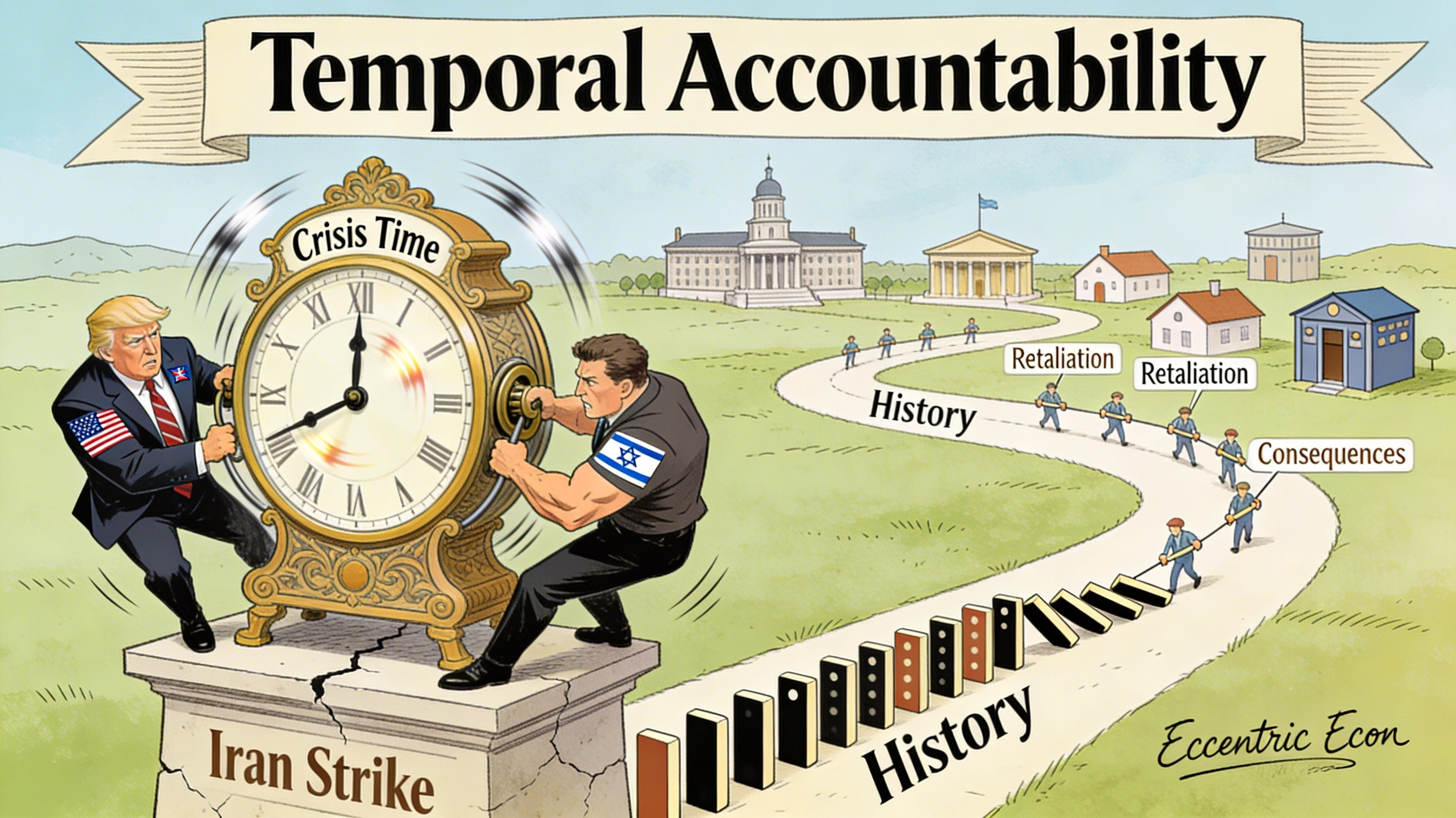
News of the U.S.–Israeli strike that killed Iran’s Supreme Leader, Ali Khamenei, produced an almost immediate demand for judgment. Within hours, commentators sorted the event into familiar categories: decisive success, reckless escalation, overdue deterrence, catastrophic gamble. Modern political discourse rarely tolerates ambiguity. Major events must be interpreted quickly, because democratic politics rewards clarity even when reality does not.
Yet foreign policy decisions unfold across timelines very different from those that produce them. Military and political leaders act under conditions of perceived immediacy—incomplete intelligence, alliance pressures, domestic expectations, and the ever-present fear that inaction today may produce disaster tomorrow. In crisis time, uncertainty feels indistinguishable from urgency. Choices appear compressed, alternatives narrow, and delay itself begins to look like risk.
History operates differently. The consequences that ultimately define such decisions emerge slowly: through institutional adaptation, succession struggles, regional responses, and second-order effects no planner fully controls. Actions taken in hours or days are evaluated over decades. By the time outcomes become visible, the officials who authorized the decision are often gone, replaced by successors tasked not with choosing the intervention but managing its aftermath.
The killing of Khamenei therefore presents less a question of immediate moral or strategic verdict than a problem of temporal accountability. Iran’s supreme leader was eighty-six years old, presiding over a political system already approaching an inevitable succession moment. Whether the strike prevented future instability or merely reshaped an ongoing transition cannot be known now—and may not be knowable for years. What appears necessary in crisis often looks contingent in retrospect.
Democracies nevertheless feel compelled to judge immediately. Praise and condemnation arrive long before consequences mature. The result is a recurring mismatch between the time horizon of decision and the time horizon of evaluation—a structural tension at the heart of modern foreign policy.
The question raised by the Iran strike is therefore larger than the strike itself: how political systems should assess irreversible decisions whose true effects belong to the future rather than the present.
Crisis-Time Decision Logic vs Historical-Time Evaluation
When leaders authorize military action, they do so within a distinct temporal frame. Crisis time operates according to its own logic—compressed, urgent, dominated by the immediate threat of irreversible harm. Intelligence reports arrive incomplete. Allies demand reassurance. Domestic audiences expect resolve. Bureaucratic institutions generate momentum toward action. And beneath it all sits the gnawing fear that passivity today will be indistinguishable from negligence tomorrow.
Decision-makers do not experience this environment as calm deliberation over probabilities. They experience it as urgency made institutional. The question is rarely “should we act?” but “can we afford not to?” The very structure of crisis rewrites the calculus of risk. Delay becomes its own form of hazard. Inaction acquires moral weight. Uncertainty transforms into a reason for movement rather than restraint.
In this environment, the strike on Khamenei’s compound appears as one decision among a constrained set of alternatives, each carrying its own dangers. Allow Iran’s nuclear program to advance further? Risk appearing weak to regional adversaries? Leave Israeli security concerns unaddressed? Permit domestic critics to frame the administration as passive in the face of escalating threats? Each path carries visible costs; the costs of action remain hypothetical.
But historical time operates under different rules entirely. The consequences that ultimately define foreign policy decisions do not arrive on the schedule of crisis. They emerge through:
• Regional actors recalibrating strategies in response to new power distributions
• Iranian political institutions adapting to the vacuum left by decades of centralized leadership
• Successor administrations inheriting commitments they did not authorize
• Second-order effects—refugee flows, economic disruptions, alliance realignments—that no planner fully anticipated
• Domestic political systems reinterpreting the decision’s meaning as new information arrives
What appears unavoidable under crisis conditions frequently reveals itself as contingent when evaluated years later. The intelligence that seemed compelling proves incomplete. The threat that appeared imminent was perhaps containable through alternative means. The action that promised to resolve uncertainty instead produced new forms of instability.
This is not hindsight bias. It is the predictable result of evaluating decisions made under compressed timelines using evidence that only becomes available across extended periods. The officials who authorized the joint operation acted on the information and incentives available in late February 2026. History will judge them using information that accumulates over the next decade.
The temporal mismatch is structural, not accidental. Democratic political systems demand responsiveness to immediate threats. Historical evaluation demands patience for outcomes to mature. These two timelines rarely align.
The strike on Khamenei therefore illustrates not merely a strategic decision but a temporal one. Leaders acted within crisis time, but the meaning of that action now migrates into historical time, where evaluation proceeds according to entirely different standards.
The Illusion of Necessity
One of the more analytically troubling aspects of the Khamenei strike involves what it intervened in, not merely what it accomplished.
Iran’s Supreme Leader was eighty-six years old. He had held ultimate authority over Iranian political life since 1989, longer than many current voters have been alive. The question of succession was not hypothetical—it was inevitable. Iranian political elites had been maneuvering for position for years, aware that the transition would arrive regardless of external intervention. The Assembly of Experts, charged under Iranian law with selecting the next Supreme Leader, already faced the challenge of managing this process.
The strike did not prevent a succession crisis. It accelerated one.
Democracies frequently mistake acceleration for resolution because acceleration produces visible action, while patience produces only uncertainty.
This distinction matters analytically because acceleration and prevention are fundamentally different operations. Prevention removes a problem. Acceleration reshapes a transition already underway, altering its timing and character but not its underlying inevitability. The political and institutional dynamics that would have accompanied Khamenei’s death from natural causes—elite competition, factional realignment, uncertainty over institutional continuity—will now unfold under the shadow of foreign military action.
This raises uncomfortable questions:
• Did the strike solve a problem that required immediate resolution, or intervene in a process that was progressing toward resolution through internal dynamics?
• Does foreign intervention in a predictable succession make the resulting outcome more stable, or does it introduce new sources of instability by appearing to vindicate hardline narratives about Western hostility?
• If the goal was to create conditions for Iranian political reform, does leadership decapitation through military action make reform more or less likely than allowing internal succession pressures to run their course?
States frequently reinterpret optional actions as inevitable ones after the fact. Once irreversible decisions have been made, political systems generate narratives that render those decisions necessary in retrospect. The psychological and political incentives to do so are overwhelming—acknowledging that a major foreign policy action was optional rather than required opens space for criticism that officials acted recklessly or prematurely.
But necessity is a claim about alternatives. To say an action was necessary is to say no other course was viable. In the case of Khamenei, this claim is difficult to sustain. Iran’s succession was coming regardless. The choice was not whether to address succession but whether to force its timing through external military action.
That choice may prove correct. It may generate outcomes that justify the risks undertaken. But it was, structurally, a choice—not a compulsion imposed by circumstances beyond control.
Temporal Distribution of Responsibility
One of the most consequential features of modern foreign policy is how responsibility migrates across time.
Executives authorize military action in a compressed decision window, often hours or days. Military institutions execute the operation within a similarly brief timeframe—the initial U.S.-Israeli strikes reportedly involved nearly 900 individual targets hit within twelve hours. Political praise or condemnation follows almost immediately, structured around the binary logic of success versus failure.
But the consequences emerge across a vastly longer timeline. Iranian political institutions must now navigate a succession process under external pressure. Regional actors—Saudi Arabia, Turkey, Iraq—will recalibrate strategies based on the new distribution of power and perceived Western willingness to intervene directly. Refugee flows, economic disruptions, and proxy conflicts will unfold over years. Future U.S. administrations will inherit the strategic commitments and regional relationships shaped by this action, regardless of whether they would have authorized it themselves.
This creates a fundamental misalignment between decision and outcome. Those who bear the consequences are often:
• Successor administrations forced to manage commitments they did not choose
• Regional civilian populations affected by instability they did not cause
• Military personnel deployed to address follow-on crises
• Future voters who will evaluate candidates based on conditions created by decisions made before they could participate politically
Democratic accountability assumes that those who authorize decisions will face political consequences for their outcomes. But in foreign policy, the timeline of consequences frequently exceeds the timeline of political careers. Officials retire, administrations change, and public attention shifts to new crises before the full effects of prior decisions become apparent.
This temporal distribution of responsibility creates predictable distortions:
1. Frontloading benefits, backloading costs. Leaders have strong incentives to pursue actions that generate immediate political rewards (appearing strong, reassuring allies, demonstrating resolve) while deferring costs that emerge slowly (regional instability, long-term commitments, unintended escalation).
2. Asymmetric information. Decision-makers possess maximal information at the moment of choice—intelligence assessments, military capabilities, diplomatic context. Voters and future evaluators must judge the decision using incomplete information, often relying on selective disclosures and retrospective narratives.
3. Narrative consolidation. Once action is taken, political systems generate success stories to maintain coalition stability and justify resource commitments. Early declarations of victory serve institutional functions—reassuring allies, deterring adversaries, maintaining domestic support—but arrive before outcomes can be observed.
The result is a systematic disconnect between the incentives that produce foreign policy decisions and the accountability mechanisms that democratic systems rely upon to discipline those decisions. Presidents and prime ministers face electoral consequences based on public perceptions of success or failure, but those perceptions form long before outcomes mature.
This is not a problem that better institutional design can fully resolve. The temporal gap between action and consequence is inherent to foreign policy. What can be improved is democratic systems’ awareness of this gap and willingness to build accountability mechanisms that operate across longer timescales than election cycles.
Power Vacuums and Institutional Collapse
Temporal accountability becomes most difficult precisely at moments of political transition. Leadership removal produces immediate observable outcomes, while institutional adaptation unfolds slowly, often invisibly, across years.
The historical pattern is clear enough to warrant concern, even if specific predictions remain impossible.
Removing centralized leadership from authoritarian systems does not automatically produce stable transitions. It removes the institutional mechanism that previously coordinated elite behavior and suppressed internal competition. What follows depends less on the act of removal than on the underlying strength of institutions, the distribution of factional power, and the capacity of successor elites to establish new equilibria.
In Iran’s case, several trajectories appear plausible:
• Consolidation around a new leader. The Assembly of Experts moves quickly to install a successor—possibly Khamenei’s son Mojtaba, possibly a consensus candidate from the clerical establishment—who restores centralized authority and maintains continuity with prior policies.
• Managed reform. Moderate factions use the succession moment to negotiate reforms that reduce the Supreme Leader’s authority, shifting power toward elected institutions and creating space for political liberalization without full regime collapse.
• Fragmentation. Elite competition produces paralysis. The Revolutionary Guard, clerical establishment, and elected government pursue competing agendas. Iran enters a period of institutional uncertainty where no single actor can coordinate national policy effectively.
• Escalation. Hardline factions interpret the strike as vindication of their worldview, consolidate power, and pursue aggressive regional policies to demonstrate strength and regime continuity. Retaliatory strikes against U.S. bases and Israeli targets intensify rather than diminish.
None of these outcomes was determined by the strike itself. The action created conditions—removed a central coordinating figure, forced accelerated succession, provided narratives for competing factions—but the ultimate trajectory depends on Iranian institutional capacity and elite behavior in the coming months.
This uncertainty is precisely the point. Leadership decapitation does not solve the problem of authoritarian governance. It creates a different problem: managing the transition from centralized authority to whatever comes next. Sometimes that transition produces improvement. Sometimes it produces chaos. Sometimes it produces a more hostile version of the prior regime.
The relevant historical examples offer limited comfort:
• The removal of Saddam Hussein created conditions for sectarian conflict that lasted over a decade and produced ISIS
• The fall of Gaddafi left Libya without functioning central authority, creating space for civil war and regional proxy conflicts
• The collapse of authoritarian regimes in Egypt and Syria produced, respectively, a return to military rule and a devastating civil war
These cases do not predict Iran’s trajectory. Iran has stronger institutions, deeper administrative capacity, and a different factional structure than Iraq, Libya, or Syria possessed. But they illustrate the general principle: removing leadership creates opportunity for change, but change can take multiple forms.
The analytical lesson is not that intervention always fails. It is that intervention transfers the locus of uncertainty from “what happens if we don’t act” to “what happens after we act.” Both involve risk. The question is whether democratic systems have the patience and institutional capacity to manage the second kind of risk, which unfolds slowly and requires sustained attention across multiple political cycles.
Post Hoc Justification and the Psychology of Irreversibility
Within hours of confirmation of Khamenei’s death, political leaders across Washington and Jerusalem declared the operation a success. This response was predictable—not because outcomes were already visible, but because irreversible actions create psychological and political pressure to affirm their correctness immediately.
This is not cynicism. It is institutional logic.
Once major foreign policy decisions become irreversible, political systems face strong incentives to generate success narratives quickly. These narratives serve multiple functions:
1. Coalition maintenance. Military operations require buy-in from multiple actors—intelligence agencies, military branches, allied governments, legislative bodies. Early declarations of success help maintain that coalition by framing the action as validated and justified.
2. Domestic reassurance. Publics tolerate foreign policy risk more easily when leaders project confidence. Acknowledging profound uncertainty after irreversible action invites criticism and undermines support for follow-on commitments.
3. Bureaucratic legitimacy. Agencies that planned and executed the operation have institutional interests in framing it as successful. Their future budget allocations, strategic relevance, and internal morale depend partly on public perception of competence.
4. Deterrent signaling. Adversaries and allies alike observe how states characterize their own actions. Projecting confidence—even if privately officials harbor doubts—serves strategic communication functions that admissions of uncertainty would undermine.
Post hoc justification does not primarily persuade opponents; it stabilizes supporters who must continue operating within the consequences of the decision.
The result is a predictable temporal pattern: immediate congratulation, followed by cautious wait-and-see assessments as complications emerge, followed eventually by either vindication or revisionism depending on how events unfold.
But this pattern creates a problem for democratic accountability. Judgment arrives before evidence exists. Officials declare success when the only observable fact is that the target was killed and immediate retaliation remains limited. Whether the operation achieves its broader strategic objectives—regional stability, Iranian moderation, enhanced deterrence—cannot possibly be known yet.
Early celebration is therefore not an assessment of outcomes. It is a social and political act designed to shape expectations and maintain support during the period of maximum uncertainty. This is rational behavior for political leaders operating under democratic constraints. But it makes retrospective evaluation more difficult, because the initial framing becomes embedded in public memory and subsequent developments must overcome that anchoring effect.
Consider the counterfactual: if officials had responded to news of Khamenei’s death by saying “we have achieved the immediate military objective; whether this produces long-term strategic benefits remains to be seen,” that response would be analytically more honest. It would also be politically untenable. Publics demand confidence from leaders, especially after irreversible actions involving military force.
The practical result is that foreign policy debates often occur in reverse chronological order. Instead of deciding first and evaluating later, political systems affirm decisions immediately and only revisit that affirmation if subsequent events become impossible to reconcile with initial success narratives. By that point, officials have moved on, public attention has shifted, and accountability mechanisms have weakened.
This does not make early declarations of success dishonest. It makes them premature. The distinction matters for how democratic systems should approach foreign policy evaluation. If the goal is to improve decision-making over time, evaluation must occur on a timeline that allows consequences to materialize—not on the timeline that political incentives demand.
Democratic Guardrails Under Foreign Policy Shock
One of the least discussed consequences of major foreign policy actions is how they temporarily reorganize the internal balance of democratic institutions.
War and crisis compress deliberation. When events move quickly and threats appear immediate, the normal processes of legislative oversight, public debate, and bureaucratic review begin to look like obstacles rather than safeguards. Executives gain discretion. Dissent becomes risky. Intelligence assessments acquire outsized influence. And constitutional checks that function adequately during peacetime erode under the pressure of perceived emergency.
This is not unique to any particular administration or political system. It is a recurring pattern in how democracies respond to external threats. The urgency that justifies action also justifies bypassing the institutional friction designed to prevent hasty decisions.
The current situation illustrates the dynamic clearly:
• Congressional authorization for the strike, if it occurred at all, happened through expedited processes that minimized deliberative debate
• Intelligence assessments that justified the operation remain classified, preventing external evaluation of their quality or completeness
• Dissenting views within the bureaucracy, if they existed, were either overruled or never reached public discussion
• Media coverage focused overwhelmingly on operational success rather than strategic rationale, partly because operational details were immediately visible while strategic outcomes remain speculative
None of these features indicate malice or conspiracy. They reflect how institutions behave under conditions of perceived crisis. But they create conditions where mistakes become harder to prevent and easier to entrench.
The deeper problem is that foreign crises tend to be self-reinforcing. Once military action begins, any call for restraint or reconsideration gets reframed as undermining national security during a critical moment. This rhetorical move is extraordinarily powerful in democratic politics. It transforms substantive disagreement over strategy into questions about loyalty, resolve, and willingness to support the nation under threat.
The result is a temporary reorganization of constitutional balance. Executives expand discretion. Legislatures defer. Courts avoid interference in matters classified as national security. And civil society actors who raise concerns find themselves marginalized as unserious or unpatriotic.
This reorganization is usually temporary. As the immediate crisis recedes, normal institutional checks reassert themselves. But the decisions made during the period of compressed deliberation remain in place, shaping the strategic environment that future administrations must navigate.
Democracies rarely abandon guardrails permanently. Instead, crises normalize temporary exceptions that gradually redefine what counts as ordinary executive authority.
This creates a ratchet effect. Each crisis expands executive discretion slightly. Some of that expansion persists even after the crisis ends. Over time, the normal baseline of executive power in foreign affairs drifts toward greater autonomy and reduced oversight.
The Iran strike will likely follow this pattern. In six months, public attention will have shifted to other issues. In two years, the operation will be a settled fact, debated only among specialists. In five years, the consequences will be unfolding in ways that bear little resemblance to current expectations. And the institutional precedent—that executives can authorize strikes on foreign leaders with minimal deliberation during perceived crises—will be absorbed into the background assumptions of American foreign policy.
This is how democracies gradually lose their capacity for restraint. Not through dramatic ruptures, but through accumulated precedents established during moments when restraint appeared too risky to tolerate. Foreign policy shocks do not merely reshape external environments; they temporarily reorganize the temporal structure of democratic decision-making itself.
Conclusion: The Time Problem in Democratic Judgment
The killing of Ali Khamenei will be evaluated many times, by many actors, using many different standards. Immediate assessments focus on operational success: the target was eliminated, allied coordination functioned effectively, and initial retaliation remained limited. Future assessments will focus on strategic outcomes: whether the strike enhanced regional stability, how Iranian succession unfolded, and whether long-term U.S. interests were advanced or compromised.
These assessments will occur on different timelines and reach different conclusions. That divergence is not a failure of analysis. It is the predictable result of evaluating decisions whose consequences unfold slowly using political systems designed to respond quickly.
The central difficulty is not deciding under uncertainty—that is unavoidable in foreign policy. The difficulty is evaluating decisions whose consequences will only become visible long after the decision-makers are gone.
This temporal gap creates recurring problems for democratic accountability:
• Leaders face incentives to pursue actions that generate immediate political benefits while deferring costs to future administrations
• Voters must judge decisions based on incomplete information and provisional outcomes that may later be reversed
• Institutional checks designed to prevent hasty action erode precisely when they matter most
• Success narratives form before outcomes can be observed, creating anchoring effects that distort later evaluation
None of these problems can be fully solved. The mismatch between crisis-time decision-making and historical-time evaluation is structural. But democracies can improve how they manage this mismatch by:
1. Resisting the demand for immediate judgment. Foreign policy decisions should be evaluated provisionally in the short term and revisited as evidence accumulates. Early declarations of success should be treated skeptically, not because officials are dishonest but because outcomes have not yet materialized.
2. Strengthening institutional checks during crises. The moments when executive discretion feels most necessary are precisely when oversight matters most. Democracies that bypass deliberation during emergencies store up problems for later.
3. Distinguishing acceleration from prevention. Not every intervention prevents disaster. Some merely reshape transitions already underway. That distinction should inform both decision-making and evaluation.
4. Acknowledging irreversibility honestly. Once major actions are taken, political systems face pressure to vindicate them. Acknowledging uncertainty after irreversible decisions does not undermine support—it creates space for course corrections when early assumptions prove incorrect.
The Iran strike raises a question that extends far beyond Iran: how should political systems evaluate decisions whose consequences will unfold across timelines longer than electoral cycles, longer than individual careers, and longer than public attention spans?
That question has no clean answer. But asking it is the first step toward building foreign policy institutions capable of learning from experience rather than repeating mistakes dressed up as necessity.
Democracies cannot avoid acting under uncertainty. Nor can they postpone judgment indefinitely. But the temptation to render immediate verdicts on irreversible decisions remains one of the greatest sources of foreign policy error. The killing of Ali Khamenei will eventually be understood not through the clarity of the moment that produced it, but through the slow accumulation of consequences no participant could fully control.
The enduring question is therefore not whether leaders acted decisively, but whether democratic societies possess the patience to judge decisiveness only when history, rather than crisis, has rendered its verdict.
This essay is part of an ongoing series on temporal accountability in democratic governance.
Rereading after publication, I’m realizing the framework here owes an unintentional intellectual debt to Robert Higgs — particularly the idea that crisis decisions are made under compressed incentives but evaluated across much longer institutional timelines.
Thank you for this useful framework within which current events can be more carefully considered.