

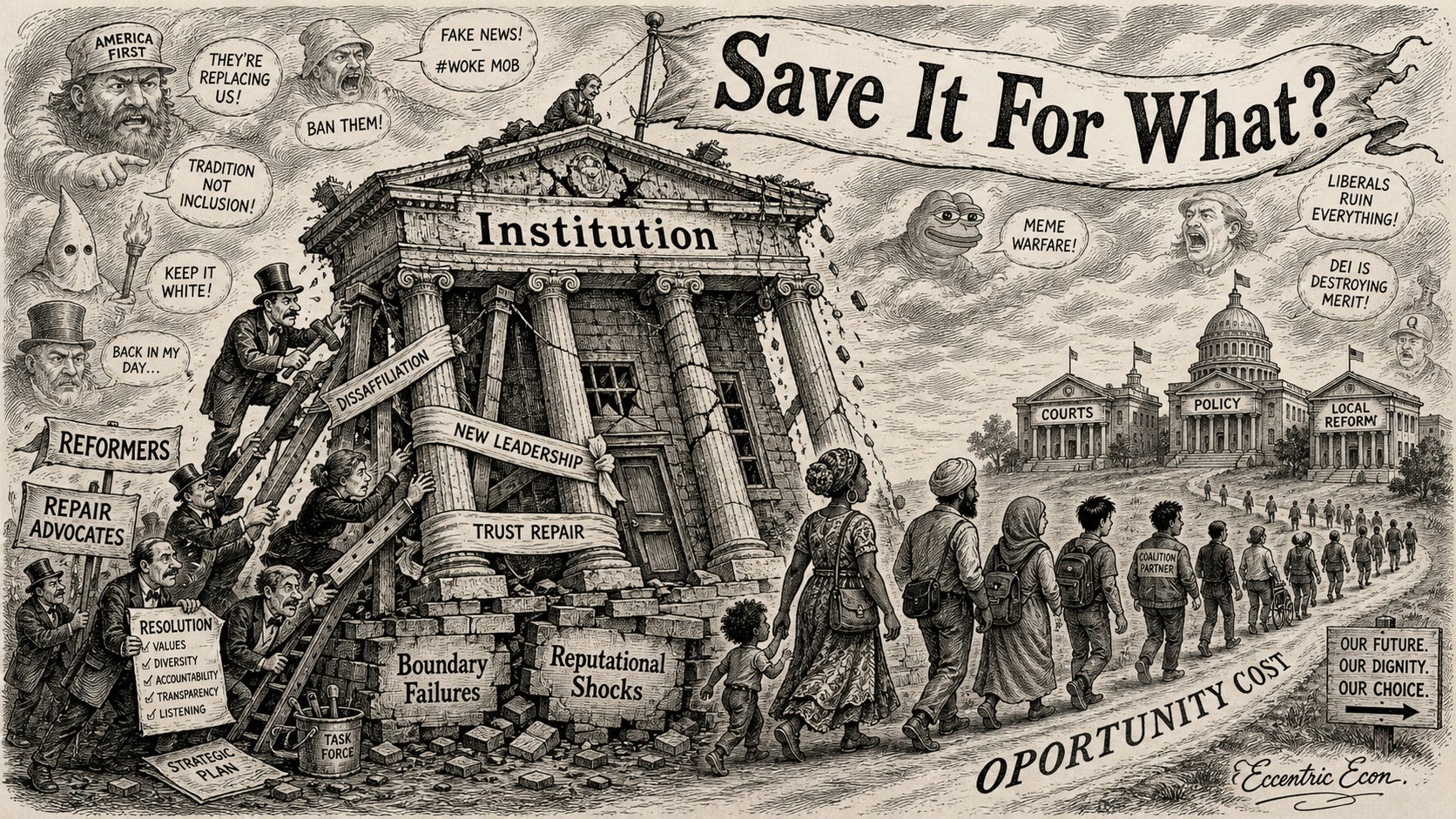
The newly elected Libertarian National Committee has voted to disaffiliate the Libertarian Party of New Hampshire. Some former members and outside observers are treating this as overdue institutional correction. Others have moved quickly to a different conclusion: the worst actors are gone, the adults are back, and critics should return.
A simpler question cuts through the sentimentality: save it for what?
The argument here is not about settling scores or relitigating every internal fight in the Libertarian Party. It is about institutional timing. Institutions are not Markovian systems with negligible transition costs. In plainer language: institutions remember. The route taken changes what futures remain available. A delayed repair after a reputational cascade is not equivalent to prevention, and it is not equivalent to timely boundary enforcement when the first signals appeared. Once an institution has moved through a reputational shock, subsequent corrections operate on changed terrain.
The path matters
Think of an institution as a sequence of states over time: I(0), I(1), I(2). At I(0), an organization may be flawed, ideologically messy, and strategically inconsistent, yet still possess real institutional capital. In the Libertarian Party’s case, that meant ballot-access investments, some coalition breadth, local activists, candidate pipelines, and years of outreach that made the party legible to people outside its core subculture.
Then comes the first transition: I(0) → I(1). This is the phase of boundary failure and reputational shock. After that comes I(1) → I(2), the phase of delayed correction, when reformers try to restore norms after the damage has already compounded.
The key proposition is straightforward:
Let institutional evolution be represented as a simple sequence of states I(0) → I(1) → I(2). Here, I(0) denotes the pre-cascade equilibrium, with whatever mix of capital, coalitions, and ambiguity it initially possessed. I(1) is the phase of boundary failure and reputational shock. I(2) is the delayed corrective phase, when reformers finally attempt repair. The central error of repair discourse is treating I(2) as approximately equivalent to a restored I(0), rather than as a different state constrained by the path already taken.
The path matters because institutions carry memory. Actor composition changes. Coalition partners update. The media builds narratives that persist. Volunteers and donors recalculate. Once the institution traverses I(1), the future set of feasible equilibria narrows. The organization is no longer choosing between the old institution and a repaired version of it. It is choosing among post-cascade futures burdened by the costs of the path already taken.
In ordinary language: one does not burn down part of the house, live in the smoke for several years, and then call the installation of a fire extinguisher a return to the original structure.
What changed in the LP
The Libertarian Party’s I(1) phase had at least two visible dimensions. The first was leadership and ideological shift. The Mises Caucus consolidated control of the national party, and the party’s tone and identity moved toward a more culture-war-oriented, paleolibertarian posture. During this period, long-standing anti-bigotry language was removed from the platform, and positions associated with immigrant outreach and coalition maintenance became less institutionally secure.
The second was reputational shock. The party and some of its state affiliates generated repeated national controversy through social-media rhetoric, internal signaling, and a style of provocation that attracted negative coverage well beyond the usual range of third-party politics. In New Hampshire, especially, inflammatory public messaging produced condemnations and helped fix the affiliate as a reputational liability not just internally, but publicly.
That distinction matters. At a certain point, an organization is no longer mainly managing internal governance. It is managing embedded public narrative. Once the scene becomes a meme, screenshots become archives, and every subsequent actor inherits them. The institution is no longer judged only by what it does next, but by what outsiders have already learned to expect from it.
Exit as Bayesian updating
This is where constituency costs become visible. A person can spend years doing minority recruitment, immigrant outreach, and coalition-building under one institutional understanding, only to discover that the institution has revealed a different equilibrium. The relevant fact is not simply that offensive statements were made. It is that the organization signaled what it would tolerate, reward, and normalize in public view.
That changes the calculation for people who had vouched for the institution. If those who were asked to enter the room look around and conclude that the room is not for them after all, their exit is not necessarily a tantrum or moral performance. It can be a straightforward Bayesian update on revealed institutional preference.
The room spoke. Some people heard an invitation to stay and fight. Others heard a different message and left. That decision may feel personal, but analytically it is about the recalculation of expected value under new information.
Why repair is harder than repair advocates assume
The current reform effort deserves to be described fairly. At the 2026 convention, delegates elected new national leadership, and the Libertarian National Committee moved to disaffiliate the Libertarian Party of New Hampshire. Those actions clearly signal that at least some delegates understand the reputational and organizational damage done during the prior period and want to impose boundaries that were not imposed earlier.
That is not meaningless. Ballot access matters. Party infrastructure matters. Electoral vehicles are real institutional assets and rebuilding them from scratch is costly.
But repair advocates often sneak in a much stronger claim than they defend. They assume that once the institution has corrected itself, trust should be restored on roughly the same timeline as the formal correction. That assumption underestimates temporal costs.
Institutional reputation typically exhibits destructive asymmetry. Trust and coalition breadth accumulate slowly through repeated signals but can be destroyed rapidly by a concentrated run of boundary failures. Repair efforts then operate under higher costs, narrower feasible sets, and altered actor composition compared to the conditions under which the original institutional capital was built.
Those costs are sticky and cumulative:
Reputational persistence: old headlines, screenshots, memes, and labels continue to circulate long after leadership changes.
Trust erosion: minorities, immigrants, coalition partners, donors, and volunteers do not update instantly just because a convention vote finally occurred.
Human-capital exit: competent actors leave, redirect time elsewhere, and become less willing to re-enter a damaged institution.
Path dependence: the composition of members, delegates, expectations, and feasible futures changes during the damaged phase, which means later leadership inherits a different organization than the one it claims to be restoring.
Repair after I(1) is therefore not “undo.” It is a new optimization problem over a changed state space.
Another case: police reform after scandal
The same temporal logic appears in a very different institutional setting: police departments placed under federal consent decrees after patterns of misconduct. When the Department of Justice identifies systemic violations, the resulting consent decree usually mandates changes in training, supervision, reporting, and oversight for years at a time. The aim is institutional repair rather than abolition.
In many cases, those reforms do improve formal practices. Departments revise policies, establish oversight structures, and alter training protocols under external pressure. Yet the literature on police reform repeatedly notes a recurring problem: once oversight weakens or ends, departments can drift back toward earlier practices, and community trust does not rebound simply because compliance language has changed.
That is exactly the point. A department that reaches the consent-decree stage has already passed through I(1): years of abuse allegations, protests, media attention, and public learning. The decree is an I(1) → I(2) repair attempt, not a prevention strategy at I(0). Residents who lived through the earlier phase do not experience a revised policy manual as a reset. They experience it as an institutional promise made after the institution has already taught them how little earlier promises were worth.
The same temporal costs appear here as in party politics. Reputational damage persists. Trust remains conditional and fragile. Personnel composition shifts. Future reforms operate under a credibility deficit created by the earlier path. This is why delayed institutional correction so often feels inadequate even when the reforms themselves are real.
The real question is resource allocation
Once the problem is framed this way, the central question changes. It is no longer merely whether a damaged institution can be repaired in principle. Almost anything can be repaired in principle. The real question is whether scarce institutional talent should be allocated to that repair project rather than to alternative vehicles with higher expected value.
That is what makes the current LP moment analytically interesting. The people being drawn back into repair are often exactly the kind of adults any institution would want: experienced organizers, former chairs, credible candidates, disciplined operators, and people capable of managing real budgets and reputational risk. The issue is not whether they are intelligent or well-intentioned. The issue is whether this institution, at this stage of its path dependence, is the best use of their finite time.
That is not a complete argument. It is a budget request. Time, reputation, and high-functioning labor are scarce. Every hour spent trying to reverse a long reputational cascade inside one damaged organization is an hour not spent on litigation, policy work, local reform, educational institutions, or other classical liberal projects that may now offer a higher expected return.
This does not prove that the LP should be abandoned. It does force a harder question than nostalgia permits: saved for what future equilibrium?
Fairness to the repair case
A fair analysis has to grant the strongest counterargument. Electoral vehicles are not trivial. Ballot access is difficult to obtain and easy to lose. Party labels, filing structures, donor systems, and legal recognition are all forms of accumulated institutional capital. Abandoning them can itself be irrational, especially in a political system that already punishes entrants.
That much is true. Repair may still be worth attempting. There are cases where preserving a damaged institution is more efficient than rebuilding its functional equivalent from scratch.
But that concession does not change the temporal argument. It sharpens it. The question is not whether the institution once had value. The question is what expected value remains after the institution has already traversed a reputational cascade, lost trust among marginal constituencies, and induced the exit of some of the very people needed to rebuild it. Sunk costs, friendships, and nostalgia are not useless, but none of them answer the forward-looking allocation problem.
The transition had already occurred
The broader claim is not “the LP is bad.” The broader claim is that delayed repair after a reputational cascade is not the same thing as prevention or timely boundary enforcement. Institutions incur temporal costs, and those costs do not disappear when leadership changes hands.
Delayed correction alters the optimization problem rather than resetting the board. That is true in a minor party. It is true in police reform. It is true in any organization that waits too long to discipline boundary violators and then discovers that formal correction cannot cheaply reverse learned public expectations.
The room spoke. Some heard a call to repair. Others heard a different message: the transition had already occurred.
For readers who want a blunter version, the institutional point can be stated in less academic language: you shat the bed, and the scene became a meme. That’s just not going away.