

A recent article at Independent Institute examined the constitutional and institutional implications of President Trump’s recent tariff initiatives, with a focus on emergency authorities and delegated trade power. This note expands on the analytical structure underlying that argument and situates it within ongoing work on temporally distributed accountability and institutional time horizons.
What the Published Piece Could Not Do
The Independent Institute article had to compress a multi-layered institutional story into a short policy essay: a general audience, limited space, and a statutory focus left little room to spell out the underlying mechanism design in detail. In particular, the piece sketched but did not fully formalize how emergency statutes like IEEPA, balance-of-payments tools like Section 122, and judicial review interact over time to shape executive incentives in trade policy.
Policy essays also tend to treat doctrinal questions—does IEEPA authorize tariffs, how far can Section 122 go—as discrete legal puzzles rather than as parts of an evolving system where actors respond to delayed feedback and shifting constraints. This note treats the same episode as a live example of temporally distributed accountability: how costs, corrections, and incentives are dispersed across time rather than resolved at a single decision point.
Mechanism Walkthrough
At the center of the tariff episode is a familiar executive incentive: presidents face strong pressure to “act” on economic grievances quickly, especially when trade policy can be framed as defending domestic workers or punishing foreign adversaries. Emergency and quasi-emergency statutes—IEEPA for national emergencies, Section 122 for balance-of-payments concerns—offer a comparatively low-friction channel to act unilaterally, especially when ordinary tariff legislation would require building and sustaining a congressional coalition.
Once this channel is available, the mechanism begins:
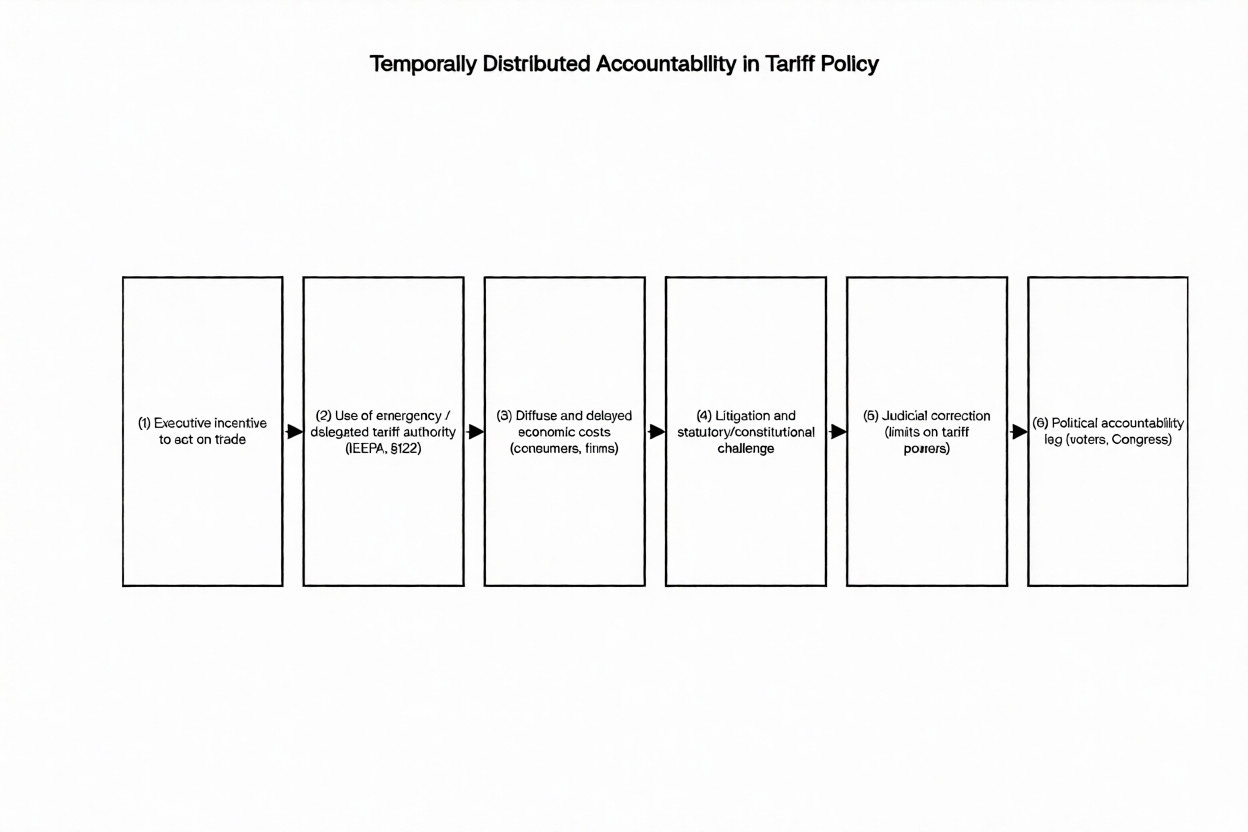
· Executive incentive → emergency statute use. When ordinary lawmaking is costly and slow, emergency or delegated authorities become the margin of adjustment for ambitious tariff initiatives. Recent uses of IEEPA and Section 122 illustrate how emergency statutes can be stretched to support trade measures that resemble general tax policy rather than crisis response.
· Emergency statute use → diffuse cost distribution. Tariffs impose concentrated costs on specific importers and exporters but diffuse, often opaque costs on consumers and downstream firms through higher prices and supply-chain disruptions. Because these costs are spread out and partially hidden in complex price and quantity adjustments, they are politically easier to sustain in the short run than an explicit tax increase passed by Congress.
· Diffuse cost distribution → delayed judicial correction. Litigation requires identifiable plaintiffs who can show standing, assemble a legal strategy, and bear the time and expense of challenging the policy. In the tariff episode, importers, states, and public-interest groups had to coordinate challenges across multiple theories—statutory interpretation of IEEPA and Section 122, nondelegation and major questions arguments, and separation-of-powers claims about Congress’s taxing authority.
· Delayed judicial correction → political accountability lag. By the time a case like Learning Resources v. Trump reaches the Supreme Court and results in a ruling that IEEPA tariffs are unconstitutional, the policy has already generated real economic and distributional effects. Voters observe the judicial correction as a discrete “event,” but the underlying costs and incentives that produced the tariffs were generated years earlier, under different political conditions and media narratives.
This sequence—executive incentive, emergency-channel activation, diffuse costs, delayed judicial review, and lagged political response—is what “temporally distributed accountability” looks like in a concrete legal setting. The Constitution’s allocation of tariff and taxing power to Congress remains formally intact, but the timing of when that allocation actually binds behavior is mediated by statutory design, litigation dynamics, and the political economy of diffuse versus concentrated costs.
Figure 1 summarizes the timing structure.
Why Courts Appear “Late”
From a news-cycle perspective, courts often look like they are “late” to the party: by the time the Supreme Court limits presidential tariff powers or rejects an expansive reading of IEEPA, the tariffs have already bitten. But as an institutional matter, courts are designed as lagged correction mechanisms: they do not initiate policy, they respond to disputes, and they rely on affected parties to bring justiciable cases.
That lag is not necessarily a failure; it is a feature of a system that separates initiation, implementation, and review across different bodies with different time horizons. Executives operate on election and news cycles; legislators on legislative calendars and coalition dynamics; courts on dockets, briefing schedules, and precedential constraints, with each step introducing delay but also additional information about a policy’s real-world effects.
In the tariff episode, the Court’s eventual conclusion that IEEPA tariffs exceeded statutory authority and encroached on Congress’s power to impose duties is best understood as a delayed reassertion of an existing constitutional allocation, not the creation of a new one. From a temporally distributed accountability perspective, the key question is not “Why did the Court take so long?” but “How did the statutory and political environment allow the executive to exploit that time window?”
This is exactly the kind of timing structure that Fairness Over Time-style analyses emphasize: outcomes are evaluated at one moment, but the path that produced them spans multiple periods, with different actors and constraints at each step. The tariff case provides a policy-domain counterpart to the way fairness metrics in algorithms can misalign with the longer-run dynamics of incentives, feedback, and institutional learning.
Research Note / Forward Link
The tariff episode illustrates how institutional systems repeatedly correct policy expansions only after their fiscal, distributive, and constitutional costs become visible enough to crystallize into litigation and judicial review. In the interim, executives can bank political credit for “toughness” on trade, even as the underlying measures are structurally fragile once subjected to full statutory and constitutional scrutiny.
The argument developed here did not originate as an abstract theoretical exercise. It emerged from attempting to understand why institutional corrections to policy expansion so often appear delayed or reactive, even when underlying constraints remain unchanged. The recent tariff litigation provided a particularly clear illustration of this recurring temporal pattern.
A more formal treatment of these dynamics, treating emergency authorities and judicial review as components of a temporally distributed accountability system, appears in ongoing work on time, institutions, and fairness in public policy. For readers interested in the broader framework, a draft of that project is available here: Fairness Over Time / temporally distributed accountability preprint.