

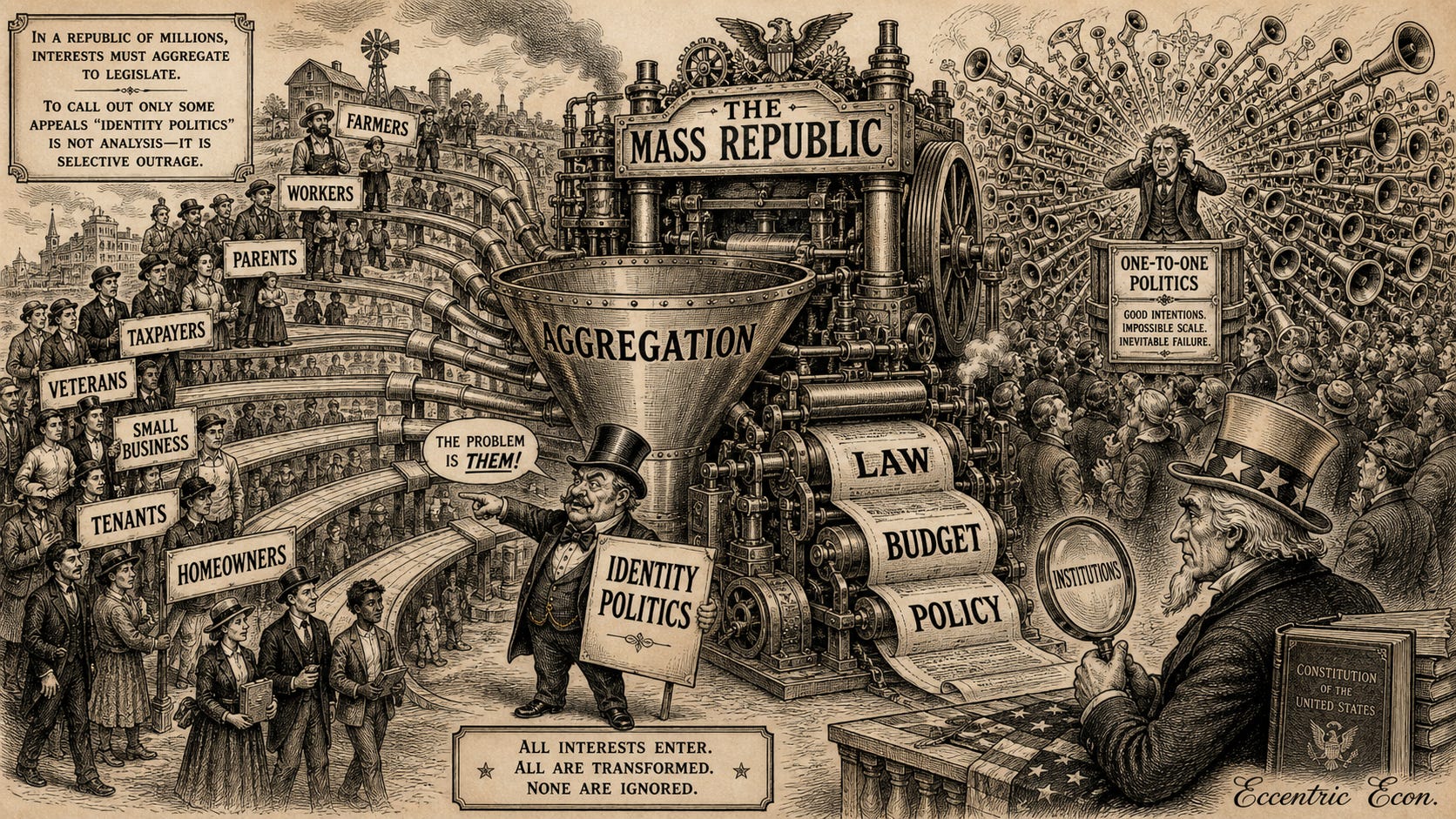
The phrase “identity politics” is commonly used as though it identifies a departure from ordinary democratic politics. It does not. In a mass republic, politics necessarily operates through groups. The useful questions are which groups are being organized, under which rules, for what ends, and at whose expense.
There is a familiar story about identity politics. On this account, politicians once addressed citizens as citizens: they offered general principles, appealed to the common good, and competed for the support of individuals who assessed programs on their merits. Then politicians discovered race, sex, religion, ethnicity, sexuality, region, and similar markers. Politics became tribal. The universal gave way to the particular.
It is an attractive story, especially for those who would like to place themselves outside the conflict. They do not practice identity politics, they say. They speak for taxpayers, working families, ordinary Americans, the middle class, small businesses, or the national interest. But these are identities and aggregates too. A taxpayer is not an atomized person; neither is a working family, a homeowner, a veteran, a parent, a farmer, or an “ordinary American.” Each is a category through which a large population is rendered politically intelligible.
The ordinary pejorative use of identity politics therefore rests on a false baseline. It imagines a normal, non-identity politics in which officials communicate with fully individualized citizens, and an abnormal politics in which they communicate with groups. In a mass representative system, the former is not an available institutional arrangement. It is a fantasy about scale.
The Impossible Voter File
Imagine a presidential candidate who announces a new strategy: no blocs, no demographics, no constituencies, and no generalizations. She will tailor her platform to the unique utility function of every citizen. She will discover each voter’s particular ranking of taxes, schools, trade, land use, criminal law, war, welfare, and regulation, and then formulate a program specifically responsive to that ranking.
The candidate has discovered retail politics in its purest form. She has also made herself unelectable.
The problem is not only that there are too many voters and too few hours. Most citizens do not have complete, stable, and fully informed rankings over all possible policy bundles. They have partial preferences, conflicting commitments, limited information, and changing beliefs. Candidates must choose platforms before every relevant preference is known; voters must assess proposals they cannot fully study; legislators must make decisions on matters that were not and could not have been fully specified during an election.
This is why political theory treats democracy as a problem of aggregation. Electoral institutions receive inputs from many people and transform them into offices, laws, budgets, and rules. Work on American representation describes several such stages: citizens select officials across districts and states, and those officials subsequently combine their actions into institutional outcomes.
A republic must compress. It has no alternative. Candidates and parties use geographic, occupational, demographic, religious, and ideological categories because they lower the costs of communicating, organizing, and estimating support. Voters use party labels, trusted associations, occupational experience, social networks, and group interests as shortcuts because they cannot independently audit every claim or predict every consequence.
That is not a moral defect uniquely introduced by one faction. It is a structural feature of collective decision-making among millions of people.
Every Coalition Has an Identity
Consider the routine contrast between identity politics and economic issues. It sounds precise until one asks what an economic constituency is.
“Manufacturing workers” is an identity category. It identifies people by occupation, labor-market exposure, location, experience, and usually a recognizable set of political concerns. “Small-business owners,” “homeowners,” “retirees,” “students,” “veterans,” “parents,” “farmers,” “union households,” “technology workers,” and “energy-producing states” work in the same way. They are not arbitrary labels, and their members are not identical. But they are politically useful aggregates.
Some groups are organized principally around demographic traits; others around geography, religion, class, occupation, or industry. Their moral histories and policy claims can differ profoundly. A racial minority confronting a legacy of legal exclusion, a professional association seeking a licensing rule, and homeowners pursuing a local zoning restriction are not advancing interchangeable demands. Their cohesion, their internal diversity, and the burdens they impose on outsiders must all be examined.
But the institutional point remains. Political communication at scale requires categories. A politician cannot credibly address each citizen in exactly the form that citizen’s wholly particular circumstances demand. She must make appeals that are recognizable, repeatable, and actionable for many people at once.
That is why allegedly neutral alternatives to identity politics so often turn out to be identities in disguise. “The forgotten taxpayer” is a constructed constituency. “Real Americans” draws a boundary around an imagined public. “The common-sense majority” is a claim that a particular coalition’s outlook should be treated as normal, while opponents are cast as deviations from it. The language may be universal in tone, but it still selects a social reference group.
The question is never whether politicians will appeal to identities. The questions are how identities are constructed, whether members can dissent or exit, what interests the category organizes, and which rules it asks the state to impose.
A Mechanism, Not a Confession
Mechanism design begins with constraints rather than slogans. What information do participants possess? What incentives do they face? What messages can they credibly communicate? What rule converts those messages into a collective decision? Mechanism design is a formal language for assessing the properties of institutions, though translating formal properties into political or ethical judgments requires additional normative argument.
In political life, the relevant mechanism includes electoral rules, districting, primaries, party organizations, campaign finance, legislative procedure, federalism, administrative law, media institutions, and informal norms. These arrangements do not merely record preferences that exist independently of them. They alter incentives to organize, define interests, acquire information, form coalitions, and bargain.
The literature on political information aggregation starts from this problem. Political actors possess different information and conflicting objectives, while institutional arrangements can either improve or impede the collection and use of dispersed knowledge.
The serious mechanism-design question is therefore not whether politics can be made group-free. It cannot. It is whether the institutions through which groups compete generate informed, peaceful, accountable, and rights-respecting outcomes.
Take three familiar constituencies: farmers seeking crop insurance, coastal homeowners seeking subsidized flood protection, and urban renters seeking housing assistance. It is analytically empty to call one case normal interest-group politics and another identity politics merely because the relevant category is occupational, geographic, or demographic. Each coalition advances a distributive claim. Each relies on a shared category to reduce information and organization costs. Each seeks a public allocation of benefits, costs, or legal authority.
The appropriate questions are more demanding:
Is the claimed problem genuine?
Does the proposal address it at a tolerable cost?
Who benefits and who pays?
Are benefits concentrated while costs are dispersed?
Does a rule create an enduring rent-seeking opportunity?
Does it secure equal citizenship, or confer a privilege unavailable on general terms?
Are there less coercive alternatives?
Those are questions of political economy. Calling a coalition “identity politics” before asking them is often a way to avoid asking them.
The Tautology Problem
At this point, one may say that all politics is identity politics. I certainly do, by way of offering a corrective. As a corrective, the slogan has force. It punctures the pretense that some political appeals arise from pure universality while others are somehow contaminated by group interest.
As an analytical conclusion, however, it goes too far. A term that encompasses taxpayers, workers, consumers, racial minorities, religious majorities, regions, parents, veterans, immigrants, investors, and citizens has ceased to distinguish among important political phenomena. It tells us nothing about whether a movement seeks equal treatment, legal privilege, cultural recognition, redistribution, exclusion, deregulation, or constitutional reform.
The better response is to use more exact terms. Distinguish descriptive representation from substantive representation. Distinguish interest-group politics from status politics, class politics, ethnonationalism, and constitutional politics. A representative can share salient traits with constituents yet fail to advance their interests; a representative can lack those traits yet represent constituents’ policy preferences effectively. The distinction between descriptive and substantive representation is central to the literature, and the two forms need not be mutually exclusive.
Precision does not make political conflict disappear. It makes the conflict discussable.
The Constitutional Problem
None of this means that group politics is benign. Groups can pursue transfers at outsiders’ expense. Political entrepreneurs can exploit fear, resentment, and status anxiety more readily than they can explain a tax schedule. Organizations can suppress internal disagreement by claiming exclusive authority to speak for a whole category. Electoral rules can amplify some constituencies and mute others.
But these are not objections to identity as such. They are objections to particular coalition structures and institutional incentives. A sound constitutional order cannot abolish aggregation. It can, however, make aggregation less destructive: disperse power, protect individual rights, preserve room for dissent and exit, prevent temporary majorities from treating minorities as spoils, and require political coalitions to bear more of the costs they impose.
Political identities are unavoidable under mass representation. They are organizational and cognitive technologies, allowing people with limited time, knowledge, and bargaining power to navigate collective action. They can be used for domination. They can also make previously unorganized interests visible. The institutional task is not to pretend that politics can return to atomized individuals. It is to build rules under which aggregates compete without converting political victory into permanent subordination.
Identity was already there. So were interests. So were coalitions. So was aggregation.
The only thing newly visible is the machinery.