

The Constraint We Ignore
Economists spend a great deal of time thinking about constraints.
Scarcity. Tradeoffs. Opportunity cost. The fact that every choice excludes alternatives. These are treated as foundational features of the world—so basic they rarely require justification. Human beings want more than they can have. Resources are limited. Choices must be made.
But theology offers a different lens.
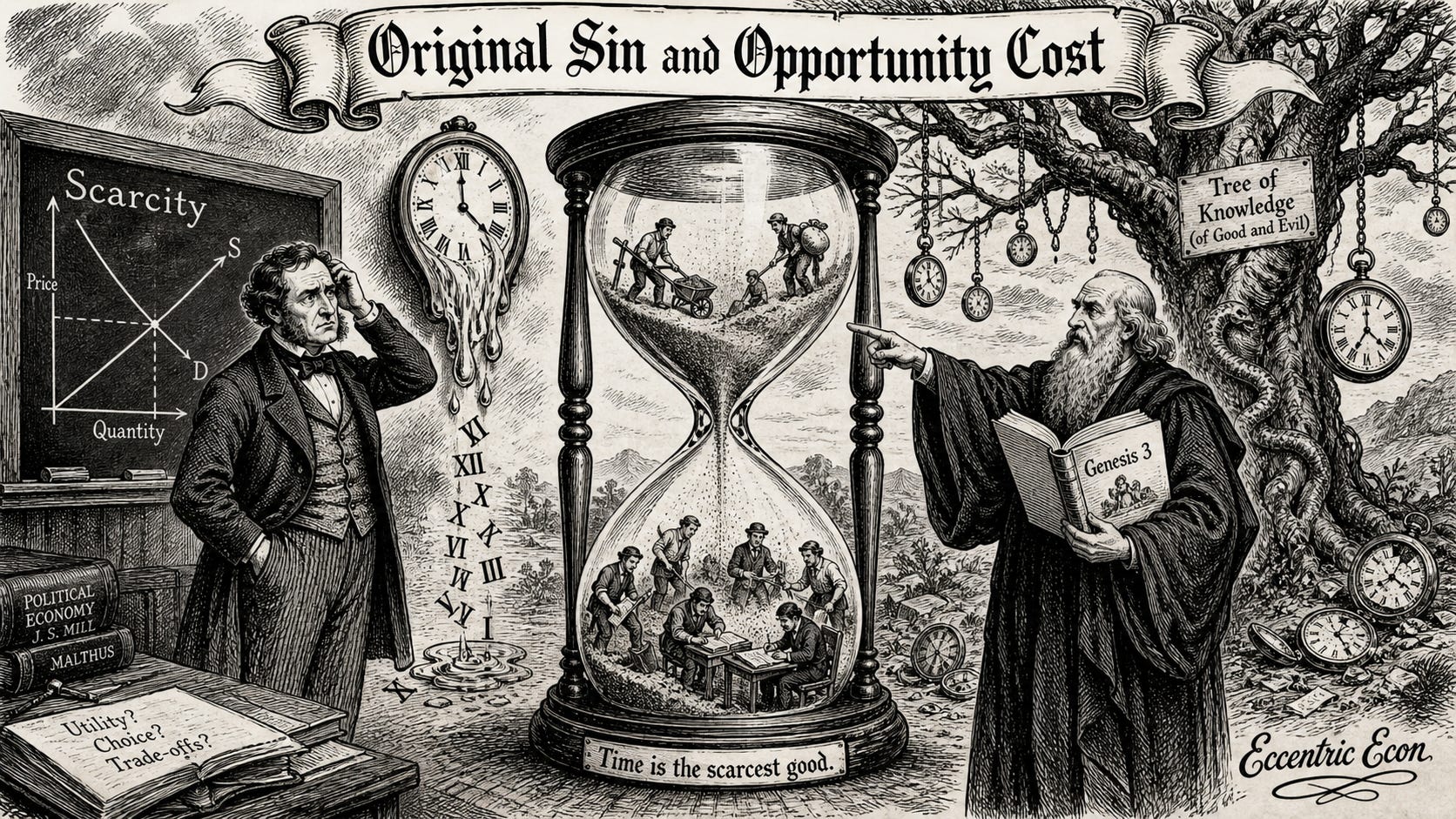
The World After the Fall
In the Genesis account, the consequences of the Fall are often summarized as mortality: Adam and Eve eat the fruit, and death enters the world (Genesis 3). Yet the curse is broader than death alone.
What follows is toil.
Work becomes difficult. Childbirth becomes painful. Human beings must wrest sustenance from the earth. Relationships become strained. Generations succeed one another. And time itself changes character. It is no longer experienced as an undifferentiated present, but as a sequence of moments structured by necessity, uncertainty, and loss. Genesis 3:17 captures that shift in the curse on the ground: “in pain you shall eat of it all the days of your life.”
In economic terms, the Fall introduces constraints.
This is not a claim about reconstructing a literal pre-Fall production function. It is a conceptual claim about the human condition. Whatever one takes the pre-Fall world to represent, the post-Fall world is unmistakably one of finitude.
Human beings confront limits: finite resources, finite knowledge, and—most importantly—finite time.
Opportunity Cost Is Temporal
From this condition, opportunity cost emerges naturally.
To choose one path is to forgo another. To spend an hour writing is to lose the possibility of spending it elsewhere. To invest in one project is to deny resources to another. Every action carries with it a shadow set of unrealized alternatives.
That is the basic intuition behind Lionel Robbins’s classic definition of economics as the study of “ends and scarce means which have alternative uses”. It remains one of the clearest ways to explain why economists care so much about choice.
But that still leaves a deeper question.
Why do these constraints bind so tightly?
Scarcity Follows Time
The standard answer is that resources are limited. But scarcity matters because decisions must be made over time—and time does not permit revision without cost.
Time moves in one direction.
That is why the “time value of money” makes sense even to non-economists: a dollar today is not the same as a dollar tomorrow, because delay changes what can be done with it. The same logic applies far beyond finance. Every delay has a cost. Every waiting period narrows the range of possible responses. Every choice is made before full information arrives.
So perhaps scarcity is not the deepest constraint. Time is.
Resources are scarce because they must be allocated across moments that cannot be revisited. Knowledge is scarce because decisions must be made before learning is complete. Even mortality can be understood as the ultimate temporal constraint; a hard boundary on the set of feasible choices.
The core economic problem, then, is not simply allocation. It is action under irreversibility.
Institutions Are Time Machines
This idea is already embedded in a great deal of economics, even when it is not stated so directly.
When individuals save, they are moving resources across time. When firms invest, they commit capital today under uncertainty about tomorrow. When governments borrow, spend, tax, or regulate, they are shaping behavior through time, not just in a single moment. The Federal Reserve’s own educational materials make this plain: interest rates matter because they affect borrowing, saving, and investment decisions across time.
Across these domains, the structure is the same. Decisions must be made before uncertainty is resolved, and once made, they constrain what comes next.
Human beings act in a world where knowledge is incomplete, the future is uncertain, and choices close off possibilities that cannot be reopened.
Every action is, in a meaningful sense, a commitment.
Same Problem, Different Vocabulary
Seen this way, the language of the Fall maps surprisingly well onto the economic problem of temporally constrained choice.
The theologian describes a condition in which human beings are finite, burdened by toil, and subject to death. The economist describes agents making decisions under constraints, facing tradeoffs across time and uncertainty.
These are different vocabularies. But they describe the same underlying predicament: what it means to be a finite creature moving through time.
Genesis 3 is not just a story about punishment. It is also a story about the structure of postlapsarian life: labor, pain, succession, uncertainty, and the fact that human existence is now lived under conditions of irreversible choice.
Why Institutions Matter
This reframing becomes especially useful when we turn to institutions.
If time is the fundamental constraint, then institutions can be understood as mechanisms for managing temporal tradeoffs. They structure when decisions are made, who makes them, and how the costs of irreversibility are distributed.
Consider capital markets. At a basic level, they allow resources to move across time. Savings today become investment tomorrow. Interest rates reflect time preferences, risk, and expectations.
Or take criminal justice policy. Sentencing decisions impose costs not just in the present, but across an individual’s future trajectory. A longer sentence may increase immediate public safety, but at the cost of long-term reintegration challenges. Reentry policy exists precisely because what happens after release matters for public safety and life outcomes.
Drug policy offers an even clearer example. Harm reduction approaches – such as syringe services programs – aim to reduce immediate harms like overdose and disease transmission. More prohibition-oriented approaches often emphasize long-run behavioral change and deterrence.
These are not simply disagreements about values.
They are disagreements about how to structure tradeoffs across time under uncertainty.
The Weight of the Past
Once time is central, another concept becomes unavoidable: path dependence.
Early decisions shape the set of future options in ways that are difficult to reverse. Legal rules, institutional frameworks, and policy choices create trajectories that persist long after the original decision is made. The past does not merely influence the present; it helps define what the present can be.
In a world without temporal constraints, this would not matter. Mistakes could be undone without cost. Decisions could be replayed with better information.
But that is not our world.
We inherit institutional paths we did not choose, and we make decisions that will constrain people we will never meet.
The Common Ground
This is where the theological and economic perspectives converge most clearly.
The Fall is not merely about death. It is about the introduction of a world in which choices have lasting consequences, knowledge is incomplete, and time cannot be reversed.
A world in which human beings must act…and then live with the results.
Economics, at its best, is an attempt to make sense of that condition.
It asks how we should structure tradeoffs, allocate time, and design institutions in a world defined by irreversibility. How we can mitigate error, distribute risk, and preserve as much flexibility as possible without pretending that constraint can be eliminated.
These are not just technical problems.
They are questions about how to live under conditions we did not choose.
Time, Not Scarcity
Once that is clear, the familiar language of scarcity begins to look less like a starting point—and more like a consequence.
Scarcity is what constraint looks like from the inside.
Time is what makes it binding.
I absolutely love my open rates, but guys, I gotta say these barren wastelands in the comments are bruuutal...