

Viktor Orbán’s electoral defeat is real, important, and deserved. But if the anti-authoritarian story ends with the fall of one man, the lesson will be wasted. Orbán was never just a Hungarian oddity, never merely a provincial strongman with a taste for grievance, media manipulation, and nationalist theater. He was a model, a proof of concept, and for admirers abroad a live demonstration that liberal institutions can be hollowed out from within while elections still occur on schedule.
That is why the question is not simply what happens to Orbán next. The better question is what political entrepreneurs everywhere learned from him. Orbán showed that democratic erosion need not arrive wearing jackboots. It can come draped in constitutional language, carried by parliamentary majorities, and marketed as the restoration of popular sovereignty against decadent elites.
The temptation after a defeat like this is to move immediately to a new villain. Pick the next tyrant. Find the next cartoon heavy. Declare the danger relocated. That instinct is understandable, but it is analytically sloppy. Personalizing structural problems flatters the audience while obscuring the mechanism. If a political order can generate one Orbán, it can generate another, even if the next one is smoother, younger, more articulate, and better dressed.
Orbán Was a Template
Orbán mattered well beyond Hungary because he functioned as a working template for twenty-first century illiberalism. He demonstrated that an ambitious leader does not need to abolish elections to weaken meaningful competition. He needs only to tilt the terrain: discipline public institutions, cultivate loyal media ecosystems, convert cultural anxiety into political capital, and depict every constraint on executive ambition as an attack by enemies of the nation.
That formula traveled. International admirers did not praise Orbán because they were experts on Hungarian administrative law. They praised him because he looked like a statesman who had found the cheat code: use democratic legitimacy to reduce the substance of liberal democracy, all while insisting that one is merely returning power to “the people.” Orbán’s symbolic value to the global right was therefore larger than Hungary itself.
This is also why his loss matters. A template loses mystique when it stops delivering victories. The aura of inevitability disappears. The story shifts from strongman invincibility to institutional exhaustion, voter fatigue, and the accumulated costs of governing through polarization. That is bad news for Orbán personally, but it is worse news for those abroad who used him as evidence that illiberal nationalism was not merely sustainable but ascendant.
The Machinery Behind the Man
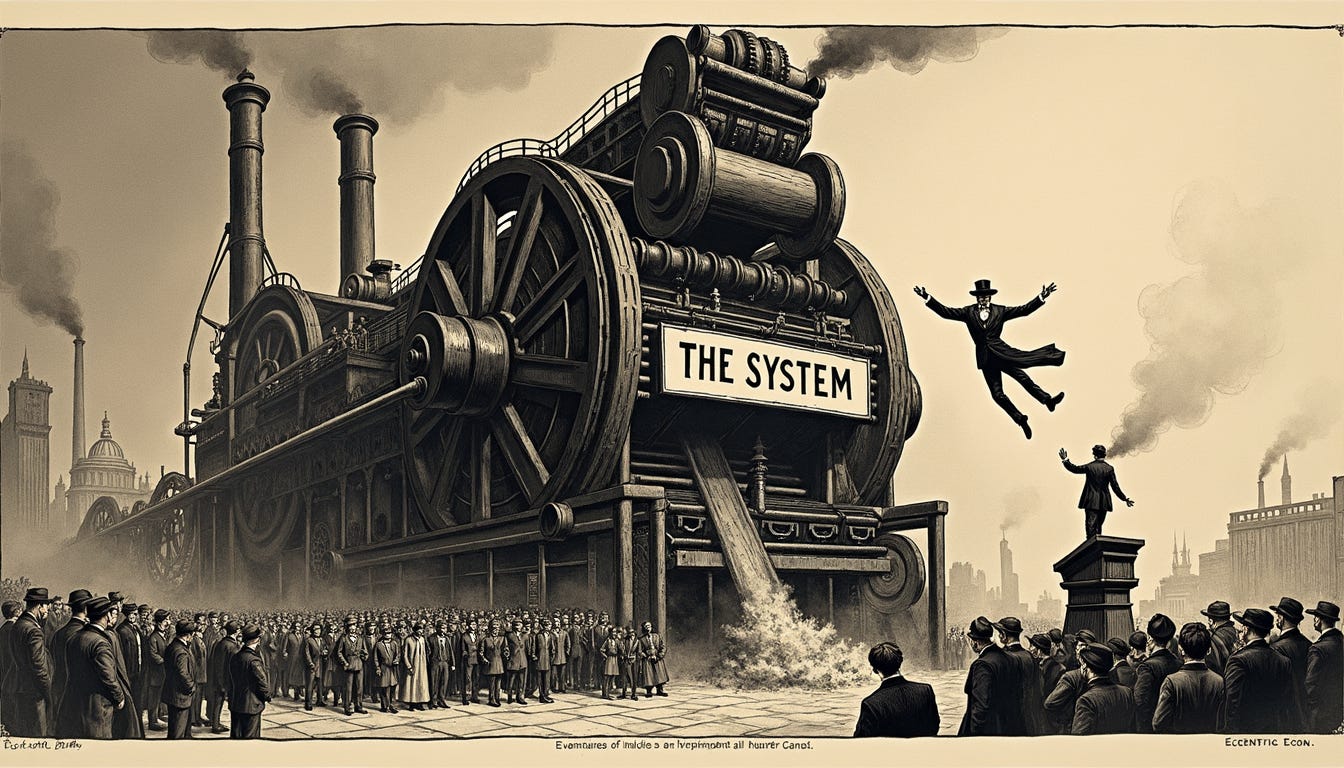
The phrase “the Orbán system” should be taken literally. Systems matter more than personalities because systems outlast them. What made Orbán formidable was not charisma alone, nor even ideology alone, but the interaction of narrative, institutional leverage, partisan loyalty, and strategic conflict. He did not simply win arguments. He altered incentives.
That is the part too many critics miss. Strongmen are sustained not only by true believers but by officeholders, bureaucrats, media figures, donors, and ordinary citizens who conclude that accommodation is safer than resistance. The longer such a system persists, the more it trains people to anticipate power rather than challenge it. Fear matters, but so does adaptation. In time, opportunism begins to masquerade as realism.
Every durable illiberal system relies on a similar political technology. First, it identifies an internal enemy and an external menace. Then it fuses the two. Domestic critics become agents of foreign corruption; independent institutions become camouflage for elite domination; procedural restraints become betrayals of the nation’s authentic will. At that point, the leader no longer appears as a threat to constitutional order but as its necessary defender.
This is the real inheritance of Orbánism. It is less a fixed ideology than a governing style. It can wear Christian nationalism, civilizational rhetoric, anti-globalist populism, or ordinary law-and-order politics. The labels change. The operating logic does not.
Why Péter Magyar Is Still Worth Watching
Orbán’s defeat does not automatically resolve the deeper problem, because democratic backsliding can give way to democratic disappointment. Péter Magyar’s rise is newsworthy not just because he defeated a dominant incumbent, but because replacement politics often inherits some of the emotional grammar of the regime it displaces. Opposition figures succeed by channeling frustration, but frustration is not a governing philosophy.
That does not mean Magyar is simply Orbán in different packaging. It means transitions deserve scrutiny instead of romanticism. Voters often remove entrenched rulers because they are exhausted, economically frustrated, institutionally alienated, or morally disgusted. Those are excellent reasons to reject a ruling order. They are not, by themselves, a guarantee of liberal renewal.
This is where anti-Orbán commentary can become unserious. It is easy to cheer the defeat of an entrenched leader. It is harder to ask whether the incoming coalition or party can rebuild habits of restraint, restore trust in impersonal institutions, and govern without reproducing the same politics of existential emergency. The fall of an illiberal incumbent is a beginning, not a conclusion.
The Transatlantic Lesson
Orbán’s importance to American politics was never primarily diplomatic. It was theatrical and ideological. He became a kind of political exhibit for factions on the American right that wanted proof that national conservatism could move from think-piece aspiration to governing practice. Hungary, in that sense, served as a showroom for those who imagined a post-liberal future but preferred to describe it as democratic correction.
That symbolic role linked Orbán to Donald Trump, even where their political circumstances differed. Both men benefited from grievance as a mobilizing instrument. Both treated opponents not as rivals within a shared constitutional order but as hostile forces corrupting the nation from within. Both encouraged supporters to see institutional friction not as a normal feature of republican government but as evidence of conspiracy, sabotage, or illegitimate elite control.
To say this is not to claim that Hungary and the United States are identical. They are not. Institutional scale, constitutional design, federalism, media structure, civil society density, and party history all differ. But political actors borrow scripts across borders all the time. Orbán’s appeal abroad rested on the sense that he had converted diffuse cultural resentment into a coherent governing project. Others noticed.
Why Putin Still Matters
If Trump represents a democratic-world adaptation of strongman politics, Vladimir Putin represents the harder edge of the same anti-liberal impulse. Orbán was not Putin, and Hungary was not Russia. But Orbán’s critics were not imagining things when they placed him in a broader authoritarian continuum. The continuum matters because authoritarian politics often spreads less by formal alliance than by imitation, legitimation, and shared rhetorical habits.
Putinism offers the stark version: centralization, managed opposition, nationalist mythmaking, and the treatment of independent institutions as threats to state power. Orbánism functioned as a softer, electorally dressed variant that could travel in societies not yet willing to abandon the democratic script altogether. Where Putin embodied coercive authoritarian consolidation, Orbán embodied democratic corrosion.
That distinction matters because many citizens in liberal democracies would reject open dictatorship while still tolerating a politics that progressively empties liberal norms of content. They do not want tanks in the streets. They merely want the “right people” unconstrained by courts, media critics, universities, or bureaucratic procedure. That desire is how constitutional democracies begin making excuses for their own erosion.
Why Strongmen Keep Selling
The market for strongman politics is not created by propaganda alone. It is fed by genuine frustrations: stagnation, disorder, cultural dislocation, elite hypocrisy, administrative failure, and the maddening inability of normal democratic politics to act with speed or coherence. When institutions perform poorly, citizens become susceptible to anyone who promises energy, clarity, punishment, and direction.
This helps explain Orbán’s wider allure. He did not market himself as a destroyer of democracy. He marketed himself as the cure for drift. That is how strongman politics usually works in the twenty-first century. It does not denounce popular rule as such. It denounces pluralism, proceduralism, and institutional friction as luxuries that decadent societies can no longer afford.
The sales pitch is always morally flattering to supporters. You are not embracing domination, they are told. You are defending order. You are not rejecting liberty. You are preserving civilization. You are not silencing opponents. You are finally refusing to let the nation be ruled by people who hate it. Once those premises are accepted, extraordinary political measures begin to feel not dangerous but responsible.
The Liberal Error
Liberal critics often answer this challenge with moral denunciation alone. Some denunciation is warranted. But denunciation without institutional analysis becomes therapy for the already convinced. It names the villain, signals virtue, and leaves the operating mechanism intact. Worse, it sometimes reproduces the same personalization it claims to oppose, treating every democratic crisis as the product of one uniquely evil man rather than a recurring pattern of incentives and institutional weakness.
That pattern is harder to confront because it demands more than outrage. It requires asking why so many voters become willing to trade dispersed power for concentrated force, why elites accommodate obvious norm violations, and why institutions designed to check ambition so often hesitate until the damage is advanced. These are less emotionally satisfying questions than asking who the next tyrant is. They are also the only useful ones.[
A politics of restraint cannot survive on procedural piety alone. If liberal institutions want defenders, they must prove that dispersed power, open contestation, and constitutional friction are not just morally superior abstractions but practical safeguards against predation, favoritism, and arbitrary rule. Citizens tolerate messy systems when those systems still appear capable of correction. They stop tolerating them when mess begins to look indistinguishable from decay.
After Orbán
So what tyrant should come next? The truest answer is that the target should not be one man at all. The target should be the machinery that keeps making strongmen intelligible, attractive, and institutionally survivable. Orbán’s fall matters precisely because it reveals that even durable systems can lose legitimacy. But unless the underlying demand for illiberal politics is addressed, the supply will return.
That means watching Magyar without naïveté, criticizing Trump without parochialism, and understanding Putin not as a distant monster but as the hard endpoint of a broader anti-liberal temptation. These are not interchangeable figures. They occupy different regimes, different political cultures, and different levels of coercive severity. But together they map a family resemblance: power justified by emergency, dissent recast as treachery, and institutions treated as obstacles rather than safeguards.
Orbán lost. Good. But the more serious question is whether his defeat marks a repudiation of the style of politics he helped normalize, or merely a pause before that style finds a new spokesman, a new flag, and a new electorate willing to confuse domination with strength. The answer to that question will matter far more than the fate of one former prime minister in Budapest.