

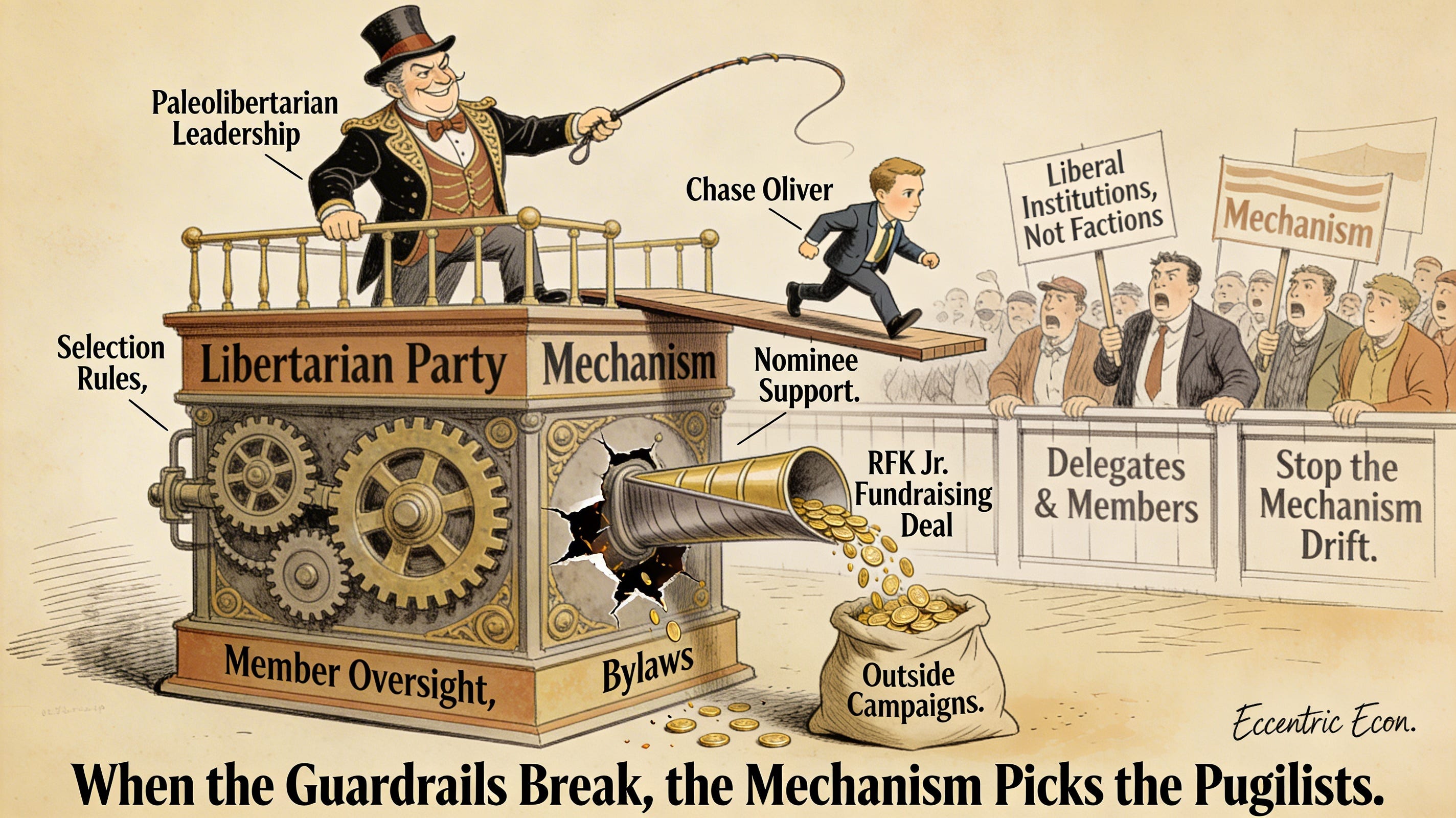
Angela McArdle likes to style herself a libertarian polemicist. But the story of her tenure atop the Libertarian National Committee (LNC) is less about polemics than about institutional incentives — a live demonstration of mechanism failure: adverse selection in leadership, moral hazard in candidate support, and a principal–agent breakdown between party leadership and the people it was supposed to represent.
This isn’t gossip, and it isn’t about personality. It’s an institutional autopsy. The interesting question isn’t who was right — it’s what the rules made almost inevitable.
From liberal party to factional vehicle
Start with the coalition that brought the current leadership to power. The Libertarian Party Mises Caucus openly embraces a paleolibertarian, fusionist orientation — more socially conservative, more comfortable with right-populist politics, and explicitly interested in working alongside Republicans rather than simply opposing them.
By 2022, the caucus had consolidated control of the LNC, displacing the party’s older classical-liberal and pragmatic wings. Several state affiliates responded with splits or disaffiliations, a conflict sketched in coverage of LP factional politics and critiques such as “Of Mices and Mises.”
The institutional question was never whether factions would fight — that’s normal politics. The real question was whether liberal governance mechanisms would constrain leadership behavior once power changed hands. What follows traces how that mechanism evolved: selection, incentives, and institutional drift. The answer, increasingly, appears to have been no.
The RFK Jr. fundraising arrangement as adverse selection
The joint fundraising deal with Robert F. Kennedy Jr. should be taught in a public-choice seminar.
In 2024 the LNC entered a fundraising structure that allowed donors to write unusually large checks routed through Libertarian Party infrastructure and then distributed to Kennedy-aligned entities. Kennedy was never the Libertarian nominee — he sought the nomination and lost — yet the committee reportedly raised roughly $5 million, most of which flowed toward Kennedy’s campaign and affiliates, with only a smaller share remaining within Libertarian structures.
Reporting from outlets including the Boston Globe, alongside analyses such as “Where We Are on RFK Money” at Third Party Watch, fueled internal criticism that the arrangement functioned less like a partnership and more like a conduit. Additional reporting and party investigations described payments to entities connected to leadership figures and their networks.
The institutional point is straightforward. Party rules assumed leadership would internalize party objectives and treat conflict-of-interest boundaries as real constraints. Instead, the mechanism selected for a leadership type comfortable using party infrastructure as a bridge between donors and outside projects.
In mechanism-design language: screening failed.
Moral hazard once power is secured
If adverse selection explains how leadership arrived, moral hazard explains what came next.
After Chase Oliver secured the Libertarian presidential nomination, leadership messaging often framed his candidacy less as the party’s centerpiece and more as a potential spoiler dynamic — an approach criticized by state affiliates and internal voices who argued it undermined unified support for the nominee.
At the same time, leadership pursued highly public outreach toward Donald Trump, including inviting him to address the Libertarian convention, even as the party’s own candidate struggled with institutional support and ballot-access challenges. Litigation filed by LNC secretary Caryn Ann Harlos and related internal disputes alleged failures in core responsibilities, including nominee certification and organizational neutrality.
This is textbook moral hazard. Once in office, leadership had the ability to quietly reallocate effort and signaling toward outside coalition goals while rank-and-file members — the nominal principals — lacked real-time information or enforcement power.
Principal–agent collapse
Put together, the pattern resembles a classic principal–agent breakdown.
In theory, Libertarian Party members and delegates serve as principals; leadership acts as their agent. In a healthy liberal institution, rules and transparency are designed to keep those incentives aligned.
But during this period, internal litigation and public complaints alleged resource misallocation, conflicting loyalties, and procedural maneuvers that appeared to prioritize factional or external interests over the party’s own nominee. In several instances, internal accountability mechanisms seemed to reverse direction — disciplining those attempting to reassert institutional alignment rather than the actors accused of undermining it.
Once the agent begins disciplining the principals, the mechanism is no longer functioning.
Paleolibertarian polemic vs. liberal institutionalism
The deeper issue here isn’t personality. It’s philosophy.
Paleolibertarian politics tends to merge libertarian rhetoric with culturally conservative, populist-right coalition building. Classical liberalism, by contrast, treats institutions themselves — rules, fiduciary duties, procedural neutrality — as intrinsic to a free order.
From that perspective, the central problem isn’t disagreement over policy. It’s what happens when institutional constraints are treated as negotiable tools rather than binding commitments.
The rhetoric may remain libertarian. The revealed incentives tell another story.
A broader pattern in minor parties
And this isn’t unique to the Libertarian Party.
Minor parties live in a perpetual tension between being ideological movements, ballot-access vehicles, and fundraising infrastructures. Those overlapping roles create predictable vulnerabilities. Without strong constraints, coalition entrepreneurs can repurpose institutions toward outside goals while preserving branding continuity.
What looks like ideological evolution is often just mechanism drift.
Lessons for liberals and minor parties
The lesson isn’t “choose better people.” Institutions cannot rely on moral luck.
Joint fundraising agreements with outside candidates should face strict transparency requirements and real member oversight. Financial relationships involving officers or close associates should trigger automatic disclosure and recusal. Mechanisms must be designed on the assumption that incentives will diverge — because eventually, they do.
More fundamentally, liberal institutions survive only when participants treat rules as constraints rather than suggestions. A party that views its nominee as optional, its bylaws as elastic, and its donor network as a bargaining chip with outside movements risks becoming something other than what it claims to be.
If there is a polemic worth writing here, it isn’t about personalities. It’s about mechanism design — and how quickly a nominally liberal institution can be repurposed once the guardrails stop working.
Who is proposing the reconfigure the mechanism for selecting LP Presidential ticket? I have a draft blueprint. I would like to see others.