

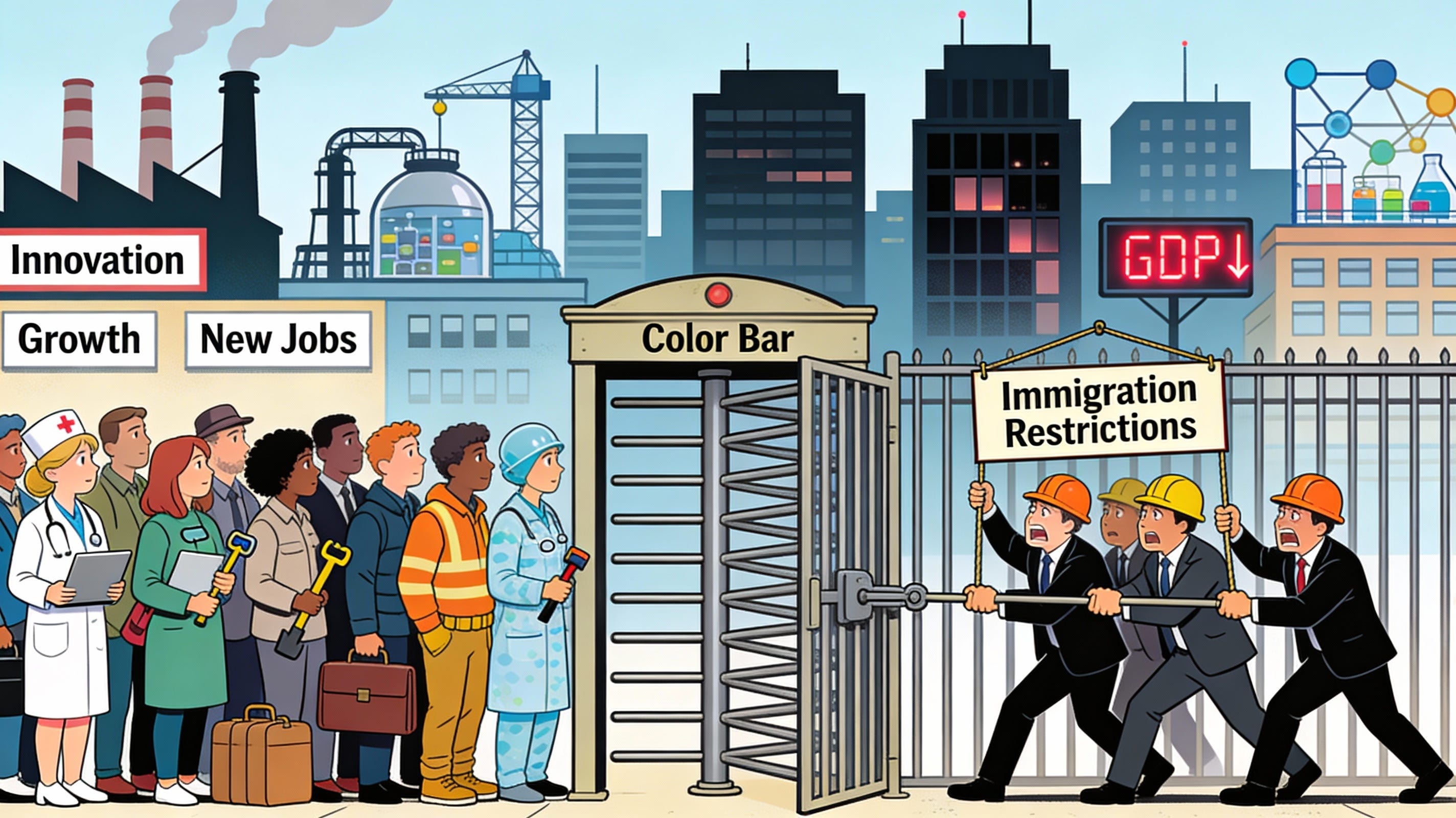
I was scrolling Facebook, as I spend entirely too much of my time doing, and as I was parsing through comments on one of my friend James Hanley’s (yes, THAT Hanley; legendarily of The Pedantic Puffin) posts, it got me to thinking about Trump’s recent boasts concerning net outmigration. Naturally, this spurred me to write my own Facebook post regarding the subject (with graphs and everything!), which comments in turn got me to thinking about Gary Becker and W.H. Hutt. Specifically, I pondered their thoughts on the economic drawbacks of discrimination, and that’s what forms the foundation for this article.
Racism and immigration restrictions are often sold as hard-headed realism: protecting “our” jobs, “our” communities, “our” way of life. The sales pitch leans on a simple story—exclude the “wrong” people and the “right” people will prosper. Gary Becker and William Hutt both spent careers dismantling that story, and the empirical record has been quietly backing them up ever since. Once you translate prejudice into costs, discrimination looks less like realism and more like an especially expensive luxury good.
Becker: Discrimination as a Pricey Taste
Becker’s core move in The Economics of Discrimination is almost annoyingly simple. Instead of treating bias as a mysterious social force, he treats it as a “taste” with a price tag: a prejudiced employer acts as if it is costly to interact with the disliked group and therefore pays extra to avoid them. If equally productive Black workers are available at a lower wage than white workers, an employer who insists on hiring only whites is, in effect, imposing a self-tax for the privilege of indulging racism.
That logic generates three uncomfortable implications for defenders of exclusion.
· First, discrimination is not free even for the discriminator. A bigot who passes over cheaper, equally productive workers pays more for the same output. That hits profits in competitive markets and forces prejudiced firms to cede market share to less prejudiced rivals willing to hire the underpriced group.
· Second, wages for the discriminated group are pinned not by “society’s racism in general” but by the prejudice of the marginal discriminator—the most prejudiced employer they still have to deal with. If some firms in the market are less prejudiced, those firms will quietly scoop up underpriced minority workers and earn higher profits, while the worst bigots either shrink, exit, or retreat into niche markets where customers share their tastes.
· Third, discrimination is a luxury that declines as competition intensifies. In a cozy, cartelized, or heavily regulated market, it is easier to indulge taste-based prejudice because the competitive penalty is smaller. In a tightly competitive environment, firing a productive worker or refusing to hire one because of skin color, accent, or passport is more likely to show up in the bottom line.
Becker doesn’t argue that markets magically erase discrimination overnight. He does something more irritating to politicians: he shows that discrimination behaves like an expensive hobby. You can keep it, but you will pay for it—in lower profits, lower output, and lower wages for everyone, not just the targeted minority.
Before moving on, as an interesting aside, the U.K'.’s Open University offers a free course that looks at Becker’s work in some detail: Economics explains discrimination in the labour market.
Hutt: The Color Bar as a Wage-Fixing Scheme
William Hutt tells the same story from the other side of the world. In The Economics of the Colour Bar, Hutt examines South African apartheid not as an inexplicable eruption of racial hatred, but as a set of labor-market restrictions carefully designed to protect a politically powerful white working class.The early “colour bar” provisions, like the 1911 Mines and Works Act, did two main things: they reserved higher-paid jobs for whites and legally prohibited Black workers from moving up the occupational ladder.
Hutt’s claim is blunt. White workers used the state to do what they could not do in a free labor market: lock in above-market wages and keep out competitors. When the law sets a “rate for the job” above the level that would emerge in open competition, and then reserves those jobs for the “right” race, several consequences follow.
· Output falls, because firms cannot profitably employ as many workers at the inflated wage, and, because such laws prevent discovery, they cannot freely substitute cheaper Black workers into skilled positions.
· Black workers are trapped in artificially low-paid occupations, regardless of their productivity, wasting human capital on a national scale.
· White workers enjoy temporary gains, but only by shrinking the overall size of the pie, which eventually feeds back into slower growth, fewer opportunities, and political instability.
Like Becker, Hutt insists that employers, left to themselves, had strong incentives to hire qualified Black workers at market wages; it was unions and political coalitions that pushed for legal color bars. The tragedy of apartheid, in his telling, is not just that it was evil but that it was profoundly wasteful—an elaborate apparatus for burning income so that a subset of insiders could feel safe from competition.
By the early 1970s, South African business elites began pressuring the government to loosen the system, not out of sudden moral enlightenment but because the economic costs had become prohibitive. A labor market starved of skills is not a recipe for long-run profitability, no matter how much it flatters the ego of the “protected” class.
From Theory to Trillions
Becker and Hutt wrote in a world where it was still possible to argue, with a straight face, that racism might be economically rational for the dominant group. The data have not been kind to that defense.
Citigroup estimates that since 2000, racial discrimination has cost the U.S. economy up to $16 trillion in lost GDP. The channels line up almost perfectly with Becker and Hutt’s frameworks.
· Unequal access to credit and capital means Black entrepreneurs start fewer firms and at smaller scale, leaving money on the table in the form of unrealized profits and jobs. Citigroup estimates lost Black business revenue around $13 trillion and 6.1 million forgone jobs.
· Wage gaps for equally qualified workers suppress consumption and savings, reducing aggregate demand and investment. Citigroup estimates $2.7 trillion lost from persistent wage disparities alone.
· Housing discrimination and redlining blocked minority households from the most reliable asset in twentieth-century America: appreciating suburban housing.
· Those lost wealth-building opportunities show up today in the racial wealth gap that Treasury now warns is a structural threat to economic security.
Other analyses suggest racial and ethnic inequality since 1990 has reduced U.S. GDP by $51 trillion by sidelining workers and entrepreneurs who would have been more productive if they had equal access to education, capital, and high-return occupations. If Becker is right that discrimination acts like a self-imposed tax and Hutt is right that legal color bars suppress output, these aggregate numbers are just the national-scale version of the same story.
The ROI of racism, in other words, is deeply negative. There is no hidden macroeconomic upside waiting beyond the moral costs; the ledger does not balance.
Immigration Restrictions as the New Color Bar
If Becker’s discriminator is willing to pay more for the same output, and Hutt’s white unionist is willing to shrink the industry to protect his wage, immigration restrictionists are willing to shrink the labor force itself. The logic is familiar: fewer immigrants mean less competition for “our” jobs and higher wages for native workers. The empirical record looks more like a modern color bar.
Contemporary studies highlight three mechanisms.
· Slower labor force growth. Immigrants have been the main driver of U.S. labor force expansion for decades. Tightening legal channels and ramping up enforcement reduces the number of working-age adults, especially in sectors with high demand and few native applicants, depressing potential GDP growth.
· Sectoral bottlenecks. When immigration restrictions bite hardest in agriculture, caregiving, hospitality, and construction, employers either cut back output, automate, or simply cannot meet demand. The result is higher prices, delayed projects, and foregone economic activity—not some clean transfer of “jobs from them to us.”
· Innovation and entrepreneurship. Immigrants are disproportionately represented among patent holders, startup founders, and STEM workers. Curtailing inflows therefore clips not just current output but future growth, by lowering the rate at which new products, firms, and technologies appear.
The historical analogy to Hutt’s South Africa is not rhetorical. The Chinese Exclusion Act of 1882, a classic piece of racially explicit labor protectionism, offers a clean test case. Recent research finds that areas that lost Chinese workers experienced dramatic declines in manufacturing—output down more than 60%, the number of establishments down 54–69%—as labor shortages rippled through the local economy. White workers were not “protected”; they were stranded in less dynamic labor markets with fewer opportunities and slower wage growth.
The modern U.S. has not reenacted Chinese Exclusion word-for-word, but the pattern is similar: a tightening of legal migration channels and aggressive enforcement campaigns in the name of “protecting” native workers. The Dallas Fed and others now warn that declining immigration will weigh on GDP growth for years, with little to show in terms of sustained wage gains for the least skilled natives. In Becker’s terms, the country is paying more for the same work; in Hutt’s terms, it is choosing a smaller pie so that a political coalition can claim symbolic victories.
Jim Crow, Redlining, and the Long Shadow
Becker’s framework distinguishes between “market” discrimination—tastes that show up in hiring, pay, and promotion—and “premarket” discrimination, the unequal preparation that occurs through schooling, neighborhoods, and health. Jim Crow and redlining operated in both dimensions.
New work on Jim Crow’s economic impact shows that Black families in states with the harshest segregation regimes suffered long-run income and mobility losses compared to Black families in places that limited or dismantled those laws earlier. Segregated schools with shorter terms and fewer resources meant lower human capital; barriers to migration and professional licensing trapped workers in low-wage, low-opportunity environments. If Becker is right that relative wages are determined by the prejudice of the marginal discriminator, Jim Crow ensured that the marginal discriminator was always and everywhere very prejudiced.
Redlining and related housing policies then built a physical map of discrimination over that legal structure. Federal maps marked minority neighborhoods as “hazardous,” denying them access to FHA-backed mortgages and other forms of subsidized credit, while white neighborhoods received generous support. That differential treatment did exactly what Becker would predict: it handed majority households cheap leverage to buy appreciating assets while forcing minorities to rent or buy on punitive terms, depressing their wealth and, over time, their ability to invest in education and entrepreneurship.
Today, those decisions echo in the racial wealth gap that the U.S. Treasury identifies as a central driver of unequal economic security. They also show up in health outcomes, with formerly redlined neighborhoods suffering higher rates of chronic disease and lower life expectancy, which in turn feeds back into labor market performance and health expenditures. Systemic discrimination, in Becker’s language, has been steadily increasing the “cost” of minority labor long before individuals reach the job market.
There is a striking continuity here. Hutt’s white miners and clerks, Jim Crow’s political architects, and today’s restrictionists all bet that shrinking competition for insiders will translate into durable gains. Becker’s model and a century of data say otherwise: the insiders may enjoy brief rents, but the long-run equilibrium is lower output, fewer opportunities, and a more fragile economy.
The Negative ROI of Exclusion
If discrimination is a taste with a price, and laws like the colour bar or Chinese Exclusion Act institutionalize that taste, then “return on investment” is not the right metaphor. These policies are not investments; they are consumption. A society that chooses them is signaling that it prefers a smaller, poorer, more brittle economy paired with the psychic comfort of keeping certain people out or down.
The evidence does not offer consolation prizes. Racial inequality has cost tens of trillions in lost GDP. Immigration restrictions have muted labor force growth and innovation with little sustained benefit to low-skill natives. Apartheid and Jim Crow sacrificed output and stability to lock in wage premiums that proved temporary at best.
Becker gives the microeconomics of that choice; Hutt gives the political economy. Together they highlight a basic point that ought to be uncontroversial by now: racism and exclusion are not tools for national prosperity. They are preferences—costly ones—that a society can indulge only by sacrificing growth, stability, and opportunity it could otherwise have had.
There is a different choice available. Remove the legal color bars—whether drawn by race, origin, or immigration status—and the price of indulging prejudice rises. Open up education, credit, and migration, and the highest return investments are precisely those previously blocked by discrimination. None of this requires utopian assumptions about perfect markets or perfect people. It just requires taking Becker and Hutt at their word: if you are going to build policy around your tastes, at least be honest about the bill.
My only regret is that I have but one like to give for this piece.
"Citigroup estimates that since 2000, racial discrimination has cost the U.S. economy up to $16 trillion in lost GDP."
That study was published in 2020, so that's $16 trillion over roughly 20 years, or $640 billion a year, or somewhere between the GDP of Colorado and Michigan. It's like losing almost an entire state of Michigan GDP each and every year, year after year.
All for preserving some folks' sense of status.
And unlike most goods, we can't manufacture more status, or grow the pie of it, so that everyone can have one. It's truly rivalrous, coming at the expense of others. So too bad if you lose it. It hurts, but it's fair.