

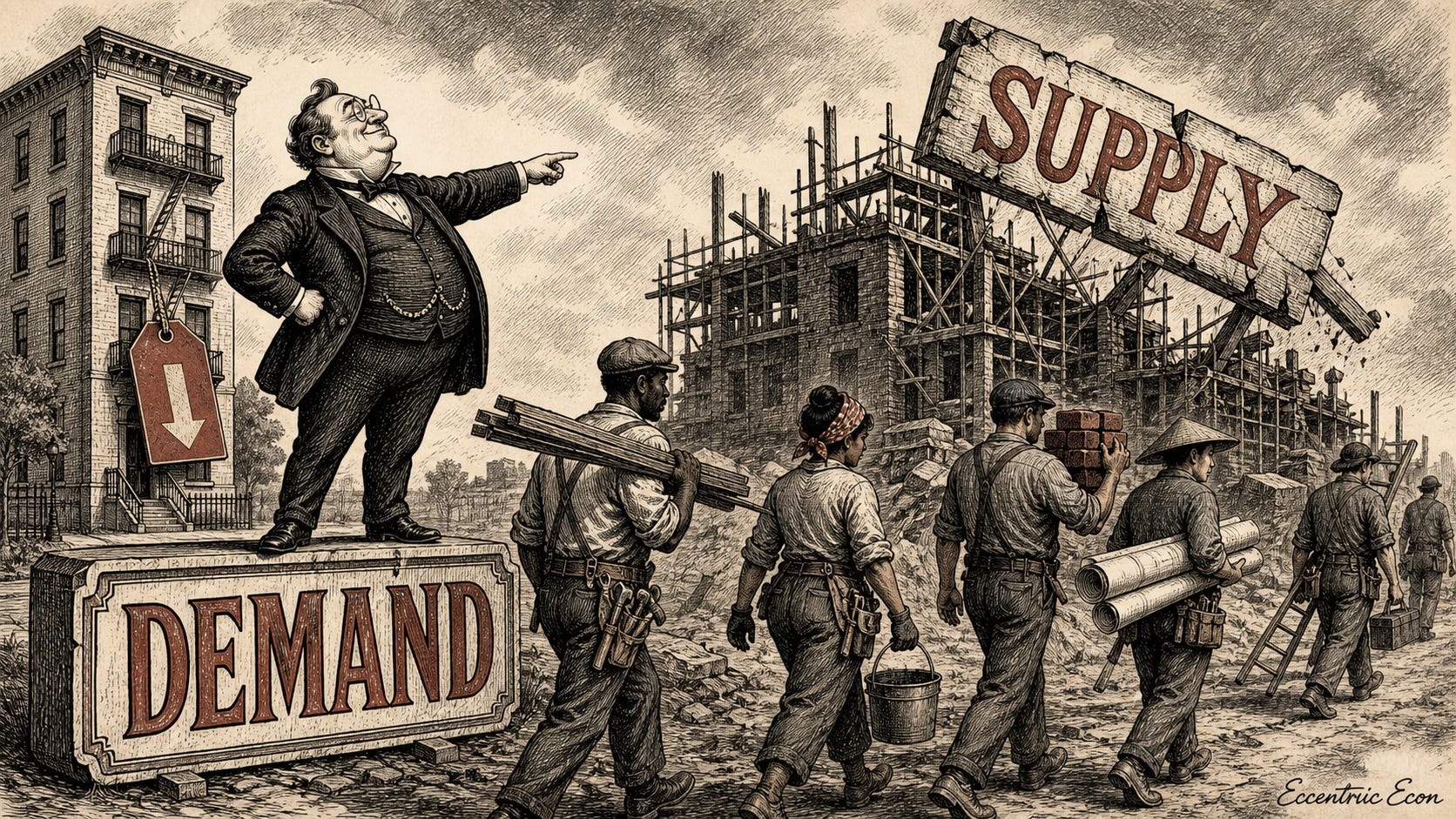
There is a pleasing simplicity to the newest political housing slogan: where ICE goes, rents go down. The proposition, attributed to Treasury Secretary Scott Bessent, is that removing undocumented immigrants reduces demand for housing, especially in lower-cost rental markets, and therefore lowers rents.
As with many slogans that survive because they contain a fragment of economic truth, this one leaves out the part of the model that makes the conclusion uncertain. More people competing for a fixed stock of apartments can indeed bid up rents. But removing people from an economy does not only remove renters. It also removes workers, consumers, entrepreneurs, taxpayers, and, importantly, people who build and repair housing.
A theory of housing affordability that counts immigrant households in the demand column but refuses to count immigrant labor in the supply column is not a theory of housing affordability. It is an accounting trick.
The Partial-Equilibrium Temptation
Begin with what is true. In the short run, housing supply is often highly inelastic. A city cannot instantly produce apartments merely because more people want them. Land must be acquired, permits secured, financing arranged, labor hired, materials purchased, and construction completed. In a market where those constraints already bind, an abrupt increase in the number of households can increase market rents.
A recent Dallas Federal Reserve working paper provides evidence consistent with this proposition. Studying the large unauthorized-immigration inflow from 2021 through early 2024, the authors estimate that an increase in unauthorized immigrant-worker flows equal to 1 percent of a locality’s initial employment raised local rents by about 1.4 percent and house prices by about 2.2 percent. They found little evidence that new housing supply rose over that short interval.
That is a serious empirical result, and people who favor more liberal immigration rules should not pretend otherwise. If housing construction is constrained, more residents will put pressure on the existing stock. One need not endorse mass removal, or any particular enforcement policy, to accept that elementary point.
But it does not establish the converse proposition: that ICE enforcement, deportation, or fear-induced departure will reliably produce lower rents. To reason that way is to mistake a short-run estimate of an inflow’s demand effect for a complete causal account of an outflow engineered through enforcement. The two experiments are not mirror images.
The People Who Build the Apartments
Housing is produced with land, capital, materials, rules, and labor. In the United States, immigrant labor is a substantial part of that last category. The Urban Institute estimates that immigrants constituted more than 23 percent of construction workers in 2023, and reports that about half of foreign-born workers in the sector may be undocumented. This is not a minor detail to be appended after the conclusion has been reached. It is the conclusion’s principal complication.
Suppose a construction crew loses its general laborers, roofers, drywall installers, or concrete workers. The effect is not simply that a few workers disappear and native-born workers slide effortlessly into identical positions the next morning. Projects are delayed; bids rise; subcontractors cannot coordinate schedules; financing costs accumulate while buildings remain unfinished. Higher-skilled workers who complement rather than substitute for the missing workers—electricians, plumbers, project managers, inspectors—may find fewer projects on which to work.
This is not merely speculation. Research summarized by the Urban Institute finds that the Secure Communities immigration-enforcement program produced persistent reductions in construction employment and homebuilding, while home prices rose. The relevant lesson is not that every act of enforcement has one identical consequence in every city. It is that the supply-side effect is real, potentially large, and directly contrary to the bumper-sticker certainty that removals must make housing cheaper.
The Dallas Fed paper itself recognizes this ambiguity. Its authors note that unauthorized workers may be disproportionately represented in construction, where they can lower building costs and eventually expand housing supply. It also reviews research finding that the short-run housing-price effects of deportations can reverse when housing supply contracts. In other words, the paper frequently invoked to support the “rents go down” slogan warns against treating immigration and enforcement as a one-variable demand story.
A City Is Not a Spreadsheet Cell
There is a further problem with the claim’s casual application to New York City. New York is not a textbook market in which every landlord can immediately reset rent whenever the number of potential tenants changes. Almost half of the city’s rental apartments are rent stabilized. Rent increases for those units are governed by law and by the Rent Guidelines Board, not by a weekly headcount of who has left the neighborhood.
That does not mean population changes are irrelevant. They can affect vacancies, the unregulated segment of the market, neighborhood businesses, and the eventual political and economic conditions in which rents are set. It means only that a crude one-for-one story about enforcement and rents is especially implausible in a city where a large share of leases does not function as an unconstrained spot market.
Nor are the people targeted by enforcement distributed randomly across the housing and labor markets. A family that leaves may free a unit. But the same community may lose a restaurant worker, a home-health aide, a contractor, a tenant who helped support a local shop, and a parent whose absence disrupts the work decisions of relatives who remain. Enforcement is not a sterile population-adjustment mechanism. It changes expectations, labor-force participation, business formation, and household behavior—often well beyond the individuals formally removed.
That is why even the narrow question, “Will rents fall?” cannot be answered responsibly with a chant. Which rents? Over what time horizon? In what city? Is the city allowed to build? Are displaced workers replaced? Does construction slow? Do native residents move in or out? Does the measure describe asking rents, new-lease rents, regulated rents, or rents actually paid?
The more specific the question becomes, the less useful the slogan becomes.
The Housing Lesson Is Supply
There is a temptation in every housing debate to find a group of people whose disappearance will solve scarcity. At various times the culprit has been speculators, second-home owners, students, investors, migrants, or landlords. These targets differ politically, but the analytical mistake is the same: treating a shortage of homes as though it were principally a problem of too many disfavored people.
America’s housing problem is, at its core, that in many places we have made building difficult, slow, expensive, and legally precarious. Zoning restricts density. Permitting processes impose delay. Parking mandates consume space and capital. Height limits, minimum-lot rules, discretionary review, and neighborhood veto points make new homes scarcer than they need to be. Construction-labor shortages then compound those institutional barriers.
If policymakers genuinely want lower rents, they should make it easier to construct apartments, accessory dwelling units, row houses, and multifamily buildings where people want to live. They should reduce the artificial costs that turn each proposed building into a years-long political negotiation. And they should hesitate before using a policy that removes part of the labor force necessary to build the very housing they say they wish to make affordable.
There is no contradiction in enforcing immigration law while recognizing this economic constraint. A country may choose to regulate entry and residency. But it cannot repeal scarcity by rhetoric. If enforcement reduces housing demand while also reducing the capacity to produce housing, the final effect is an empirical question, not a slogan.
“Where ICE goes, rents go down” is therefore not a serious general proposition. At most, it is an incomplete short-run hypothesis about one side of a two-sided market. The demand effect may be real. But the supply effect is real too, and in a nation already struggling to build enough homes, it is remarkably reckless to pretend otherwise.
Lower rents will not come from discovering ever more people to exclude from the housing market. They will come from allowing more housing to exist.