

The comforting slogan
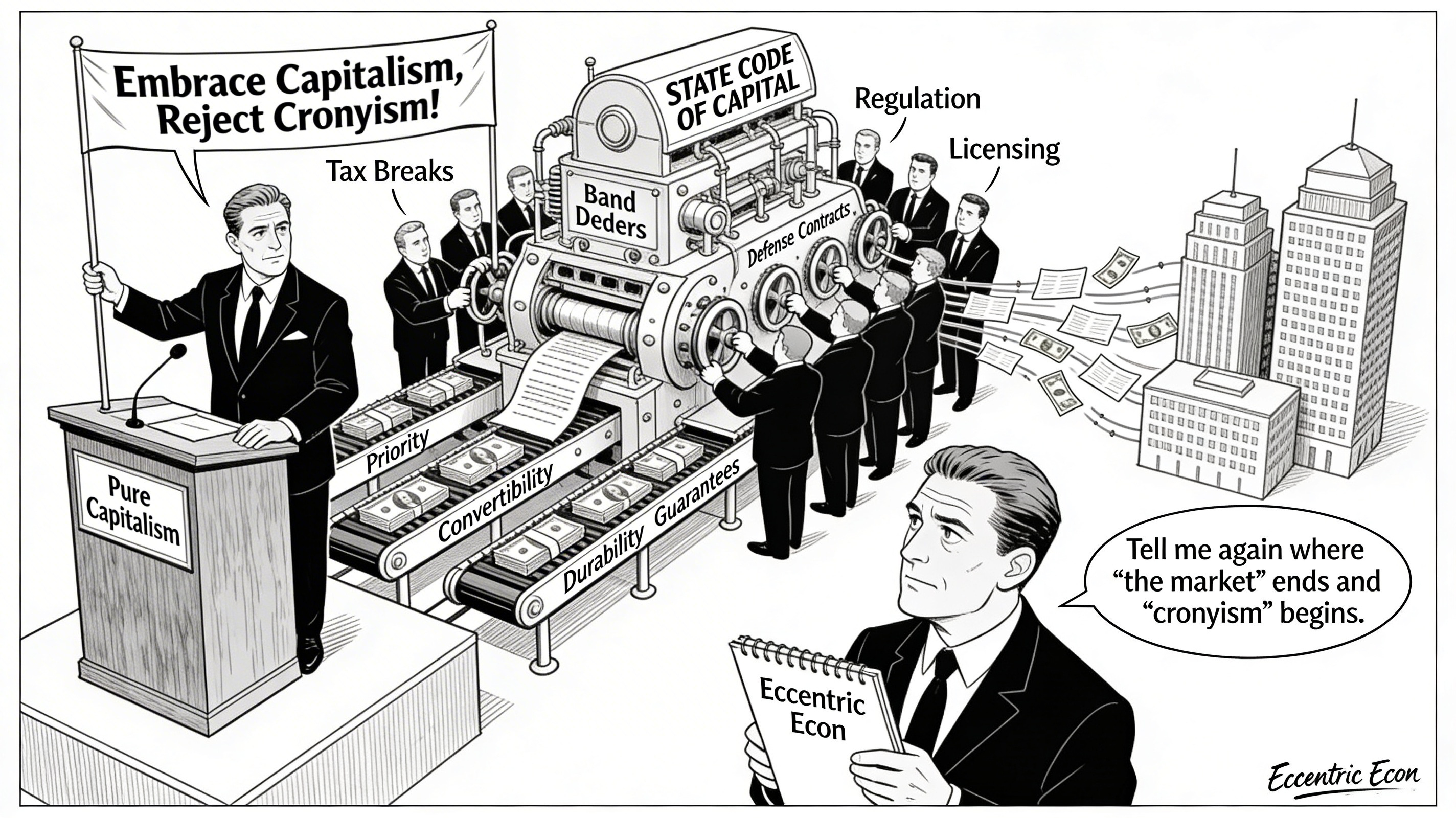
A recent post making the rounds declares that if America would “embrace capitalism and reject cronyism” in health care, agriculture, military contracting, insurance, media, technology, and banking, we would experience a renaissance unprecedented in human history.
It’s the kind of line that plays well on social media: capitalism good, cronyism bad, problem solved.
But there’s a deeper problem hiding under that contrast. Once you look closely at how modern capitalism actually works, the clean separation between “real capitalism” and “crony capitalism” starts to dissolve. The more you know about how law creates and structures markets, the harder it is to pretend that we can simply peel away cronyism and be left with some pristine, neutral capitalism underneath.
Capital is not a natural object
Start with an uncomfortable fact: capital is not a natural object lying around in the world, waiting for the state to either respect or ignore it. Capital is a legal status.
As Katharina Pistor argues in The Code of Capital, what makes an asset “capital” is not its physical form but the legal code wrapped around it. Land, corporate shares, mortgage-backed securities, intellectual property, even complex derivatives become capital because the legal system endows them with a specific bundle of attributes:
Priority over competing claims
Durability over time
Universality against third parties
Those attributes don’t come from nature. They come from contract law, property law, corporate law, trusts, bankruptcy codes, and the courts that interpret and enforce them.
In other words, “capitalism” as we live it is already a product of state-mediated legal engineering. The state decides which claims are recognized as property, how far they extend, how easily they can be enforced, and what happens when they collide with other claims.
That’s not an accidental add-on. It’s the operating system.
The state doesn’t just protect property; it defines it
This immediately complicates the popular story in which the state and the market are separate spheres, and the healthy version of capitalism is the one where the state merely “protects property rights” but otherwise stands aside.
Protect what property rights?
Whether a piece of land can be encumbered by a mortgage and then sliced into tranches for investors is not given by nature; it is a legal choice.
Whether an idea can be owned as a patent, for how long, and under what conditions is not given by nature; it is a legal choice.
Whether a bank deposit is just a private IOU or a state-guaranteed claim backed by deposit insurance and lender-of-last-resort facilities is not given by nature; it is a legal choice.
Every one of those choices creates and transfers value. It determines who bears risk and who enjoys upside. It decides whose contracts are credible and whose are fragile.
State action here is not just “intervention” into a pre-existing market order. It is how the order is built in the first place.
Once you accept that, the line between capitalism and cronyism stops being “markets versus government” and becomes a question about how the government’s unavoidable role is structured, and who gets to shape it.
Why capture is an equilibrium, not an accident
If law is the code of capital, who writes the code?
The answer is: legislatures, regulators, judges, and—crucially—the lawyers and lobbyists who translate private interests into legal text.
That brings us to public choice. As James Buchanan and Gordon Tullock emphasized, once government has the power to hand out concentrated benefits—subsidies, tax breaks, regulatory privileges, exclusive licenses—organized interests will invest real resources in capturing those benefits.
Rent-seeking isn’t an aberration; it’s the predictable byproduct of two facts:
The state’s legal coding of assets and contracts creates enormous economic rents.
The groups most affected by those rents are better organized, better informed, and better funded than the diffuse public that bears the costs.
When a defense contractor lobbies for a procurement rule that only a handful of firms can realistically satisfy, or a bank lobby quietly adjusts the definition of “systemically important,” or a tech platform pushes for expansive IP protection and liability shields, that’s not some foreign substance invading an otherwise pure market. It is capital owners negotiating over the source code of capitalism itself.
From a public-choice perspective, cronyism is what you should expect when the state both:
defines which assets count as capital and on what terms, and
retains broad discretion to tweak those definitions in ways that can massively shift wealth.
The engine of crony capitalism is not “markets.” It’s discretion plus rents.
“Just say no to cronyism” is not a policy
This is why the Massie-style slogan—“embrace capitalism, reject cronyism”—is so unsatisfying.
If by “capitalism” we mean a system where private actors own capital and trade in markets under a general rule of law, then the question is not whether the state is involved. It’s involved all the way down, in the very definition of ownership, contract, and enforcement.
The real question is:
How tightly constrained is the state’s power to single out particular firms, sectors, or constituencies for special treatment?
How general are the rules that confer the key attributes of capital—priority, durability, universality, convertibility—and how easy is it to carve out exceptions?
You can yell “no cronyism” all day, but if your constitutional and statutory architecture leaves wide, unprincipled discretion intact, you’ve left the engine of rent-seeking running at full speed.
A more honest market liberalism
None of this means we should shrug at cronyism or accept it as inevitable. It does mean that a grown-up defense of markets has to move beyond treating “government” as an exogenous meddler and “cronyism” as a simple moral failing.
If we take both Pistor and public choice seriously, a serious market-liberal position has to start from at least three admissions:
Markets are institutional artifacts. They depend on dense, contestable legal coding that defines capital and contract.
That coding is politically produced. Legislators, regulators, and judges write it under constant pressure from organized interests.
Rent-seeking is endogenous. Whenever there are large, discretionary rents to be had—procurement, subsidies, barriers to entry—private actors will chase them.
From there, the question shifts from “how do we get rid of cronyism and have pure capitalism?” to “how do we constitutionally design the unavoidable state role so that:
the rules are as general, predictable, and open-access as possible;
discretion is narrowed and made transparent;
and the total rent pool available through politics is reduced?”
That’s a very different agenda than simply insisting that the right people refrain from bad behavior.
What reform actually looks like
Concretely, if limiting cronyism is something you desire, you should think a lot about:
How general our tax and regulatory rules are. The more narrow carve-outs and industry-specific credits we tolerate, the more we invite rent-seeking.
How we structure emergency powers and bailouts. Discretionary rescue facilities for particular firms or sectors are cronyism magnets, even when initially justified by crisis.
How easy it is to “opt out” through jurisdictional arbitrage. If the code of capital can be written by picking and choosing among jurisdictions and legal devices, those with the best lawyers will always tilt the playing field.
How transparent procurement and licensing really are. Defense, health care, infrastructure, and financial regulation all involve vast procurement and licensing regimes where discretion and opacity go hand in hand with political money.
Notice what this list is not: it’s not a checklist of which industries to love or hate. It’s a set of institutional design questions about the relationship between law and capital.
You don’t fix that with a viral post. You fix it, if at all, with painstaking changes to how laws are written, how agencies exercise discretion, and how easy it is to convert political connections into legally protected rents.
The real Renaissance
Would we “experience a renaissance unprecedented in human history” if we could somehow have capitalism without cronyism?
If by that we mean a world where private actors freely invest, innovate, and trade under a stable, predictable rule of law, without having to buy favors in Washington to survive—that would indeed be a massive improvement over our present mix of markets and favoritism.
But getting there requires more institutional realism, not less.
It requires admitting that:
Capitalism as we know it is already the product of state-made legal code, not its absence.
Cronyism is not an invading virus but a failure mode of that code, driven by discretion and concentrated benefits.
The relevant reform margin is not wishful thinking about “real capitalism” but hard questions about constitutional constraints, general rules, and the design of the state’s role in making markets.
That’s a much less satisfying slogan. But it has the virtue of being true.