

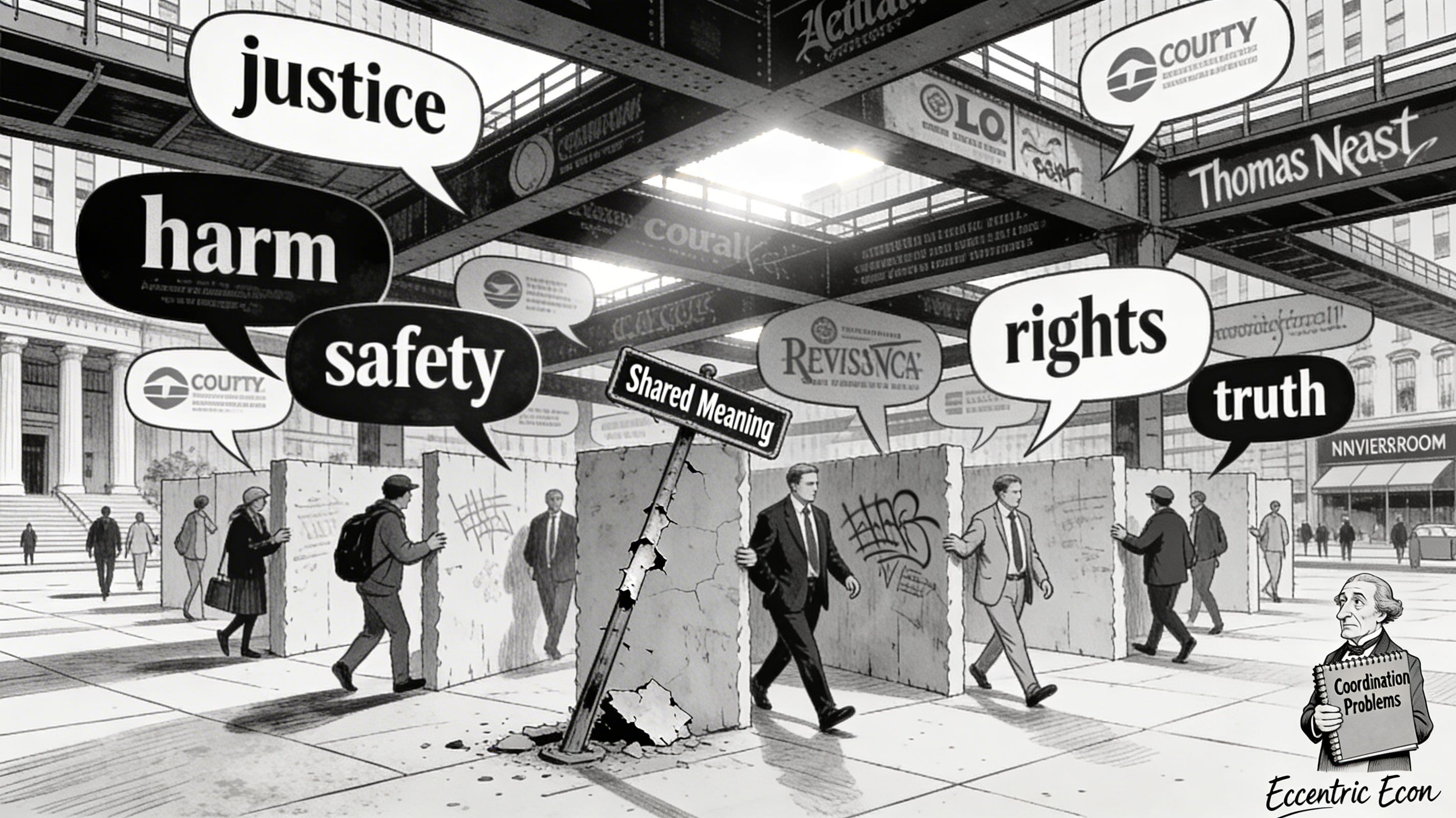
We are arguing more — and understanding each other less. Something strange has happened to public language over the last decade. Words that once felt stable now feel provisional. Definitions shift mid-conversation. People speak past each other with confidence, convinced they are using the same vocabulary when they plainly are not.
It would be easy to dismiss this as ordinary linguistic evolution. Language changes; it always has. New generations stretch old words, academics refine terms for analytical precision, and political movements try to name experiences that previously lacked clear vocabulary. None of that is new, and none of it is inherently alarming.
What feels different, however, is the speed — and the incentives. Definitions now seem to change on the timescale of headlines. Terms are reconfigured not slowly through shared usage, but rapidly through conflict. In highly polarized environments, redefining a concept often becomes cheaper than persuading people about it.
This matters because language is not merely expressive. It is infrastructure. Shared definitions function much like legal standards or accounting rules: they lower the cost of coordination. Contracts become possible because people broadly agree what words mean. Scientific claims can be debated because terms remain stable long enough for evidence to accumulate. Institutions operate because citizens and officials at least partially inhabit the same linguistic world.
When that infrastructure begins to wobble, the immediate effect is not philosophical confusion. It is rising transaction costs. Arguments linger longer because participants are debating vocabularies rather than claims. Policy conversations stall because entire debates collapse into fights over terminology. Trust declines, not necessarily because people are more dishonest, but because the shared frame of reference that makes disagreement productive becomes harder to find.
This is why the current moment feels less like ordinary partisanship and more like a descent into Babel. The problem is not that people disagree. The problem is that the underlying conditions for disagreement — shared meanings, shared procedures, and shared expectations about language — are becoming less stable.
And that raises a question that is more institutional than linguistic: how do societies continue to coordinate when words themselves are contested terrain?
Language as Infrastructure
We rarely think of language as infrastructure because, when it works, it disappears into the background. Like roads or power grids, its success lies in being unremarkable. People coordinate, transact, argue, and govern without constantly renegotiating the meaning of basic terms.
Economists sometimes describe certain goods as “coordination devices” — shared frameworks that reduce friction among actors who do not fully trust one another. Language plays a similar role. It allows strangers to sign contracts, citizens to interpret laws, and researchers to build cumulatively on one another’s work. The point is not that everyone agrees; the point is that disagreement occurs within a shared semantic architecture.
When that architecture is stable, disagreement can be productive. People can argue about evidence, outcomes, or values while assuming that key terms remain fixed enough for the conversation to progress. A policy debate, for example, might be fierce, but it still relies on participants roughly agreeing what counts as “risk,” “harm,” or “cost,” even if they weigh those things differently.
The moment definitions become unstable, however, the character of disagreement changes. Arguments shift from the empirical to the semantic. Participants start contesting what words are allowed to mean before they can even discuss what should be done. Coordination slows. Trust erodes. The conversation begins to feel less like debate and more like parallel monologues sharing the same air.
This is not simply a matter of annoyance or rhetorical style. There are real institutional consequences. Laws become harder to interpret consistently when their social meaning shifts rapidly. Policy becomes harder to evaluate when core concepts are constantly reframed. Academic conversations become brittle when key terms carry different moral or ideological weight depending on the audience.
In short, shared meaning functions as a public good. Everyone benefits from it, but no single actor bears responsibility for maintaining it. And like many public goods, it becomes fragile when incentives encourage short-term gains over long-term stability. The system drifts.
Definitional Drift — and Definitional Turpitude
Not all changes in meaning are the same. Language evolves constantly, and most of the time that evolution is healthy. New realities demand new vocabulary. Scholars refine concepts for precision. Communities adapt words to fit changing social experience. None of this is especially controversial.
But there is a difference between gradual evolution and something more strategic.
For lack of a better phrase — and because the phrase makes me laugh — I think of the latter as definitional turpitude. By this I mean the deliberate or semi-deliberate reshaping of established terms to serve immediate rhetorical or political goals, often without acknowledging that the definition itself is being renegotiated.
The distinction matters. Organic drift is slow and collective; definitional turpitude is fast and instrumental. Linguists have long described this as an “invisible hand” process in language change — emergent rather than centrally directed. One emerges from shared usage over time. The other treats language as a tactical resource.
In highly polarized environments, the incentives are obvious. Persuasion is hard. Redefinition is easier. If a term can be expanded, narrowed, or morally recharged, entire debates can be reframed without changing any underlying facts. The conversation shifts before anyone notices the ground has moved. So people redefine.
This is not merely a problem among activists or media personalities. Academic and intellectual spaces are susceptible for structural reasons. Novel framings are rewarded. Boundary-redrawing signals originality. The temptation to redefine concepts — sometimes quietly, sometimes openly — can become part of the incentive structure itself.
None of this requires bad faith. Most participants genuinely believe they are clarifying rather than reshaping. But the cumulative effect can still be destabilizing. When too many terms become contested simultaneously, conversation stops being about evidence and starts being about vocabulary. Participants disagree not only about conclusions, but about the meaning of the words used to reach them.
The result is a subtle but important shift: language ceases to be shared infrastructure and becomes a battleground in its own right. Any linguist worth reading will point out that semantic drift is normal — and they’re right. But institutional coordination runs on slower clocks than cultural change, and that mismatch is where trouble begins.
Why Hyperpartisan Systems Reward It
If definitional turpitude is becoming more common, the explanation is less moral than structural. Systems tend to produce the behaviors they reward, and highly polarized environments reward rhetorical efficiency more than slow persuasion.
In stable political or intellectual environments, convincing someone usually requires argument: evidence, reasoning, and a shared conceptual framework. But in hyperpartisan settings, those shared frameworks weaken. Audiences are already segmented. Trust across groups is low. The odds of persuading opponents decline sharply.
Under those conditions, changing the terms of debate can be more efficient than winning the debate itself.
Redefining a concept shifts the battlefield. It alters which arguments sound reasonable and which positions appear legitimate before any substantive claims are evaluated. From a purely strategic standpoint, this is often the cheaper move. Persuasion asks you to change minds; definitional shifts ask only that you change the frame.
Academic and intellectual ecosystems are not immune to this logic — if anything, they amplify it. Novelty is rewarded. Reframing an issue can be more publishable than refining an old argument. New terminology signals intellectual ambition and moral seriousness. Over time, even well-intentioned scholars can find themselves pulled toward conceptual innovation whether or not it improves clarity.
Again, none of this requires conspiracy or bad faith. The incentives do the work quietly. Individuals respond rationally to professional and political environments that prize reframing over continuity.
The cumulative effect, however, is cumulative instability. Each small shift may appear harmless on its own. Taken together, they raise the cost of communication across groups. People begin to suspect that words mean different things depending on who is speaking — and they are often right.
This is how public discourse drifts toward Babel: not through sudden collapse, but through a series of individually rational choices that collectively erode semantic stability.
The Coordination Cost
When shared definitions weaken, the immediate effect is not cultural decay or intellectual apocalypse. It is friction.
Coordination depends on predictable interpretation. Contracts rely on agreed meanings. Laws depend on relatively stable concepts. Scientific inquiry requires terms that hold still long enough for evidence to accumulate. Even ordinary political disagreement assumes that participants are arguing about the same object.
When definitions become unstable, that predictability declines. Actors must spend more time clarifying what they mean before they can even address whether a claim is true. Arguments stall at the level of vocabulary. Debates that should be empirical become semantic. Trust erodes, not necessarily because people are dishonest, but because the shared frame that makes disagreement intelligible becomes harder to locate.
The effect resembles an increase in transaction costs. Each exchange requires more interpretive labor. Each institutional decision carries greater risk of being reinterpreted under a shifting conceptual lens. Courts must work harder to stabilize statutory meaning. Policymakers must specify terms more exhaustively. Scholars must append caveats that would have been unnecessary a decade earlier.
None of this is dramatic in isolation. But it accumulates.
In low-trust environments, actors begin to assume that definitions are contingent on audience. That suspicion changes behavior. People hedge. They over-specify. They retreat into narrower communities where meanings feel more secure. Cross-domain communication — between academia and journalism, between law and politics, between communities that once shared partial vocabularies — becomes more fragile.
This is the point at which Babel ceases to be metaphorical. The problem is not that people disagree. It is that disagreement no longer reliably operates within a shared semantic structure. And when that structure weakens, institutional coordination becomes more expensive and more brittle.
The irony is that many of the individuals participating in definitional shifts are acting rationally within their immediate environment. But the aggregate outcome resembles a classic public-goods problem: short-term rhetorical advantage contributes to long-term semantic instability.
How Societies Actually Survive Babel
The good news is that societies have encountered versions of this problem before. Periods of intense polarization or rapid social change almost always involve semantic conflict. Words become contested because institutions, values, and identities are themselves in motion.
And yet societies rarely collapse into permanent incomprehension. Instead, they develop mechanisms that restore enough shared meaning for coordination to continue.
The first mechanism is institutional definition. Courts, regulatory bodies, professional organizations, and scientific communities stabilize vocabulary by giving terms operational meaning within specific contexts. Legal definitions, for example, do not require universal agreement; they require consistency for the purpose of governance. The same is true for professional standards and technical disciplines. These institutions act as anchors when everyday language becomes fluid.
The second mechanism is domain separation. Different communities develop partially distinct vocabularies suited to their own purposes. Scientific language does not need to mirror journalistic language, and policy language does not need to track activist discourse perfectly. What matters is that participants understand when they are crossing domains and adjust accordingly. Societies survive not by forcing a single universal lexicon, but by maintaining boundaries that preserve internal clarity.
Third, procedural trust often substitutes for semantic consensus. When people stop agreeing on meanings, they can still agree on methods. Peer review, precedent, transparent standards of evidence, and institutional process allow disagreement to persist without dissolving into chaos. In effect, procedures become the shared language when words themselves are contested.
Finally, societies rely on translators — individuals who can move between vocabularies and explain one domain to another. These figures rarely command universal agreement, but they reduce misunderstanding by making implicit assumptions visible. The role is less glamorous than it sounds; translation often involves clarifying what people think they already understand.
Together, these mechanisms do not restore perfect consensus. They do something more modest and more realistic: they maintain partial stability. Enough shared meaning exists in enough domains that coordination remains possible even amid deep disagreement.
That is the real lesson of Babel. Societies do not survive by eliminating difference. They survive by building structures that allow difference to coexist with cooperation.
The Real Risk
The risk, then, is not disagreement. Democracies are built to withstand disagreement. Intellectual life depends on it.
The risk is simultaneous erosion.
If institutional anchors weaken, domain boundaries blur, procedural trust collapses, and translators lose credibility all at once, the stabilizing mechanisms begin to fail together. At that point, semantic conflict no longer feels temporary or localized. It begins to feel systemic.
When courts are distrusted, legal definitions no longer reassure. When scientific procedures are politicized, methodological consensus no longer stabilizes debate. When journalism collapses into activism or activism masquerades as scholarship, domain separation falters. When translators are treated as traitors by every side, cross-domain communication deteriorates.
Under those conditions, rising coordination costs are not merely inconvenient. They become corrosive. Policy gridlock deepens. Institutional legitimacy declines. People retreat into narrower interpretive communities where meanings feel safe but increasingly insular.
That is what makes hyperpartisan Babel unsettling. It is not that words change. Words have always changed. It is that too many stabilizing mechanisms are under strain at once.
Babel Is Survivable
And yet — Babel is survivable.
Societies do not require unanimity to function. They require enough stable definitions in enough places to allow cooperation to continue. Shared language does not need to be universal; it needs to be sufficiently predictable within key institutional domains.
Language will continue to evolve. Academics will continue to refine and sometimes over-refine. Political actors will continue to reframe. None of that is likely to stop.
But if institutions take seriously their role as semantic anchors — if courts clarify rather than drift, if professional communities guard technical precision, if procedural standards remain visible and consistent — the coordination problem becomes manageable.
The goal is not to freeze language in amber. It is to prevent short-term rhetorical incentives from overwhelming long-term semantic stability.
Babel, in other words, is not primarily a linguistic crisis. It is a coordination challenge.
And coordination challenges are not solved by louder argument. They are solved by rebuilding the structures that make argument productive in the first place. Coordination returns — unevenly, but enough. That work is slower than outrage. But it is the only work that lasts.